Bacteriostatic Water Canada
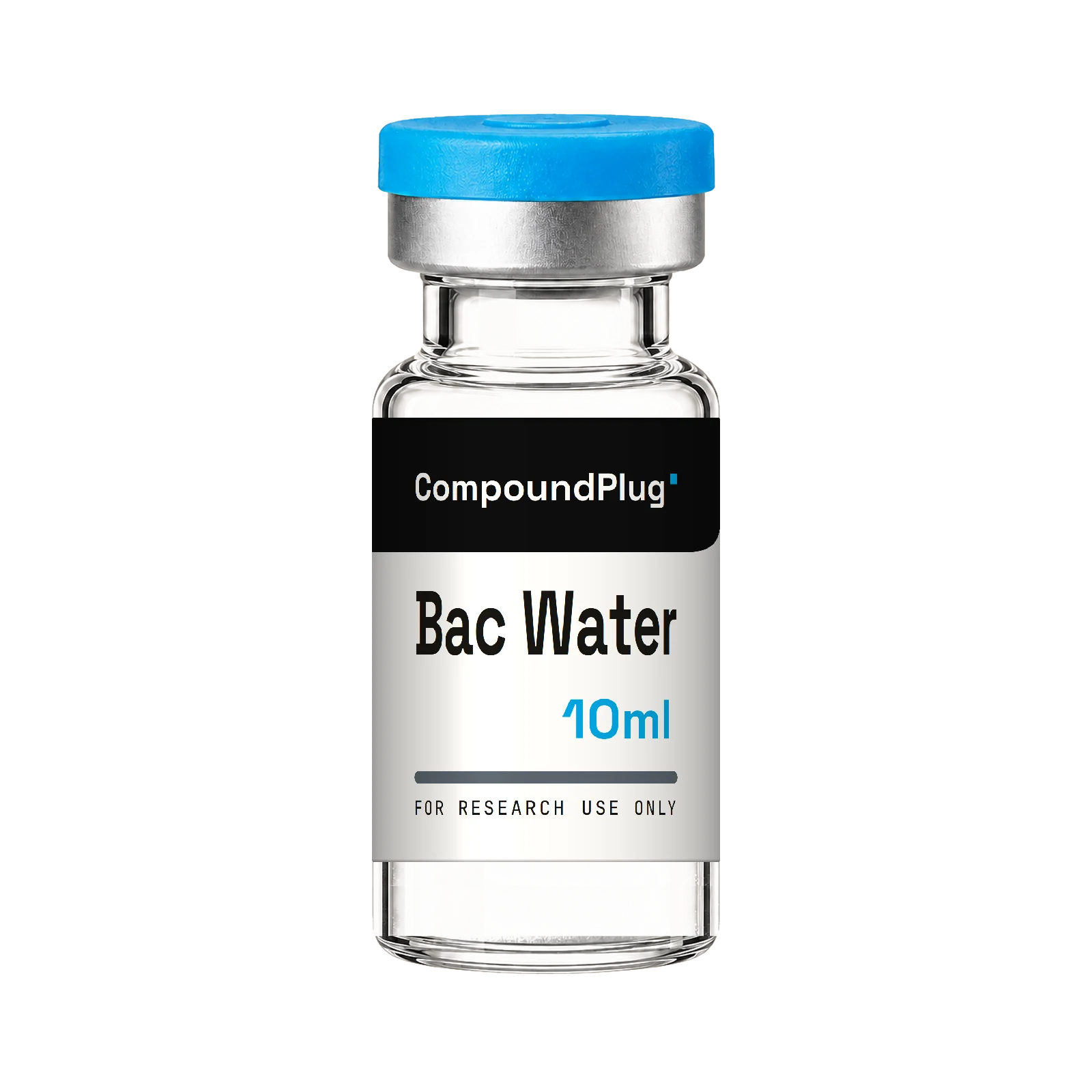
Bacteriostatic water (bac water) — 0.9% benzyl-alcohol sterile water for reconstituting lyophilized research peptides. 3mL and 10mL sealed vials. Ships with your order.
Price range: $10.00 through $13.00
| Size | Price | Availability |
|---|---|---|
| 3ml | $10.00 | In stock |
| 10ml | $13.00 | In stock |
- Purity (HPLC)
- ≥99%
- Form
- Sterile solution, 0.9% benzyl alcohol
- HPLC + Mass-Spec Tested
- COA Published Per Lot
- Ships From Canada
- Interac e-Transfer / Crypto
For laboratory research use only. Not for human consumption.
What Is Bacteriostatic Water?
Bacteriostatic water is sterile water containing 0.9% benzyl alcohol — a preservative that inhibits bacterial growth inside the vial. It is the standard diluent for reconstituting lyophilized research peptides, and the reason a reconstituted vial can be punctured more than once across a research-use window.
It is commonly shortened to bac water, and the two terms refer to the same thing — the abbreviation is what most of the field actually says.
CompoundPlug supplies it in 3mL and 10mL sealed vials.
It is the least glamorous item in this catalog and the one most likely to ruin an experiment. A peptide that arrives at ≥99% purity, correctly identified by mass spectrometry, can still be compromised by what it is dissolved in.
Bacteriostatic, not bactericidal — the distinction matters
Bacteriostatic means growth-inhibiting. Bactericidal means killing. Benzyl alcohol does the former.
It does not sterilise a contaminated vial and it does not undo a contamination event. What it does is suppress the proliferation of organisms introduced at the moment of puncture — which is why the preservative extends a multi-draw window rather than granting indefinite use. A vial that was contaminated on the first puncture stays contaminated. The preservative slows what happens next; it does not reverse it.
One property worth knowing before choosing a diluent
Benzyl alcohol is not inert toward every protein. The protein-formulation literature reports benzyl alcohol inducing aggregation in some preparations, and this is an established consideration in biopharmaceutical formulation rather than a fringe finding.
For most research peptides in ordinary use this is not the limiting factor. For aggregation-sensitive work, or where the assay endpoint is structural, it is a variable to control rather than assume. Preservative-free sterile water exists for exactly that reason.
Bacteriostatic Water vs Sterile Water
These are two different products and the difference is one ingredient.
- Sterile water — water, sterilised, nothing else. No preservative. Once the seal is broken there is nothing suppressing microbial growth, so it is treated as single-use.
- Bacteriostatic water — the same sterile water plus 0.9% benzyl alcohol. The preservative is what supports repeated withdrawal from one vial over a period of days or weeks.
The practical rule: a vial intended for a single reconstitution and immediate use does not require a preservative. A vial intended to be drawn from repeatedly does. Almost all peptide research falls into the second category, which is why bacteriostatic water is the default diluent across the field.
Sterile water is the correct choice where the preservative itself is a confound — aggregation-sensitive protein work, or any protocol specifying a preservative-free vehicle.
Bacteriostatic Water for Injection: What the Term Refers To
“Bacteriostatic Water for Injection” is a pharmacopoeial product name, and it describes a clinical product rather than what is supplied here.
The term identifies a sterile, preserved diluent manufactured and labelled for clinical use in humans, under pharmacopoeial monograph. That product is dispensed through clinical and pharmacy channels.
CompoundPlug supplies bacteriostatic water as a laboratory diluent for reconstituting research compounds. It is not supplied, formulated, or labelled as a product for human injection, and no claim of clinical equivalence is made for it. See Research Use Only.
Why Every Lyophilized Peptide Needs a Diluent
Every peptide in this catalog ships as a lyophilized powder — freeze-dried, because peptides in solution degrade far faster than peptides in a dry sealed state. That is what makes a 24-month shelf life possible.
The consequence is that the powder is not usable as shipped. It has to be returned to solution, and the diluent is what determines the concentration of the resulting stock. The vial mass is fixed. The diluent volume is the only variable — which makes it the single decision that sets every number downstream of it.
Reconstitution Procedure
The procedure is the same across the catalog and the failure modes are mechanical rather than chemical.
Add the diluent slowly, down the inside wall of the vial — never as a stream directly onto the lyophilized cake, where the force can shear the peptide. Then swirl gently until dissolved. Never shake, never vortex.
Peptide structure is held by hydrogen bonds that mechanical agitation destroys, and this is the part worth internalising: a sheared peptide dissolves exactly like an intact one. The solution looks correct either way. There is no visual test for it, which is why the procedure matters more than it appears to.
Full procedure: How to Reconstitute Peptides.
How Much Bacteriostatic Water to Use
There is no fixed answer, because the diluent volume is an input rather than a specification. It sets the concentration of the stock solution, and different work wants different concentrations.
The arithmetic is straightforward: vial mass divided by diluent volume equals concentration. Worked through:
- 5mg vial reconstituted with 2mL → 2.5 mg/mL
- 5mg vial reconstituted with 1mL → 5 mg/mL
- 10mg vial reconstituted with 2mL → 5 mg/mL
- 10mg vial reconstituted with 5mL → 2 mg/mL
The same mass at a different volume is a different concentration, and nothing else about the vial has changed. A more concentrated stock means smaller withdrawal volumes and less measurement precision at the low end; a more dilute stock means the opposite. That trade-off is the actual decision.
The Peptide Calculator performs this conversion for any vial mass and diluent volume, including molar concentration where the molecular weight is entered.
Vial Sizes: 3mL and 10mL
Two sizes, and the choice is a question of how many compound vials are being reconstituted rather than anything to do with the water itself. The composition is identical — sterile water, 0.9% benzyl alcohol.
How far each size goes, at common reconstitution volumes:
- 3mL vial — three compound vials at 1mL each, or one at 2mL with 1mL remaining
- 10mL vial — ten compound vials at 1mL each, five at 2mL, or three at 3mL
On cost: the 10mL works out materially cheaper per millilitre than the 3mL. Where more than one compound is being reconstituted, or where a single vial is being drawn from across a research window, the larger size is the better-value unit.
Where the 3mL makes sense: a single compound, a single reconstitution, or where minimising the age of an opened diluent vial matters more than cost per millilitre. An opened 10mL vial that only ever gets used for one 2mL reconstitution has 8mL sitting against the clock.
Storage and the 28-Day Window
Unopened: room temperature, sealed, per the manufacturer’s labelling.
Once punctured: the conventional figure is 28 days refrigerated at 2–8 °C, protected from light.
Where that number comes from, stated honestly: 28 days is carried over from multi-dose vial convention. It is a handling convention for the preserved diluent — not a measured stability figure for any particular peptide dissolved in it.
The reconstituted peptide has its own window, and it is frequently shorter. Glutathione oxidises on air exposure and does not keep for four weeks in any meaningful sense. Per-compound reconstituted windows are stated on each product page and those figures govern, not this one.
Quality & Verification
A diluent is not tested the way a peptide is tested, and claiming otherwise would be dishonest.
HPLC purity and mass-spec identity are the right questions for a peptide, where the risk is that the vial contains a different molecule than the label states. For bacteriostatic water the composition is water and benzyl alcohol at 0.9%, and the questions that matter are different ones: sterility, preservative concentration, seal integrity, and correct labelling.
CompoundPlug supplies sealed, sterile-filled bacteriostatic water from a commercial manufacturer, and does not publish a Certificate of Analysis against it, because a peptide COA is not the applicable document for a diluent. Every peptide in the catalog carries published third-party analysis tied to its lot — see the COA Library. The diluent is held to sterility and labelling standards instead.
Buy Bacteriostatic Water in Canada
Sterile bacteriostatic water, 0.9% benzyl alcohol, sealed vial — the standard diluent for every lyophilized compound in the catalog.
- Two sizes — 3mL and 10mL
- Bacteriostatic water Canada-wide — ships from within Canada by Canada Post Xpresspost, tracked
- Added to any order — compounds and diluent arrive together, ready to reconstitute
- CAD pricing
- Interac e-Transfer or cryptocurrency
- Discreet, unbranded packaging
Related: Peptide Calculator · How to Reconstitute Peptides · browse Supplies.
Frequently Asked Questions
What is bacteriostatic water?
Sterile water containing 0.9% benzyl alcohol, a preservative that inhibits bacterial growth inside the vial. It is the standard diluent for reconstituting lyophilized research peptides, and the preservative is what allows a vial to be punctured more than once across a research-use window.
Is “bac water” the same as bacteriostatic water?
Yes. Bac water is simply the shortened name for bacteriostatic water — the same sterile water with 0.9% benzyl alcohol, and the abbreviation most of the field uses in practice. There is no difference in product, composition or handling. If a protocol or supplier lists “bac water,” it means bacteriostatic water.
What vial sizes are available?
3mL and 10mL sealed vials, identical in composition. A 3mL covers three compound vials at 1mL each, or one at 2mL with some left over. A 10mL covers ten at 1mL, five at 2mL, or three at 3mL. The 10mL is materially cheaper per millilitre, so it is the better unit for anyone reconstituting more than one compound.
Bacteriostatic water vs sterile water — what is the difference?
One ingredient. Sterile water is water and nothing else, so once the seal is broken there is nothing suppressing microbial growth and it is treated as single-use. Bacteriostatic water is the same sterile water plus 0.9% benzyl alcohol, and the preservative is what supports repeated withdrawal from a single vial. Most peptide work involves multiple draws, which is why bacteriostatic water is the field default.
Does bacteriostatic water sterilise a contaminated vial?
No. Bacteriostatic means growth-inhibiting, not killing — benzyl alcohol suppresses the proliferation of organisms introduced at puncture, but it does not reverse a contamination event. A vial contaminated on the first puncture stays contaminated. The preservative slows what happens next.
How much bacteriostatic water should be used per vial?
There is no fixed figure — the diluent volume is an input that sets the stock concentration. Vial mass divided by diluent volume equals concentration: a 5mg vial in 2mL gives 2.5 mg/mL; the same vial in 1mL gives 5 mg/mL. A more concentrated stock means smaller withdrawal volumes and less precision at the low end. The calculator performs the conversion for any mass and volume.
Is this Bacteriostatic Water for Injection?
No. “Bacteriostatic Water for Injection” is a pharmacopoeial product name for a diluent manufactured and labelled for clinical use in humans, dispensed through clinical and pharmacy channels. CompoundPlug supplies bacteriostatic water as a laboratory diluent for reconstituting research compounds, not as a product for human injection, and makes no claim of clinical equivalence.
How long does bacteriostatic water last once punctured?
The conventional figure is 28 days refrigerated at 2–8 °C, protected from light. That number is carried over from multi-dose vial convention — it is a handling convention for the diluent, not a measured stability figure for any peptide dissolved in it. The reconstituted peptide has its own window and it is often shorter; the per-compound figure on each product page governs.
Is bacteriostatic water needed for every compound?
For any lyophilized powder, yes — it ships freeze-dried and must be returned to solution before use. Freeze-drying is why a sealed vial keeps for up to 24 months, and it is also why the powder is not usable as shipped.
Can benzyl alcohol affect the peptide?
It is not inert toward every protein. The protein-formulation literature reports benzyl alcohol inducing aggregation in some preparations — an established formulation consideration rather than a fringe finding. For most research peptides in ordinary use it is not the limiting factor, but for aggregation-sensitive work, or where the endpoint is structural, preservative-free sterile water is the controlled choice.
Why does shaking matter?
Peptide structure is held by hydrogen bonds that mechanical agitation destroys. The diluent goes in slowly down the inside wall of the vial, never as a stream onto the lyophilized cake, and the vial is swirled rather than shaken or vortexed. The reason this matters more than it appears to: a sheared peptide dissolves exactly like an intact one. There is no visual test for it.
Does bacteriostatic water carry a Certificate of Analysis?
No, and a peptide COA is not the applicable document for a diluent. HPLC purity and mass-spec identity answer the question of whether a vial contains the molecule its label claims — the right question for a peptide. For a diluent of water and 0.9% benzyl alcohol the relevant standards are sterility, preservative concentration, seal integrity and labelling. Every peptide in the catalog does carry published third-party analysis tied to its lot; see the COA Library.