CJC-1295 + Ipamorelin Canada
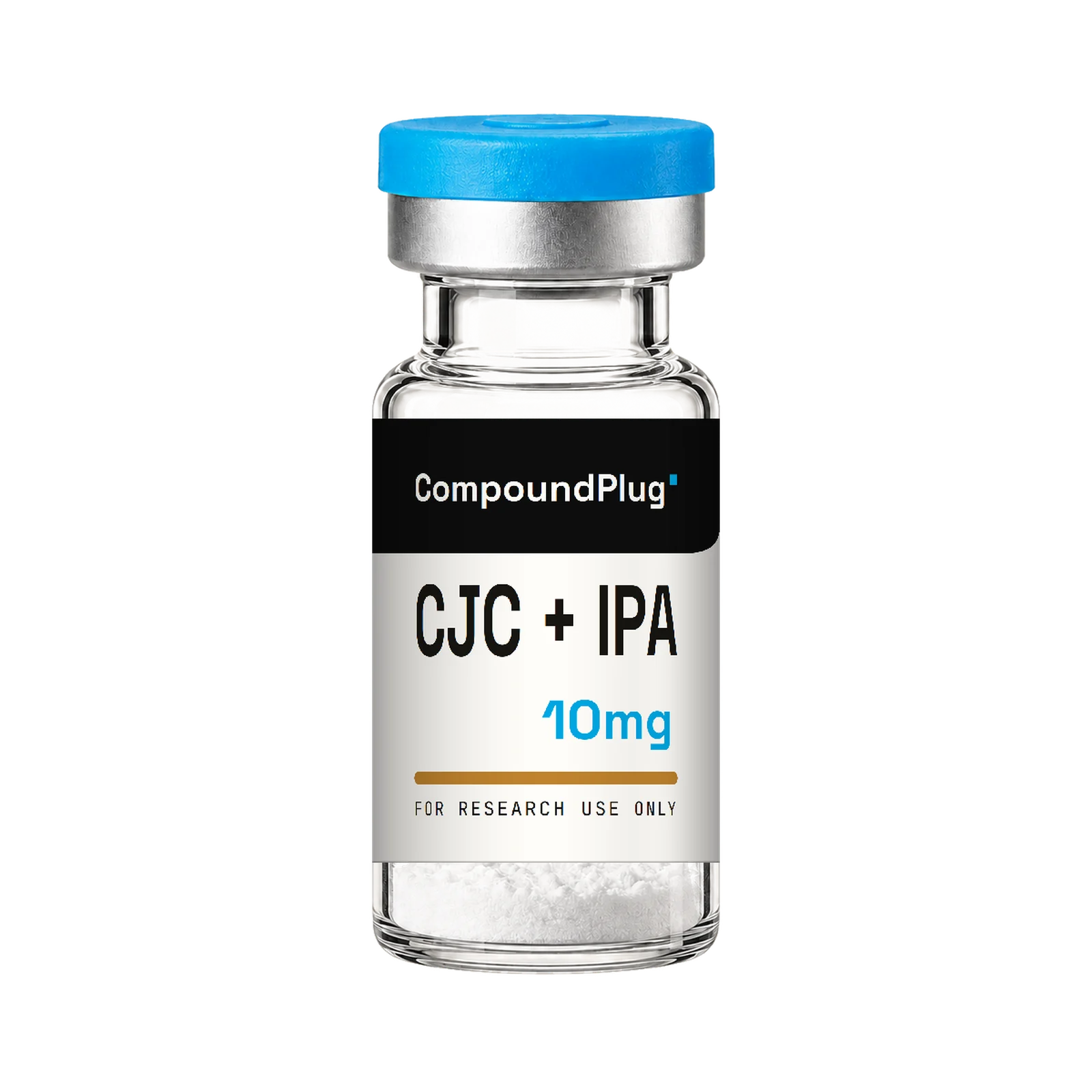
CJC-1295 (no DAC) + Ipamorelin — a GHRH analog paired with a ghrelin mimetic. Two different receptors, one axis. 5+5mg and 10+10mg lyophilized vials, ≥99% HPLC purity, mass-spec verified for identity.
Price range: $69.00 through $129.00
| Size | Price | Availability |
|---|---|---|
| 5+5mg | $69.00 | In stock |
| 10+10mg | $129.00 | In stock |
- Molecular Formula
- CJC-1295 (no DAC): C152H252N44O42 · Ipamorelin: C38H49N9O5
- Molecular Weight
- CJC-1295 (no DAC): 3367.95 · Ipamorelin: 711.85
- Purity (HPLC)
- ≥99%
- Form
- Lyophilized powder
- HPLC + Mass-Spec Tested
- COA Published Per Lot
- Ships From Canada
- Interac e-Transfer / Crypto
For laboratory research use only. Not for human consumption.
What Is the CJC-1295 + Ipamorelin Blend?
Two growth hormone secretagogues that act through completely different receptors. That is why they are blended, and it is the most important thing on this page.
They are not alternatives to each other, and they are not two versions of the same idea. They are two separate levers on the same system.
CJC-1295 (no DAC) — the accelerator
A 29-amino-acid GHRH analog, also called Mod GRF (1-29). It is a modified version of the shortest functional fragment of growth hormone releasing hormone, with four amino acid substitutions engineered to resist enzymatic degradation.
It binds the GHRH receptor on pituitary somatotrophs — the same receptor the body’s own GHRH acts on. Molecular weight 3367.95.
Ipamorelin — the brake release
A five-amino-acid ghrelin mimetic — a growth hormone secretagogue receptor (GHS-R1a) agonist. Completely different receptor. Molecular weight 711.85.
Ipamorelin is notable for its selectivity. Earlier secretagogues — GHRP-2, GHRP-6 — also elevated cortisol and prolactin, which is a problem. Ipamorelin was designed specifically to avoid that, and the published models show it does: it releases growth hormone without the cortisol and prolactin elevation that limited its predecessors (Raun et al., 1998). That selectivity is the entire reason ipamorelin exists.
The “No DAC” Distinction — and Why It Matters
Most vendor copy gets this wrong, and it is not a trivial detail.
The original CJC-1295 with DAC carries a Drug Affinity Complex — a linker that binds albumin and extends the half-life to roughly eight days.
CJC-1295 without DAC — Mod GRF (1-29) — has a half-life of 30 minutes to two hours.
CompoundPlug supplies the no-DAC form.
This is a biological difference, not a convenience difference
Growth hormone is not secreted continuously. It is released in pulses — discrete bursts, mostly during sleep, separated by periods of near-zero secretion. That pulsatility is not an accident of physiology; the pulsatile pattern itself appears to carry information that a flat, sustained elevation does not.
A compound with an eight-day half-life produces a sustained elevation. It does not produce a pulse.
A compound with a 30-minute half-life produces a pulse and then clears.
Which of those better reflects endogenous physiology is not a marketing question — it is the substantive argument for using the no-DAC form in research, and it is the reason the two variants are studied differently rather than interchangeably.
CJC-1295 vs Ipamorelin — What Each One Does
| CJC-1295 (no DAC) | Ipamorelin | |
|---|---|---|
| Class | GHRH analog | Ghrelin mimetic |
| Receptor | GHRH receptor | GHS-R1a |
| Length | 29 amino acids | 5 amino acids |
| Molecular weight | 3367.95 | 711.85 |
| Also known as | Mod GRF (1-29) | IPAM |
| Half-life | 30 min – 2 hours | ~2 hours |
| Selectivity | — | No cortisol or prolactin elevation |
| Effect on the axis | Stimulates GH release | Stimulates GH release and suppresses somatostatin |
Why the combination is synergistic rather than additive
This is the part that is almost never explained properly, and it is the whole reason the blend exists.
Growth hormone release is governed by two opposing signals:
- GHRH — the accelerator. It stimulates the pituitary to release GH.
- Somatostatin — the brake. It inhibits release.
The size of any GH pulse is the net result of both.
CJC-1295 presses the accelerator. It agonises the GHRH receptor.
Ipamorelin presses the accelerator and releases the brake. Ghrelin-receptor agonism stimulates GH release directly, and it also suppresses somatostatin — lifting the inhibition that limits how large a GHRH-driven pulse can be.
That is the mechanism of synergy. Not two compounds doing the same thing twice. One pushing harder while the other removes what is holding it back.
It is why the literature examines them together far more often than separately, and why CompoundPlug supplies them in a single vial.
CJC-1295 + Ipamorelin Dosage in the Published Research
Growth hormone secretagogue research is largely preclinical, with limited early human pharmacokinetic work.
CJC-1295 (no DAC)
Preclinical and early human studies report quantities in the microgram-per-kilogram range, administered subcutaneously. Its short half-life means the literature examines it as a pulse — a discrete stimulus rather than a sustained exposure.
Ipamorelin
Preclinical work reports a comparable range. The selectivity finding — GH release without cortisol or prolactin elevation — was established in these models (Raun et al., 1998).
Two arithmetic notes worth knowing
1. The molecular weights differ by a factor of nearly five. CJC-1295 is 3367.95; ipamorelin is 711.85. In a 1:1 blend by mass, the two components are not present in equal molar quantities. Any molar calculation must be done per component.
2. This is a blend. A “10+10mg” vial contains 10 mg of each compound — 20 mg total. The CJC-1295 + Ipamorelin calculator handles one compound at a time; run it separately for each component.
Neither compound has completed clinical development. CompoundPlug provides no dosing recommendations.
CJC-1295 + Ipamorelin Effects Reported in Studies
Reported in the literature
- Increased growth hormone pulse amplitude in preclinical models, for both compounds
- Increased IGF-1 in some models — the downstream marker of GH activity
- Ipamorelin’s selectivity — minimal cortisol and prolactin elevation compared with GHRP-2 and GHRP-6. The most-cited finding in the ipamorelin literature.
- Preserved pulsatility — the no-DAC combination is described as producing a GH pulse rather than a sustained elevation
Adverse findings
Reported adverse findings in the preclinical record are limited. Injection-site reactions and transient flushing appear in the literature.
The open question is the axis itself. Sustained stimulation of the growth hormone axis is not without consequence, and the long-term effects of chronic secretagogue exposure are not established. This is a mechanistic concern rather than a reported adverse event, and it applies to the class rather than to either compound specifically.
CJC-1295 + Ipamorelin Research Applications
- GH axis pharmacology — GHRH receptor and GHS-R1a agonism, and the interaction between them
- Somatostatin research — ghrelin-mediated suppression of the inhibitory arm
- Pulsatility research — pulsatile versus sustained GH elevation; the no-DAC versus DAC comparison
- Receptor selectivity — ipamorelin against GHRP-2 and GHRP-6; cortisol and prolactin sparing
- IGF-1 signaling — downstream markers of GH activity
- Synergy models — dual-pathway activation versus single-pathway
All applications preclinical, in-vitro / in-vivo only.
Is CJC-1295 + Ipamorelin Legal in Canada?
Neither CJC-1295 nor ipamorelin is an authorized health product in Canada. Neither has been reviewed by Health Canada, neither carries a DIN or NPN, and neither is approved for human use.
Neither is a controlled substance under the Controlled Drugs and Substances Act.
One distinction worth drawing clearly: somatropin — synthetic human growth hormone itself — is a prescription drug in Canada, with authorized DIN-bearing products.
CJC-1295 and ipamorelin are secretagogues, not growth hormone. They stimulate the pituitary to release the body’s own GH; they are not GH and they do not contain GH. Different compounds, different regulatory category. CompoundPlug does not supply somatropin.
CompoundPlug supplies both compounds strictly as research chemicals for in-vitro and in-vivo laboratory research. See Research Use Only.
CJC-1295 + Ipamorelin Reconstitution & Storage
Both compounds are water-soluble and reconstitute together with bacteriostatic water. Add the diluent slowly, down the inside wall of the vial — never directly onto the powder. Swirl gently. Never shake, never vortex.
The blend reconstitutes as a single solution. Both compounds dissolve in the same diluent; there is no need to separate them.
For molar calculations, run each component separately: CJC-1295 at MW 3367.95, ipamorelin at 711.85. A 1:1 blend by mass is not a 1:1 blend by moles.
Storage: lyophilized and sealed, stable up to 24 months. Reconstituted, store at 2–8 °C and use within 3 weeks. Protect from light. Do not freeze after reconstitution.
Peptide Calculator · How to Reconstitute Peptides · Bacteriostatic water
Quality & Verification
Every CompoundPlug compound is tested independently through third-party laboratories, and the analysis is published rather than asserted.
This blend has a specific identity risk, and it is the DAC.
CJC-1295 with DAC and CJC-1295 without DAC are different molecules with half-lives differing by a factor of roughly three hundred — eight days against thirty minutes. They are routinely sold under the same name, and vendor copy frequently does not specify which is in the vial.
A purity test cannot distinguish them. Both can return ≥99%. Mass spectrometry measures molecular weight directly — and that is what identifies which molecule is present.
CompoundPlug supplies CJC-1295 without DAC — Mod GRF (1-29), molecular weight 3367.95 — paired with ipamorelin, molecular weight 711.85. Both figures are published, and both are verifiable on the Certificate of Analysis.
Vials are measured by peptide content — the stated mass is peptide, not gross powder weight. A 10+10mg vial contains 10 mg of each compound.
Where a batch has been independently re-tested under the CompoundPlug name, a CompoundPlug Verified badge appears alongside the batch-specific Certificate of Analysis, tied to the lot printed on the vial.
Buy CJC-1295 + Ipamorelin in Canada
Research-grade CJC-1295 (no DAC) + Ipamorelin — lyophilized powder in 5+5mg and 10+10mg vials. ≥99% HPLC purity, mass-spec verified for identity, with a published reference Certificate of Analysis tied to the lot.
- No DAC, stated — Mod GRF (1-29), MW 3367.95, published. Not left ambiguous.
- Ships from within Canada — Canada Post Xpresspost, tracked
- CAD pricing
- Interac e-Transfer or cryptocurrency
- Discreet, unbranded packaging
Related: Browse Growth Peptides, or pick up bacteriostatic water. See the full COA Library.
Frequently Asked Questions
What is CJC-1295 + Ipamorelin?
A blend of two growth hormone secretagogues that act through different receptors. CJC-1295 (no DAC) is a 29-amino-acid GHRH analog binding the GHRH receptor. Ipamorelin is a five-amino-acid ghrelin mimetic binding GHS-R1a. Two levers on the same axis.
What is the difference between CJC-1295 and Ipamorelin?
Different receptors entirely. CJC-1295 is a GHRH analog — it stimulates GH release. Ipamorelin is a ghrelin mimetic — it stimulates GH release and suppresses somatostatin, the inhibitory brake on the axis. That is why the combination is synergistic rather than additive: one pushes harder while the other removes what is holding it back.
What does “no DAC” mean, and does it matter?
It matters a great deal. CJC-1295 with DAC carries a Drug Affinity Complex that binds albumin and extends the half-life to roughly eight days. Without DAC — Mod GRF (1-29) — the half-life is 30 minutes to two hours. Growth hormone is naturally released in pulses, not continuously; a 30-minute half-life produces a pulse, an eight-day half-life produces a sustained elevation. CompoundPlug supplies the no-DAC form.
What is the CJC-1295 + Ipamorelin dosage in research?
Preclinical and early human studies report both compounds in the microgram-per-kilogram range, administered subcutaneously. Neither has completed clinical development, and no dose has been established as safe or effective by any regulatory authority. CompoundPlug provides no dosing recommendations.
Why is Ipamorelin described as “selective”?
Earlier growth hormone secretagogues — GHRP-2, GHRP-6 — also elevated cortisol and prolactin. Ipamorelin was designed to avoid that, and published models show it releases growth hormone without the cortisol and prolactin elevation that limited its predecessors (Raun et al., 1998). That selectivity is the reason it exists.
Is this the same as HGH?
No. Somatropin — synthetic human growth hormone — is a prescription drug in Canada with authorized products. CJC-1295 and ipamorelin are secretagogues: they stimulate the pituitary to release the body’s own growth hormone. They are not growth hormone and do not contain it. Different compounds, different regulatory category. CompoundPlug does not supply somatropin.
Is CJC-1295 + Ipamorelin legal in Canada?
Neither compound is an authorized health product in Canada — no DIN, no NPN, not approved for human use. Neither is a controlled substance. Supplied research-use-only.
How is the blend reconstituted?
Both compounds are water-soluble and reconstitute together in the same bacteriostatic water. Add slowly down the vial wall, swirl, never vortex. For molar calculations, run each component separately — CJC-1295 at MW 3367.95, ipamorelin at 711.85. A 1:1 blend by mass is not a 1:1 blend by moles.
What’s in a 10+10mg vial?
10 mg of CJC-1295 (no DAC) and 10 mg of ipamorelin — 20 mg total, and nothing else. No fillers, no carriers. Measured by peptide content. Bacteriostatic water is available separately.