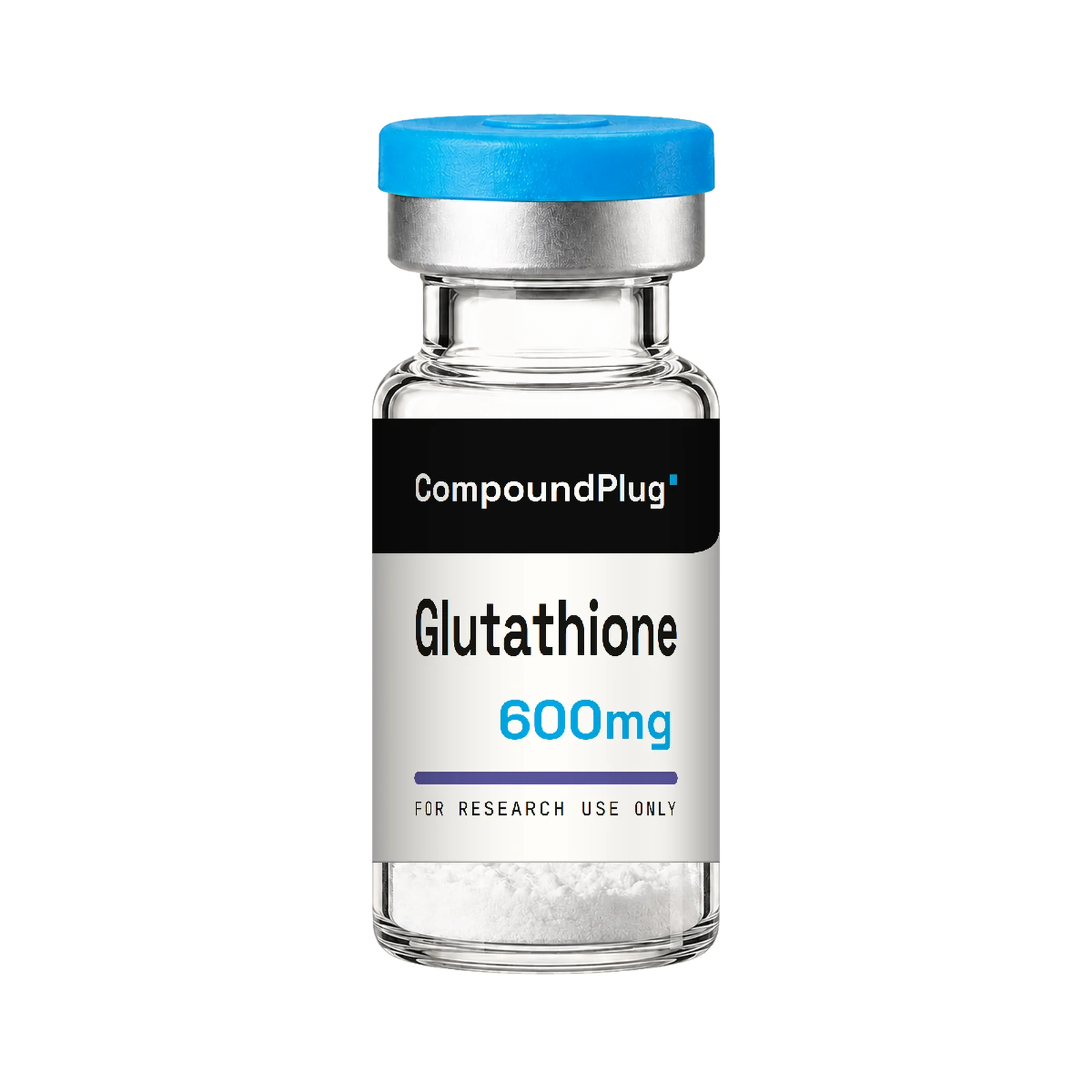
Glutathione Peptide
Glutathione peptide (GSH) — the principal endogenous cellular antioxidant. 600mg lyophilized powder, MW 307.32, ≥99% HPLC purity, mass-spec verified for identity.
$49.00
- Molecular Formula
- C10H17N3O6S
- Molecular Weight
- 307.32
- Purity (HPLC)
- ≥99%
- Sequence
- γ-Glu-Cys-Gly
- Form
- Lyophilized powder
- HPLC + Mass-Spec Tested
- COA Published Per Lot
- Ships From Canada
- Interac e-Transfer / Crypto
For laboratory research use only. Not for human consumption.
What Is Glutathione?
Glutathione is a tripeptide — γ-glutamyl-cysteinyl-glycine — and it is the principal antioxidant inside human cells.
Unlike most of this catalog, it is not experimental. It is a ubiquitous, well-characterised cellular molecule with a large and mature research literature going back decades. Present in every cell, typically at millimolar concentrations — among the most abundant small molecules in the cytosol.
The gamma bond — a genuinely unusual detail
Glutathione is not a normal peptide, and the reason is a single chemical bond.
In every ordinary peptide, amino acids are joined through the alpha-carboxyl group. In glutathione, glutamate is joined to cysteine through its gamma-carboxyl group instead — hence γ-Glu-Cys-Gly.
That single unusual bond is why glutathione exists at all. Standard peptidases cleave alpha bonds. They cannot touch a gamma bond. It makes glutathione resistant to intracellular degradation — which is precisely what a molecule needs if it is going to sit in the cytosol at millimolar concentration and act as a redox buffer.
It is a three-amino-acid peptide that peptidases cannot digest. That is not an accident.
How Glutathione Works: The Thiol
The functional element is the cysteine thiol group — the –SH.
Thiols donate electrons. That is what an antioxidant does. Glutathione neutralises reactive oxygen species by giving up an electron from that sulfur, and in doing so becomes oxidised.
GSH and GSSG
Two oxidised glutathione molecules join through a disulfide bond to form GSSG. Glutathione reductase reduces it back to two GSH.
The GSH:GSSG ratio is one of the most-used measures of cellular redox state in all of biology. A cell under oxidative stress shifts the ratio toward GSSG. It is a direct readout of how much oxidative pressure a cell is under — and it is the reason glutathione appears in research protocols across the whole of cell biology, not just antioxidant work.
Enzyme substrate
Glutathione is also the substrate for two enzyme families:
- Glutathione peroxidase — reduces peroxides, using GSH as the electron donor
- Glutathione S-transferase — conjugates glutathione to electrophilic compounds. This is Phase II hepatic detoxification. The liver disposes of a great many xenobiotics by sticking glutathione onto them.
Glutathione Benefits: What the Research Reports
Redox buffering
The central function. ROS neutralisation and maintenance of cellular redox homeostasis. Well characterised at the biochemistry level — this is textbook, not hypothesis.
Phase II conjugation
Hepatic detoxification via glutathione S-transferase. Glutathione depletion is the mechanism underlying acetaminophen hepatotoxicity — one of the best-understood examples of what happens when this system is overwhelmed.
Mitochondrial oxidative stress
Mitochondria generate ROS as a byproduct of oxidative phosphorylation, and maintain their own glutathione pool. Mitochondrial glutathione depletion is implicated in mitochondrial dysfunction.
As a research reagent
The GSH:GSSG ratio is a standard redox biomarker, used across cell biology as a direct readout of oxidative stress.
The Bioavailability Question — Stated Plainly
Oral glutathione is extensively degraded in the gut. Whether oral administration meaningfully raises intracellular glutathione is contested in the literature, and the honest answer is that it is not well established.
But for research use, that debate is beside the point. In an assay, you are adding glutathione to a system — measuring a GSH:GSSG ratio, running a glutathione peroxidase reaction, studying a conjugation pathway. The molecule itself is the reagent, not a delivery problem to be solved.
Same logic as NAD+: the transport question is a question about administration. It is not a question about research use.
Glutathione Injection: What the Term Refers To
Most searches for a glutathione injection are looking for a cosmetic product, and that is not what this is.
Injectable glutathione is marketed internationally as a skin-lightening treatment. Health Canada has issued warnings about injectable skin-lightening products, a number of which contain glutathione. No glutathione injection is an authorized health product in Canada, and none carries a DIN.
CompoundPlug does not supply a glutathione injection. What is supplied is lyophilized glutathione powder, measured by peptide content and analysed by HPLC and mass spectrometry, for in-vitro and in-vivo laboratory research only. It is not formulated, packaged, or intended as an injectable product, and no cosmetic claim of any kind is made for it.
Glutathione injection also appears in the preclinical and clinical literature across a range of routes and quantities. Those reports describe what was administered in a research setting. They are not a protocol, and no quantity has been established as safe or effective by any regulatory authority for the research-grade material supplied here.
Glutathione Dosage in the Published Research
Glutathione is present intracellularly at millimolar concentrations, and in-vitro work uses concentrations in that range — determined by the assay, not by a “dose.”
Preclinical and clinical work varies widely by route. No dose has been established as safe or effective by any regulatory authority for the research-grade material supplied.
CompoundPlug provides no dosing recommendations.
Glutathione Side Effects Reported in Studies
Glutathione is an endogenous molecule present in every human cell — which places it in a different category from most compounds in this catalog. It is not a foreign substance, and the research literature reports few adverse findings.
The honest note: Health Canada has issued warnings about injectable skin-lightening products, several of which contain glutathione. Reported glutathione injection side effects in that context centre on the unregulated products themselves — sterility, contamination and unverified composition — rather than on the molecule. CompoundPlug supplies glutathione for laboratory research, makes no cosmetic claims of any kind, and does not supply cosmetic products.
Glutathione Research Applications
- Redox biology — GSH:GSSG ratio as a redox-state biomarker
- Oxidative stress — ROS neutralisation, redox homeostasis
- Enzyme kinetics — glutathione peroxidase, glutathione reductase, glutathione S-transferase
- Hepatic detoxification — Phase II conjugation, xenobiotic metabolism
- Mitochondrial research — the mitochondrial glutathione pool, mitochondrial oxidative stress
- Thiol chemistry — disulfide bonding, protein S-glutathionylation
- Peptide chemistry — the gamma bond; peptidase resistance in non-standard linkages
All applications in-vitro / in-vivo laboratory research only.
Is Glutathione Legal in Canada?
Research-grade glutathione is not an authorized health product in Canada in the form supplied. No DIN, no NPN, not approved for human use.
It is not a controlled substance under the CDSA.
Note: Health Canada has warned about injectable skin-lightening products. CompoundPlug supplies glutathione for laboratory research only and makes no cosmetic claims.
See Research Use Only.
Glutathione Reconstitution & Storage
Water-soluble. Bacteriostatic water, added slowly down the vial wall. Swirl, never vortex.
⚠️ Glutathione oxidises readily — and that is the entire point of the molecule.
The thiol group that makes glutathione an antioxidant is the same group that makes it unstable in air. GSH oxidises to GSSG on exposure to oxygen, and a solution left standing will shift toward the oxidised form.
Practical consequence: prepare fresh where the experiment permits. Keep solutions cold and sealed. Do not assume the four-week window that applies to a lyophilized peptide. If the GSH:GSSG ratio is your measurement, a partially oxidised stock has already contaminated it.
Note the vial size: at 600mg, this is the largest vial in the catalog. Diluent volume matters accordingly.
Storage: powder, sealed — 2–8 °C, protected from light and moisture. Solutions — use promptly, keep cold.
Glutathione calculator — MW 307.32 · Reconstitution guide
Quality & Verification
Independent HPLC and mass-spec testing, published rather than asserted.
For glutathione, purity is the measurement that actually matters — and for a specific reason.
Glutathione oxidises to GSSG. GSSG is not an impurity in the ordinary sense — it is glutathione, in its oxidised state, and it is biologically active in the same system.
A partially oxidised vial doesn’t just contain less GSH. It contains GSSG — and if your experiment is measuring a GSH:GSSG ratio, the reagent has already put a thumb on the scale before the assay begins.
HPLC quantifies exactly this — how much of the vial is reduced glutathione and how much is oxidised. On a redox-active compound, that number is not a formality. It is the difference between a clean experiment and a confounded one.
Vials measured by peptide content. Published analysis in the COA Library, tied to the lot.
Buy Glutathione in Canada
Research-grade glutathione — 600mg lyophilized powder, MW 307.32, ≥99% HPLC purity, mass-spec verified, published reference COA.
- Purity published — which matters, because glutathione oxidises into its own active counterpart
- Glutathione Canada-wide — ships from within Canada by Canada Post Xpresspost, tracked
- CAD pricing · Interac e-Transfer or crypto · discreet packaging
Related: Browse Longevity Peptides — alongside NAD+, which faces the same “the transport question is not the research question” distinction.
Frequently Asked Questions
What is glutathione?
A tripeptide — γ-glutamyl-cysteinyl-glycine, MW 307.32 — and the principal antioxidant inside human cells. Present in every cell at millimolar concentrations, making it one of the most abundant small molecules in the cytosol.
Does CompoundPlug supply a glutathione injection?
No. Glutathione injection generally refers to a cosmetic skin-lightening product, and Health Canada has issued warnings about that category. No glutathione injection is authorized in Canada or carries a DIN. CompoundPlug supplies lyophilized glutathione powder for in-vitro and in-vivo laboratory research only — not formulated, packaged or intended as an injectable product, and with no cosmetic claim of any kind.
Why is glutathione written with a gamma?
Because of an unusual bond. In ordinary peptides, amino acids join through the alpha-carboxyl group. In glutathione, glutamate joins cysteine through its gamma-carboxyl group. Standard peptidases cleave alpha bonds and cannot touch a gamma bond — which is why glutathione survives in the cytosol at millimolar concentration instead of being digested. A three-amino-acid peptide that peptidases can’t break.
What is the GSH:GSSG ratio?
The ratio of reduced glutathione (GSH) to its oxidised form (GSSG), and one of the most widely used measures of cellular redox state in biology. A cell under oxidative stress shifts the ratio toward GSSG. It’s a direct readout of oxidative pressure.
Is glutathione stable in solution?
No — and that’s the whole point of the molecule. The thiol group that makes glutathione an antioxidant is the same group that makes it oxidise in air. GSH converts to GSSG on exposure to oxygen. Prepare fresh where possible, keep solutions cold and sealed, and don’t assume the four-week window that applies to a lyophilized peptide.
Why does purity matter so much for glutathione?
Because glutathione oxidises to GSSG — which isn’t an impurity in the ordinary sense. It’s glutathione, oxidised, and it’s active in the same system. A partially oxidised vial doesn’t just contain less GSH; it contains GSSG. If your experiment measures the GSH:GSSG ratio, the reagent has already skewed it before the assay starts. HPLC quantifies exactly that.
Is oral glutathione absorbed?
It’s extensively degraded in the gut, and whether oral administration meaningfully raises intracellular glutathione is contested. But for research use the question is beside the point — in an assay you’re adding the molecule to a system, not asking it to survive digestion. The transport debate is about administration, not about research use.
Is glutathione legal in Canada?
Research-grade glutathione is not an authorized health product in Canada in the form supplied — no DIN, no NPN, not approved for human use. It is not a controlled substance. Health Canada has warned about injectable skin-lightening products; CompoundPlug supplies glutathione for laboratory research only and makes no cosmetic claims.
Further reading
Related products
-
Longevity Peptides
5-Amino-1MQ
10mg
$49.00Select options This product has multiple variants. The options may be chosen on the product page -
Longevity Peptides
NAD+
500mg
$74.00Select options This product has multiple variants. The options may be chosen on the product page -
Longevity Peptides
Epithalon Peptide
10mg
$40.00Select options This product has multiple variants. The options may be chosen on the product page