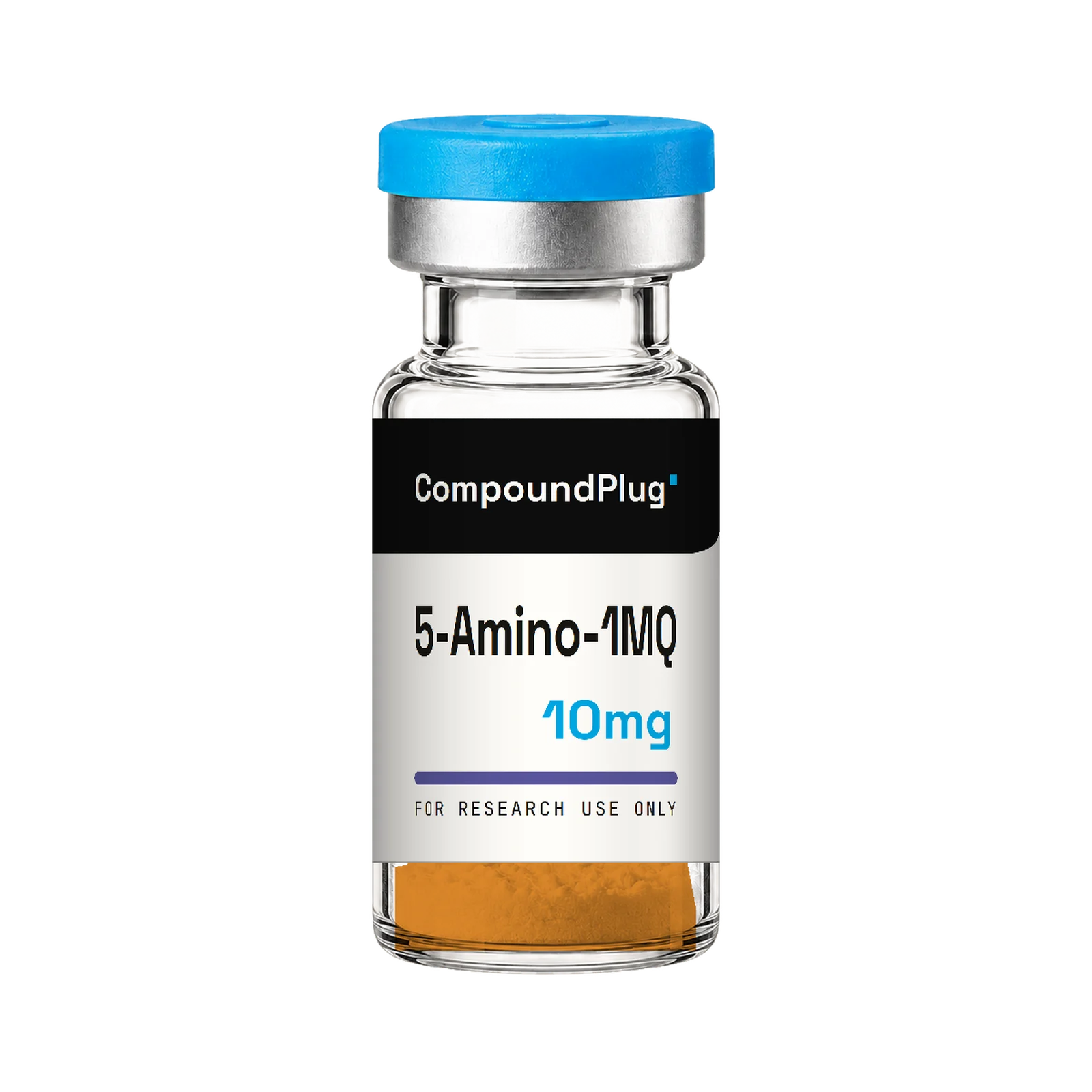
5-Amino-1MQ
5-Amino-1MQ — a small-molecule NNMT inhibitor, not a peptide. 10mg lyophilized powder, ≥99% HPLC purity, mass-spec verified for identity. Not water-soluble: requires DMSO or ethanol.
$49.00
- Molecular Formula
- C11H11IN2
- Molecular Weight
- 286.11
- Purity (HPLC)
- ≥99%
- Form
- Small molecule, lyophilized powder
- HPLC + Mass-Spec Tested
- COA Published Per Lot
- Ships From Canada
- Interac e-Transfer / Crypto
For laboratory research use only. Not for human consumption.
What Is 5-Amino-1MQ?
5-Amino-1MQ is not a peptide.
It is a small molecule — 5-amino-1-methylquinolinium — and it appears in research-compound catalogs because of its metabolic profile, not its structure. This is worth stating plainly, because it is routinely listed alongside peptides without anyone noticing the difference, and the difference has practical consequences: it is not water-soluble, and it will not reconstitute in bacteriostatic water.
It is a selective inhibitor of nicotinamide N-methyltransferase (NNMT), with a reported IC50 of 1.2 µM.
How 5-Amino-1MQ Works: The Methyl Sink
To understand this compound, you have to understand the enzyme it blocks — and NNMT is more interesting than its name suggests.
What NNMT consumes
NNMT catalyses a single reaction: it transfers a methyl group from S-adenosylmethionine (SAM) to nicotinamide, producing 1-methylnicotinamide and S-adenosylhomocysteine.
Both of those inputs are valuable, and NNMT consumes both.
- Nicotinamide is the precursor in the NAD+ salvage pathway. Every molecule NNMT methylates is a molecule that will not become NAD+.
- SAM is the universal methyl donor — the cell’s methylation currency, used across DNA methylation, histone modification, and dozens of other reactions.
For decades this reaction was regarded as simple housekeeping — a way to clear excess nicotinamide. The last fifteen years of research have reframed it as a metabolic drain, sitting at the intersection of NAD+ metabolism and cellular methylation.
The obesity connection
NNMT is upregulated in white adipose tissue in obesity. That observation is what turned it into a drug target.
The founding experiment was genetic. Kraus and colleagues (Nature, 2014) knocked down NNMT specifically in adipocytes — and the mice were protected from diet-induced obesity. No drug, just the absence of the enzyme.
5-Amino-1MQ is the pharmacological version of that experiment. Neelakantan and colleagues (Biochemical Pharmacology, 2018) took the genetic finding and asked whether a small molecule could do the same thing. It could.
5-Amino-1MQ Benefits: What the Research Reports
The pivotal study — Neelakantan et al., 2018
5-Amino-1MQ was administered to diet-induced obese C57BL/6 mice at 20 mg/kg, three times daily, subcutaneously, over 11 days. The reported findings:
- Reduced body weight
- Reduced white adipose mass
- Reduced adipocyte size
- Lowered plasma total cholesterol
- Reduced adipose-tissue NNMT enzymatic activity — confirming the mechanism was engaged
The finding that matters most: no change in food intake
Treated animals ate the same amount.
That single control result is the most important thing in the paper, and it is what distinguishes this compound from the entire GLP-1 category. Semaglutide and tirzepatide work by reducing intake — they suppress appetite and slow gastric emptying.
5-Amino-1MQ did not touch appetite. The effect was attributed to enhanced lipid oxidation rather than reduced lipid intake — a change in what fat cells do, not in how much food goes in.
Different lever entirely. That is why it appears in the literature at all.
In cell culture
Work in 3T3-L1 adipocytes reports concentration-dependent inhibition of lipid accumulation in differentiating pre-adipocytes. At 30 µM, lipogenesis fell by roughly 50%; at 60 µM, by roughly 70%. Intracellular NAD+ and SAM increased — consistent with the methyl-sink mechanism.
Muscle — the 2024 finding
Dimet-Wiley and colleagues (Scientific Reports, 2024) reported that NNMT inhibition in aged sedentary mice improved grip strength by 40%, and that it both mimicked and amplified the effects of exercise on muscle function.
That extends the compound beyond adipose tissue and into muscle and ageing research — and it is the newest and least-discussed part of the literature.
All findings are preclinical. There are no completed human trials of 5-Amino-1MQ.
5-Amino-1MQ Dosage in the Published Research
Animal models
The pivotal study administered 20 mg/kg, three times daily, subcutaneously, over 11 days in diet-induced obese mice (Neelakantan et al., 2018). Other work has used intraperitoneal administration at comparable quantities.
Cell culture
In-vitro work on 3T3-L1 adipocytes reports concentrations of 1–100 µM, with significant effects observed at 10 µM and above. The IC50 for NNMT inhibition is reported at 1.2 µM.
Humans
There are no completed human trials of 5-Amino-1MQ. No pharmacokinetic data, no dose-response curve, and no established safety margin in humans. Rodent and cell-culture quantities cannot be extrapolated across species without allometric scaling and pharmacokinetic data that do not exist for this compound.
CompoundPlug provides no dosing recommendations.
An arithmetic warning specific to this compound
5-Amino-1MQ is supplied in two forms with different molecular weights. The free base has a molecular weight of roughly 193.2; the iodide salt, roughly 286.11. That is a difference of nearly 50%.
A molar concentration calculated against the wrong figure is wrong by almost half. Check the Certificate of Analysis for the form and molecular weight before performing any stoichiometric calculation. CompoundPlug publishes both.
5-Amino-1MQ Side Effects Reported in Studies
In the research record
Reported adverse findings are limited. In 3T3-L1 viability assays, cell viability was only slightly reduced at the highest concentration tested.
The mechanistic question
NNMT is not expressed only in adipose tissue. It is present in liver and other tissues, and the consequences of systemic NNMT inhibition — as opposed to the adipocyte-specific knockdown of the founding study — are not established.
The enzyme sits at the intersection of NAD+ metabolism and cellular methylation. Both are fundamental processes. What a broad, systemic shift in methylation capacity does over time is an open question, and it is the substantive uncertainty about this compound rather than a reported adverse event.
What is not known
There are no completed human trials. No long-term safety data exists.
5-Amino-1MQ Research Applications
- NNMT inhibition — enzyme kinetics, selectivity, IC50 determination; 5-Amino-1MQ is the reference compound for this target
- NAD+ metabolism — the salvage pathway, nicotinamide availability, intracellular NAD+ flux
- Methylation biology — SAM availability, the methyl-sink hypothesis, one-carbon metabolism
- Adipose tissue research — NNMT expression in obesity, adipocyte metabolism, lipogenesis in 3T3-L1 models
- Skeletal muscle — myofiber models, satellite cell proliferation, grip strength in aged models
- Ageing biology — exercise-mimetic effects on muscle function
- Comparative metabolic pharmacology — a mechanism that alters fat-cell metabolism without affecting food intake, against incretin agonists that work by reducing intake
All applications preclinical, in-vitro / in-vivo only.
Is 5-Amino-1MQ Legal in Canada?
5-Amino-1MQ is not an authorized health product in Canada. It has not been reviewed by Health Canada for safety, efficacy, or quality, carries no DIN or NPN, and is not approved for human use. It is not approved by any regulatory authority anywhere, for any indication.
5-Amino-1MQ is not a controlled substance under the Controlled Drugs and Substances Act.
CompoundPlug supplies it strictly as a research chemical for in-vitro and in-vivo laboratory research. See Research Use Only.
5-Amino-1MQ Reconstitution & Storage
This compound is NOT water-soluble
Bacteriostatic water will not dissolve 5-Amino-1MQ. This is the single most important practical fact on the page, and it catches people out because the compound sits in a catalog full of water-soluble peptides.
Standard laboratory practice is to prepare a stock solution in DMSO or ethanol, then dilute into the working medium for cell culture, or prepare appropriately for in-vivo work.
Storage: powder is stable at room temperature. Solutions should be stored at 2–8 °C.
The Peptide Calculator performs the concentration arithmetic for any diluent — but the diluent here is DMSO or ethanol, not bacteriostatic water. And use the molecular weight from the Certificate of Analysis: 193.2 for the free base, 286.11 for the iodide salt.
Quality & Verification
Every CompoundPlug compound is tested independently through third-party laboratories, and the analysis is published rather than asserted.
5-Amino-1MQ has a specific identity problem, and it is the counterion.
The compound is supplied in two forms: the free base (molecular weight ~193.2) and the iodide salt (molecular weight ~286.11). They are the same active molecule with a different counterion — and a molecular weight differing by nearly 50%.
A purity test cannot distinguish them. Both can return ≥99%. Mass spectrometry measures molecular weight directly — and that is what identifies which form is in the vial.
This matters more here than on most compounds, because 5-Amino-1MQ is used in enzymatic assays where the molar concentration is the experiment. A 50% error in molarity is not a rounding error.
CompoundPlug publishes the form, the molecular weight, and the analysis. Vials are measured by compound content — the stated mass is compound, not gross powder weight.
Where a batch has been independently re-tested under the CompoundPlug name, a CompoundPlug Verified badge appears alongside the batch-specific Certificate of Analysis, tied to the lot printed on the vial.
Buy 5-Amino-1MQ in Canada
Research-grade 5-Amino-1MQ — 10mg lyophilized powder, selective NNMT inhibitor, ≥99% HPLC purity, mass-spec verified for identity, with a published reference Certificate of Analysis tied to the lot.
- Form and molecular weight published — free base or iodide salt, stated. Not left ambiguous.
- Not water-soluble — requires DMSO or ethanol. Stated up front, not buried.
- Ships from within Canada — Canada Post Xpresspost, tracked
- CAD pricing
- Interac e-Transfer or cryptocurrency
Related: 5-Amino-1MQ approaches NAD+ metabolism from the opposite direction to NAD+ — one supplies the molecule, the other stops its precursor being consumed. MOTS-c reaches the same territory by a third route entirely. Browse Longevity Peptides.
Frequently Asked Questions
What is 5-Amino-1MQ?
A small molecule — not a peptide — that selectively inhibits nicotinamide N-methyltransferase (NNMT), with a reported IC50 of 1.2 µM. It appears in research-compound catalogs for its metabolic profile rather than its structure.
How does 5-Amino-1MQ work?
NNMT consumes two valuable inputs: nicotinamide (the NAD+ salvage precursor) and SAM (the universal methyl donor). It is, in effect, a metabolic drain. Inhibiting it is proposed to preserve both. NNMT is upregulated in white adipose tissue in obesity, which is what made it a research target.
What are the reported benefits of 5-Amino-1MQ?
The pivotal 2018 study reported reduced body weight, reduced white adipose mass, smaller adipocytes, and lowered plasma cholesterol in diet-induced obese mice — with no change in food intake. A 2024 study reported that NNMT inhibition improved grip strength by 40% in aged sedentary mice. All findings are preclinical.
How is 5-Amino-1MQ different from a GLP-1?
Entirely different lever. Semaglutide and tirzepatide work by reducing intake — appetite suppression and delayed gastric emptying. In the pivotal 5-Amino-1MQ study, treated animals ate the same amount. The effect was attributed to enhanced lipid oxidation — a change in what fat cells do, not in how much food goes in.
What is the 5-Amino-1MQ dosage in research?
The pivotal study used 20 mg/kg, three times daily, subcutaneously, over 11 days in diet-induced obese mice. Cell-culture work uses 1–100 µM, with effects from 10 µM. There are no completed human trials and no human pharmacokinetic data. CompoundPlug provides no dosing recommendations.
Is 5-Amino-1MQ water-soluble?
No. Bacteriostatic water will not dissolve it. Standard practice is a stock solution in DMSO or ethanol, then dilution into the working medium. This catches people out because it sits in a catalog full of water-soluble peptides.
Why does the molecular weight matter for this compound?
Because it is supplied in two forms. The free base has a molecular weight of roughly 193.2; the iodide salt, roughly 286.11 — a difference of nearly 50%. 5-Amino-1MQ is used in enzymatic assays where molar concentration is the experiment, so a 50% error in molarity is not a rounding error. Check the Certificate of Analysis for the form and molecular weight.
Is 5-Amino-1MQ legal in Canada?
It is not an authorized health product in Canada — no DIN, no NPN, not approved for human use, and not approved by any regulatory authority anywhere. It is also not a controlled substance. Supplied research-use-only.
Further reading
Related products
-
Longevity Peptides
NAD+
500mg
$74.00Select options This product has multiple variants. The options may be chosen on the product page -
Longevity Peptides
Epithalon Peptide
10mg
$40.00Select options This product has multiple variants. The options may be chosen on the product page -
Longevity Peptides
Glutathione Peptide
600mg
$49.00Select options This product has multiple variants. The options may be chosen on the product page