HCG
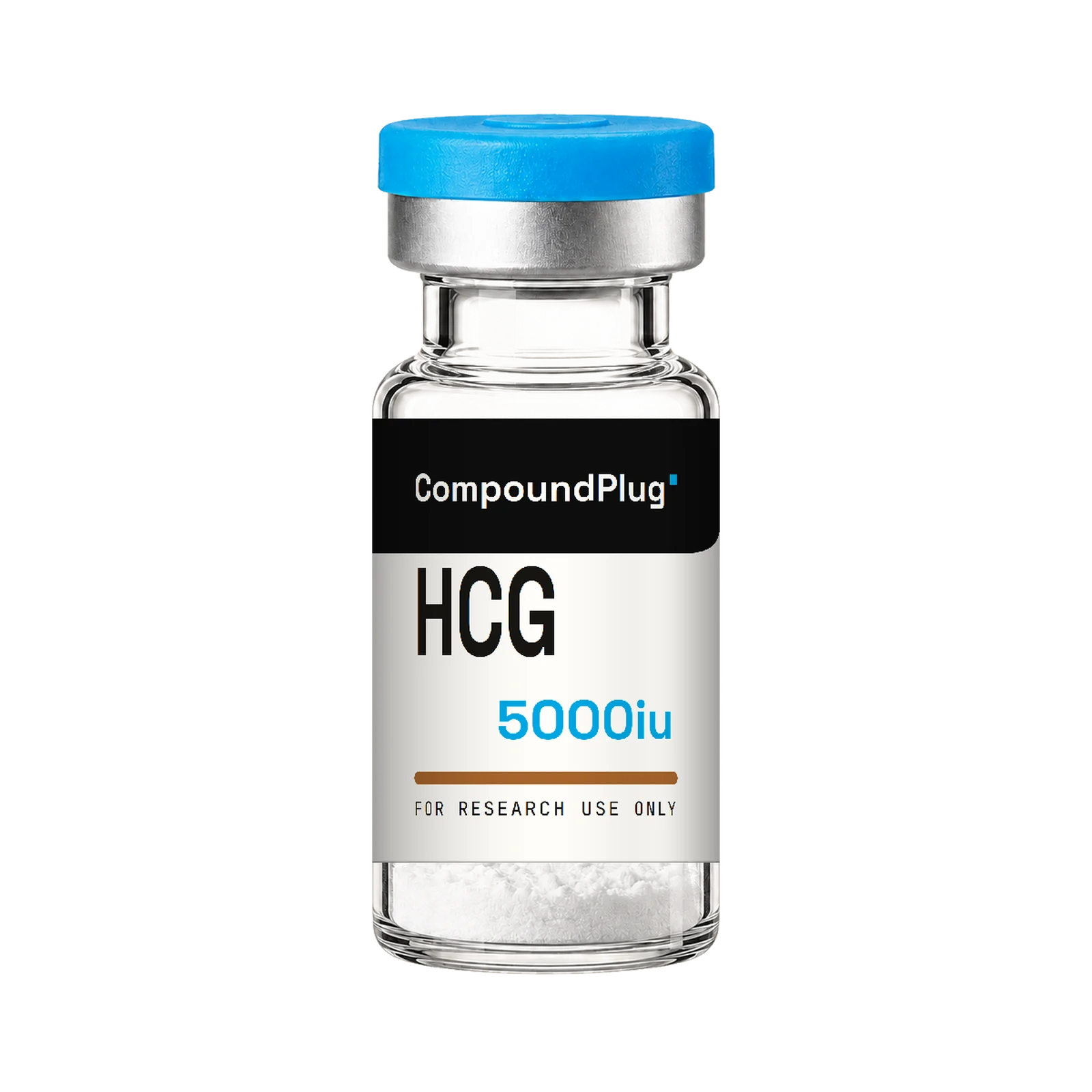
HCG — glycoprotein hormone, LH receptor agonist. Measured in international units, not milligrams. 5000iu and 10000iu vials, identity-verified, published Certificate of Analysis.
Price range: $69.00 through $124.00
| Size | Price | Availability |
|---|---|---|
| 5000iu | $69.00 | In stock |
| 10000iu | $124.00 | In stock |
- Purity (HPLC)
- ≥99%
- Form
- Glycoprotein hormone, lyophilized powder
- HPLC + Mass-Spec Tested
- COA Published Per Lot
- Ships From Canada
- Interac e-Transfer / Crypto
For laboratory research use only. Not for human consumption.
What Is HCG?
HCG is not a peptide. It is a glycoprotein hormone — and the distinction is not academic.
Human chorionic gonadotropin is a 237-amino-acid heterodimer: two separate protein chains, an alpha subunit and a beta subunit, held together non-covalently. And it is glycosylated — carbohydrate chains are attached to the protein backbone, and they are essential to its function.
The alpha subunit is shared
HCG’s alpha subunit is identical to the alpha subunit of LH, FSH, and TSH. Four different hormones, one shared component.
The beta subunit is what makes it HCG. Specificity lives entirely in the beta chain — which is why pregnancy tests measure beta-hCG specifically, not total hCG.
What it does
HCG binds the LH receptor. It is, functionally, an LH analog — and LH is the pituitary signal that drives gonadal steroidogenesis.
That single fact is the reason HCG appears in reproductive endocrinology research at all: it is a long-acting way to activate the LH receptor.
HCG in Canada: Approved Products and Regulatory Status
HCG is an approved prescription drug in Canada. Health Canada has authorized HCG products carrying Drug Identification Numbers, indicated for specific clinical uses in reproductive endocrinology.
Anyone seeking HCG for a clinical purpose should obtain an authorized, DIN-bearing product on prescription from a licensed pharmacy. That is the correct route, and it is not the route CompoundPlug serves.
Research-grade HCG is not an authorized product. It carries no DIN, has not been assessed by Health Canada for safety, efficacy, or quality, and is not pharmaceutically equivalent to any approved product. It must not be treated as a substitute for a prescription medication.
HCG is not a controlled substance under the CDSA.
CompoundPlug supplies HCG strictly as a research chemical for in-vitro and in-vivo laboratory research. See Research Use Only.
HCG Injection: What the Term Refers To
An HCG injection is a clinical product, and it is not what is supplied here.
The term refers to an authorized, DIN-bearing preparation of human chorionic gonadotropin, reconstituted and administered under the direction of a physician for an indication set out in that product’s Health Canada monograph. It is dispensed through licensed pharmacies on prescription. Dosing, route and schedule are clinical decisions made for a specific patient, and they are not determined by a supplier or a website.
CompoundPlug does not supply an HCG injection. What is supplied is lyophilized research-grade HCG, filled to a stated international-unit content and verified against a reference standard, for in-vitro and in-vivo laboratory research only. It is not formulated, packaged, or intended as an injectable product, and no therapeutic claim of any kind is made for it.
HCG injection also appears throughout the reproductive-endocrinology literature across a range of routes and quantities. Those reports describe what was administered in a research or clinical setting under supervision. They are not a protocol, and nothing about them transfers to unauthorized material.
Why HCG Is Measured in International Units, Not Milligrams
This is the single most practical thing on this page, and it catches people out constantly.
Every other compound in this catalog is measured by mass — milligrams of a defined molecule. HCG is measured in international units.
Why the difference exists
Because HCG is not a single, uniform molecule.
It is glycosylated — and the carbohydrate chains attached to the protein backbone vary between individual molecules. Two HCG molecules with identical amino acid sequences can carry different glycosylation, weigh different amounts, and have different biological potency.
So mass is the wrong unit. A milligram of HCG is not a meaningful quantity, because it does not tell you how much activity is present.
The international unit solves this. It is a measure of biological potency, calibrated against a reference standard — not a measure of weight. It answers the question that actually matters: how much does this preparation do?
What this means in practice
Standard mass-based reconstitution arithmetic does not apply to HCG in the usual way.
The calculator works on quantity and volume. For HCG, the input is IU, and the output is IU per millilitre — not mg/mL. The dilution equation is identical; the unit is not.
This is also why CompoundPlug does not publish a molecular weight for HCG. Every other product page on this site publishes one. On HCG, a single molecular weight would be false precision — there isn’t one number, because the molecule varies. Saying so is more useful than inventing a figure.
HCG Research Applications
- Reproductive endocrinology — LH receptor binding, gonadal steroidogenesis
- Receptor pharmacology — LHCGR characterisation; HCG as a long-acting LH agonist
- Assay and reference standards — HCG as a calibrated biological standard
- Glycoprotein hormone biology — the shared alpha subunit across LH, FSH, TSH, and HCG; beta-subunit specificity
- Glycosylation research — how carbohydrate structure affects potency and half-life
- Comparative endocrinology — HCG against LH signalling
All applications in-vitro / in-vivo laboratory research only.
HCG Dosage in the Published Research
HCG is dosed in international units, and that changes everything about how the question is answered.
Where HCG is prescribed as an authorized product in Canada, dosing is set by a physician, individualized to the patient, and documented in the Health Canada product monograph for that specific product. It is not determined by a supplier or a website.
Research-grade HCG has no established human dose because it is not a human therapeutic. CompoundPlug does not supply an authorized HCG product, provides no dosing recommendations, and does not supply HCG for human use.
HCG Reconstitution & Storage
Water-soluble. Reconstitute with bacteriostatic water, added slowly down the vial wall. Swirl gently, never vortex.
⚠️ Two things specific to HCG.
1. The arithmetic is in IU, not mg. A 5000iu vial reconstituted with 1 mL yields 5000 IU/mL. With 2 mL, 2500 IU/mL. Same dilution equation — different unit. Do not attempt to convert IU to milligrams. The conversion is not meaningful, because IU measures potency and mg measures mass.
2. Glycoproteins are more fragile than peptides. HCG is a large, two-chain, glycosylated protein held together non-covalently. It is more susceptible to denaturation than a short synthetic peptide. The rule against shaking and vortexing applies with more force here, not less — and a denatured glycoprotein is inactive while looking entirely normal in solution.
Storage: lyophilized and sealed, 2–8 °C. Reconstituted, 2–8 °C, use within 30 days. Protect from light. Do not freeze after reconstitution.
Calculator — enter IU, not mg · Reconstitution guide
Quality & Verification
Independent third-party testing, published rather than asserted.
HCG is tested differently from everything else in this catalog, and it is worth understanding why.
For a defined synthetic peptide, mass spectrometry answers the identity question: does the molecular weight match the sequence?
HCG has no single molecular weight. Glycosylation varies. So identity and potency are established through bioassay and immunoassay against a calibrated reference standard — measuring what the preparation does, not what it weighs.
That is what the international unit is. It is not a convenience. It is the only meaningful way to quantify a glycoprotein hormone whose mass is not fixed.
Vials are filled to the stated IU. Published analysis in the COA Library, tied to the lot on the vial.
Buy HCG Online in Canada
Research-grade HCG — 5000iu and 10000iu lyophilized vials, identity-verified, with a published reference Certificate of Analysis tied to the lot.
- Measured in international units — the correct unit for a glycoprotein hormone, and stated plainly rather than fudged into milligrams
- HCG Canada-wide — ships from within Canada by Canada Post Xpresspost, tracked
- CAD pricing · Interac e-Transfer or crypto · discreet packaging
This is a research chemical, not a therapeutic product. For HCG as a medication, consult a physician and obtain an authorized DIN-bearing product from a licensed pharmacy.
Related: Browse Hormonal Peptides, or pick up bacteriostatic water.
Frequently Asked Questions
What is HCG?
Human chorionic gonadotropin — a glycoprotein hormone, not a peptide. A 237-amino-acid heterodimer with attached carbohydrate chains. It binds the LH receptor, functioning as an LH analog, which is why it appears in reproductive endocrinology research.
Does CompoundPlug supply an HCG injection?
No. An HCG injection is an authorized, DIN-bearing clinical product, dispensed on prescription through a licensed pharmacy and administered under a physician’s direction. CompoundPlug supplies lyophilized research-grade HCG for in-vitro and in-vivo laboratory research only — not formulated, packaged or intended as an injectable product, and with no therapeutic claim of any kind. For HCG as a medication, see a physician.
Why is HCG measured in IU instead of mg?
Because HCG is not a uniform molecule. It’s glycosylated, and the carbohydrate chains vary between individual molecules — so two HCG molecules with identical amino acid sequences can weigh different amounts and have different biological potency. Mass is therefore the wrong unit. The international unit measures biological potency against a calibrated reference standard, which is the thing that actually matters.
Can IU be converted to milligrams?
Not meaningfully. IU measures potency; mg measures mass. For a glycoprotein whose mass varies between molecules, they are not interchangeable units. Any conversion factor would be an approximation for one specific preparation, not a general truth.
Why doesn’t CompoundPlug publish a molecular weight for HCG?
Because there isn’t one. Every other product page on this site publishes a molecular weight. On HCG, a single figure would be false precision — glycosylation varies between molecules, so the mass genuinely differs. Saying so is more useful than inventing a number.
Is HCG approved in Canada?
Yes — as a prescription drug. Health Canada has authorized DIN-bearing HCG products for specific clinical uses in reproductive endocrinology. Research-grade HCG is not those products, is not pharmaceutically equivalent, and is not a substitute for one. Anyone seeking HCG for a clinical purpose should obtain an authorized product on prescription from a licensed pharmacy.
How is HCG reconstituted?
With bacteriostatic water, added slowly down the vial wall and swirled — never shaken or vortexed. The arithmetic is in IU: a 5000iu vial with 1 mL of diluent yields 5000 IU/mL. Glycoproteins are also more fragile than short synthetic peptides, so the no-agitation rule applies with more force, not less.
How long does HCG last?
Lyophilized and sealed: 2–8 °C. Reconstituted: 30 days at 2–8 °C, protected from light. Do not freeze after reconstitution.