PT-141 Peptide
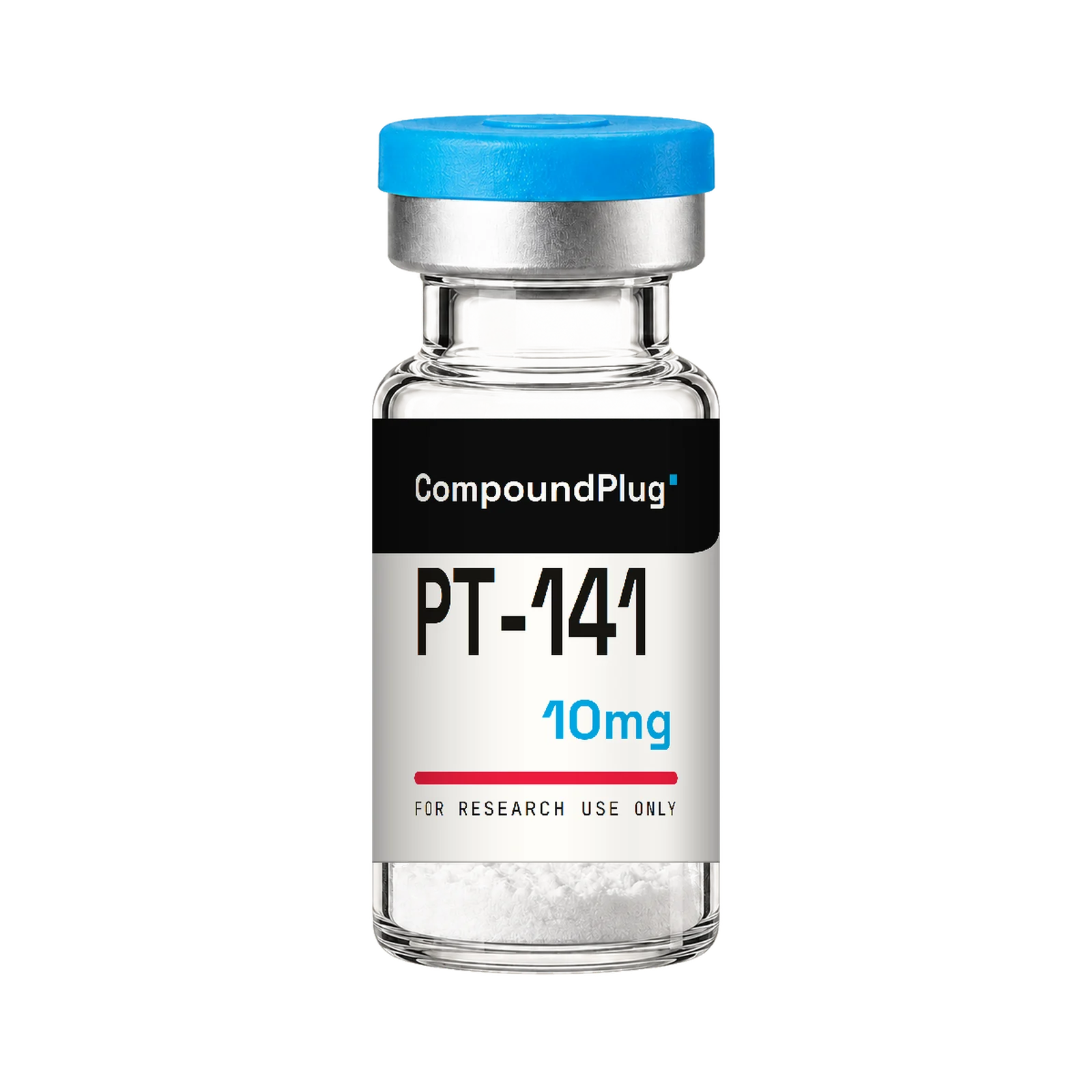
PT-141 (bremelanotide) — cyclic heptapeptide melanocortin agonist, MW 1025.2. 10mg lyophilized powder, ≥99% HPLC purity, mass-spec verified for identity. Published COA by lot.
$49.00
- Synonyms / Codes
- Bremelanotide, PT-141
- CAS Number
- 189691-06-3
- Molecular Formula
- C50H68N14O10
- Molecular Weight
- 1025.2
- Purity (HPLC)
- ≥99%
- Sequence
- Ac-Nle-cyclo[Asp-His-D-Phe-Arg-Trp-Lys]-OH
- Form
- Lyophilized powder
Identity data from PubChem CID 9941379 (US National Library of Medicine).
- HPLC + Mass-Spec Tested
- COA Published Per Lot
- Ships From Canada
- Interac e-Transfer / Crypto
For laboratory research use only. Not for human consumption.
What Is PT-141?
PT-141 — bremelanotide — is a synthetic cyclic heptapeptide: seven amino acids closed into a ring by a lactam bridge. Molecular weight 1025.2.
It is a melanocortin receptor agonist, acting primarily at MC3R and MC4R.
It was an accident
PT-141 exists because of a side effect.
Researchers were studying Melanotan 2 — a melanocortin agonist being investigated as a tanning compound, a way to trigger melanogenesis without UV exposure. During those studies they noticed something that was not the endpoint: participants were consistently reporting sexual arousal.
Melanotan 2 is non-selective — it binds MC1R, MC3R, MC4R, and MC5R. MC1R drives melanogenesis. MC4R does something else entirely.
Palatin Technologies took that unintended effect and engineered a molecule to isolate it: keep the MC3R and MC4R activity, drop the MC1R activity that causes pigmentation. The result was bremelanotide.
It worked. Bremelanotide became the first melanocortin receptor agonist ever approved by the FDA — June 2019, as Vyleesi — on the strength of two Phase 3 trials (RECONNECT) in 1,267 participants.
How PT-141 Works: Central, Not Vascular
This is the single most important thing about the compound, and it is what separates it from every drug it gets compared to.
PDE5 inhibitors — sildenafil, tadalafil — work peripherally. They prevent the breakdown of cyclic GMP in vascular smooth muscle, sustaining vasodilation. They act on blood vessels.
PT-141 does not touch blood vessels. It acts on MC4R in the hypothalamus and limbic system — brain regions where sexual motivation is generated. Research describes it engaging dopaminergic pathways in those circuits.
Different organ. Different mechanism. Different pharmacological class entirely.
Wessells and colleagues (2000) published the foundational human pharmacology showing that melanocortin agonism produced measurable physiological response through a central mechanism, independent of peripheral vasodilation. That finding is why the compound exists as a separate drug class rather than a variation on an existing one.
Selectivity is the design
The lactam bridge that closes the ring does two things: it constrains the conformation, which improves metabolic stability relative to a linear peptide, and it shapes receptor selectivity.
Compared with its parent, Melanotan 2, PT-141 has substantially reduced MC1R activity — the receptor responsible for melanogenesis. That reduction is not a side benefit. It is the entire point of the molecule.
Is PT-141 Legal in Canada? Regulatory Status
Bremelanotide is approved in the United States. It is not approved in Canada.
In the US it is marketed as Vyleesi — approved by the FDA in June 2019 for acquired, generalized hypoactive sexual desire disorder in premenopausal women. It was the first melanocortin receptor agonist approved for any indication, anywhere.
Health Canada has not authorized it. Bremelanotide does not appear in the Drug Product Database, carries no Drug Identification Number, and there is no authorized bremelanotide product available in Canada — under any brand name, on prescription or otherwise.
That is an unusual position, and it is worth being precise about. This is not a compound that failed development, and it is not a compound with a Canadian prescription route that CompoundPlug is bypassing. It completed clinical development, was approved by a major regulator, and simply has not been brought to market in Canada.
PT-141 is not a controlled substance under the Controlled Drugs and Substances Act.
CompoundPlug supplies PT-141 strictly as a research chemical for in-vitro and in-vivo laboratory research by qualified professionals. See Research Use Only.
PT-141 Benefits: What the Research Reports
The Phase 3 trial data
The RECONNECT programme — two Phase 3 randomised controlled trials, 1,267 participants — reported statistically significant improvements against placebo on validated instruments measuring desire and associated distress, with on-demand subcutaneous administration over 24 weeks.
The effect sizes were modest but statistically robust, and they were sufficient for approval. It is worth being precise about that: this is a real, controlled, adequately powered dataset — which is rare in this catalog — and the effect it demonstrates is real but not dramatic.
Mechanism
Central MC4R activation in the hypothalamus and limbic system. Preclinical work using MC4R knockout mice established MC4R as the critical mediator — remove the receptor and the effect disappears.
Melanocortin pharmacology
PT-141 is the reference selective melanocortin agonist. For researchers studying MC3R/MC4R receptor biology, hypothalamic circuit function, or the melanocortin system generally, it is the tool compound — and it has a Phase 3 dataset behind it, which almost nothing else in this catalog does.
PT-141 Dosage in the Published Research
Bremelanotide completed clinical development. The approved product is administered by subcutaneous autoinjector, on demand, at a single defined quantity, with a specified maximum frequency.
Where bremelanotide is prescribed as an authorized product, dosing is set by a physician and documented in the approved product monograph. It is not determined by a supplier.
One historical detail worth knowing. PT-141 was originally developed as an intranasal spray. Early Phase 2 data was promising — but the nasal formulation produced dose-dependent blood pressure increases, and that is why the programme pivoted to subcutaneous injection and a narrower indication. The route was changed for a safety reason, not a convenience one.
CompoundPlug provides no dosing recommendations.
PT-141 Side Effects Reported in Studies
Because bremelanotide is an approved drug, its safety profile is documented rather than inferred — which is unusual here and worth stating.
Most common in the trial record
- Nausea — by a clear margin the most frequently reported
- Flushing
- Injection-site reactions
- Headache
The cardiovascular signal
A transient increase in blood pressure and decrease in heart rate occurs after administration. This is documented in the approved product labelling, and it is why the product is not indicated for people with uncontrolled hypertension or cardiovascular disease.
This is the same signal that killed the intranasal formulation. It is not incidental to the compound — it is a property of melanocortin agonism, and it has shaped the drug’s entire development history.
These effects were observed with authorized, GMP-manufactured product under medical supervision.
PT-141 Research Applications
- Melanocortin receptor pharmacology — MC3R/MC4R selectivity; the reference selective agonist
- Central vs peripheral mechanism — CNS melanocortin signalling against PDE5 vascular action
- Hypothalamic circuit function — MC4R signalling in the hypothalamus and limbic system
- Dopaminergic pathways — melanocortin–dopamine interaction in motivation circuits
- Receptor engineering — selectivity as a design goal; the lactam bridge; PT-141 against Melanotan 2
- Autonomic modulation — the blood pressure and heart rate signal
All applications preclinical, in-vitro / in-vivo only.
PT-141 Reconstitution & Storage
Water-soluble. Bacteriostatic water, added slowly down the vial wall. Swirl, never vortex.
Storage: lyophilized and sealed, up to 24 months. Reconstituted, 2–8 °C, 3–4 weeks, protected from light.
Molar calculations: MW 1025.2. PT-141 calculator · Reconstitution guide
Quality & Verification
Independent HPLC and mass-spec testing, published rather than asserted.
PT-141 and Melanotan 2 are structurally close, and that is precisely why identity testing matters here.
Both are cyclic heptapeptides. Both derive from α-MSH. Their molecular weights are 1025.2 and 1024.2 — a difference of roughly one dalton.
But they are not interchangeable. PT-141 has substantially reduced MC1R activity; Melanotan 2 does not. MC1R drives melanogenesis. That is the difference between a selective agonist and a non-selective one — and it is invisible to a purity test.
Mass spectrometry resolves compounds that differ by a single dalton. HPLC purity does not tell you which of two closely related cyclic heptapeptides is in the vial. Only identity testing does.
Vials measured by peptide content. Published analysis in the COA Library, tied to the lot.
Buy PT-141 Canada-Wide
Research-grade PT-141 (bremelanotide) — 10mg lyophilized powder, MW 1025.2, ≥99% HPLC purity, mass-spec verified, published reference COA.
- Sequence and molecular weight published — and it matters, because MT-2 is a dalton away
- Ships from within Canada — Canada Post Xpresspost, tracked
- CAD pricing · Interac e-Transfer or crypto · discreet packaging
This is a research chemical, not a therapeutic product.
Related: Melanotan 2 — the non-selective parent PT-141 was refined out of. Browse Libido Peptides.
Frequently Asked Questions
What is PT-141?
Bremelanotide — a synthetic cyclic heptapeptide melanocortin receptor agonist, MW 1025.2, acting primarily at MC3R and MC4R. It was the first melanocortin agonist ever approved by the FDA (June 2019, as Vyleesi).
How is PT-141 different from Viagra?
Completely different mechanism and different organ. PDE5 inhibitors act peripherally — they sustain vasodilation in vascular smooth muscle. PT-141 acts centrally, on MC4R in the hypothalamus and limbic system. It does not touch blood vessels. Different pharmacological class entirely.
How was PT-141 discovered?
As a side effect. Researchers studying Melanotan 2 as a tanning compound noticed participants were consistently reporting sexual arousal. Melanotan 2 is non-selective — it binds MC1R (which drives pigmentation) and MC4R (which does not). Palatin Technologies engineered a molecule that kept the MC4R activity and dropped the MC1R activity. That molecule is PT-141.
What does the clinical trial data show?
The RECONNECT programme — two Phase 3 trials, 1,267 participants — reported statistically significant improvements against placebo on validated instruments, with on-demand subcutaneous administration over 24 weeks. The effect sizes were modest but robust, and sufficient for approval. It is a real, controlled, adequately powered dataset, which is rare in this catalog.
What are the side effects of PT-141?
Because it is an approved drug, the profile is documented rather than inferred. Nausea is the most frequent, followed by flushing, injection-site reactions, and headache. A transient blood pressure increase and heart rate decrease occurs after administration — the same signal that ended the original intranasal formulation, and the reason the approved product is not indicated in uncontrolled hypertension.
Is PT-141 approved in Canada?
No. Bremelanotide is approved in the United States as Vyleesi (FDA, June 2019) but Health Canada has not authorized it — it does not appear in the Drug Product Database and carries no DIN. There is no authorized bremelanotide product available in Canada. It is also not a controlled substance.
PT-141 vs Melanotan 2?
PT-141 is the refined version of MT-2. Melanotan 2 is non-selective — MC1R, MC3R, MC4R, MC5R. PT-141 is selective, with substantially reduced MC1R activity. MC1R drives melanogenesis; removing it was the entire point of the molecule. Their molecular weights differ by roughly one dalton (1025.2 vs 1024.2), which is why identity testing matters.
How is PT-141 reconstituted?
Water-soluble. Bacteriostatic water, added slowly down the vial wall, swirled — never shaken or vortexed. Molar calculations use MW 1025.2.
Further reading
Related products
-
Libido Peptides
Melanotan 2 Peptide
10mg
$49.00Select options This product has multiple variants. The options may be chosen on the product page