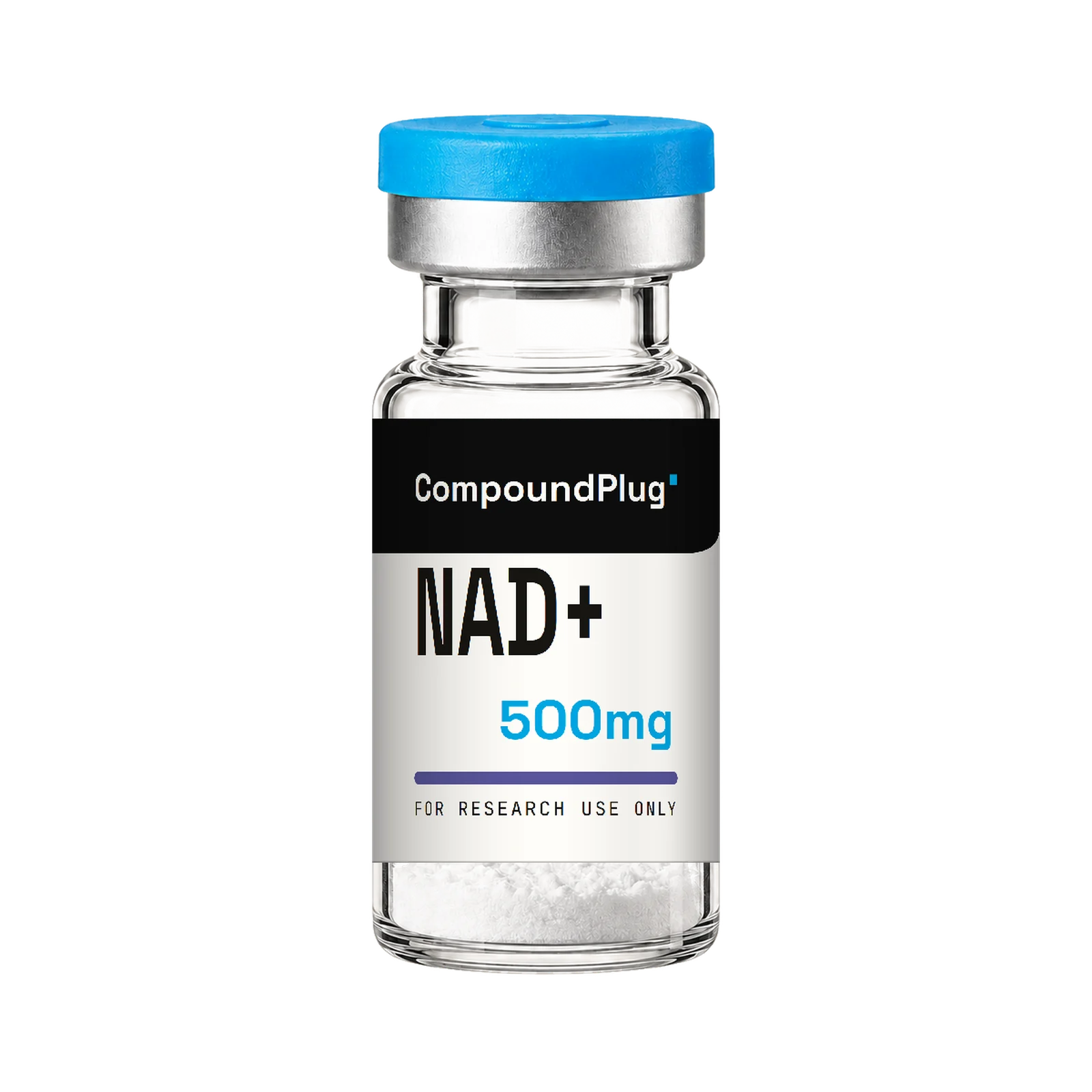
NAD+
β-Nicotinamide adenine dinucleotide — the coenzyme itself, not a precursor. 500mg lyophilized powder, MW 663.43, ≥99% HPLC purity, mass-spec verified. Substrate for sirtuins and PARP enzymes.
$74.00
- Molecular Formula
- C21H27N7O14P2
- Molecular Weight
- 663.43
- Purity (HPLC)
- ≥99%
- Form
- Coenzyme, lyophilized powder
- HPLC + Mass-Spec Tested
- COA Published Per Lot
- Ships From Canada
- Interac e-Transfer / Crypto
For laboratory research use only. Not for human consumption.
What Is NAD+?
NAD+ is not a peptide. It is a coenzyme — β-nicotinamide adenine dinucleotide — and it is one of the most fundamental molecules in biology.
It is present in every living cell, and it does two distinct jobs that are worth separating because the literature routinely conflates them:
1. Redox carrier
NAD+ accepts electrons and becomes NADH; NADH donates them and becomes NAD+ again. That cycle is the backbone of cellular energy metabolism — glycolysis, the citric acid cycle, oxidative phosphorylation. In this role NAD+ is recycled, not consumed. The same molecule goes round and round.
2. Enzyme substrate
This is the role that generates the research interest, and it is fundamentally different: sirtuins and PARP enzymes consume NAD+. They cleave it. The molecule is destroyed in the reaction and has to be replaced.
That is the whole tension. Sirtuins are implicated in longevity signalling. PARPs are implicated in DNA repair. Both run on NAD+, and both use it up — which means the more DNA damage a cell is repairing, the more NAD+ it burns.
The finding that drives the field
NAD+ declines with age. This is one of the better-replicated observations in ageing biology, and it is the reason a coenzyme ended up in a research-compound catalog. The proposed link runs: less NAD+ → less sirtuin and PARP activity → impaired repair and mitochondrial function.
Whether restoring NAD+ reverses any of that is the open question the entire field exists to answer.
Is NAD+ a Peptide?
No. NAD+ is a coenzyme, not a peptide — and the distinction is worth stating plainly, because NAD+ is stocked and discussed alongside research peptides constantly, which is where the confusion originates.
A peptide is a chain of amino acids joined by peptide bonds. NAD+ contains no amino acids and no peptide bonds. It is a dinucleotide — nicotinamide mononucleotide joined to adenosine monophosphate through their phosphate groups. Molecular weight 663.43, against the roughly 1,000–5,000 range typical of the research peptides in this catalog.
Why it sits in a peptide catalog anyway: the research context is identical. NAD+ appears in the same longevity and metabolic literature as the peptides here, it reconstitutes with the same bacteriostatic water, it is handled the same way at the bench, and it is routinely studied alongside them. 5-Amino-1MQ is not a peptide either — it is a small-molecule NNMT inhibitor. MOTS-c is a peptide, and it is reported to act on the same pathway.
“NAD+ peptide” is a search term rather than a chemical description. The molecule it refers to is this one.
The Bioavailability Question — Stated Plainly
This is the part most vendors do not tell you, and it matters.
NAD+ is a large, charged dinucleotide. It does not readily cross cell membranes.
Studies of extracellular NAD+ in cell culture report that it is degraded to nucleosides, and then to bases, before any uptake occurs. The same appears to be true of NMN, one step smaller: research describes it as being converted extracellularly to NR before entering cells. NR is the form that actually crosses the membrane, via equilibrative nucleoside transporters, and is then rebuilt into NMN and NAD+ inside the cell.
So the honest position is this: the claim that administered NAD+ directly raises intracellular NAD+ is not well supported by the transport literature. The molecule very likely gets taken apart first.
Why that does not undermine NAD+ as a research reagent
Because for research, you are not asking it to cross a membrane. You are adding it to a system.
- Sirtuin assays need NAD+. It is the substrate. A precursor will not work.
- PARP assays need NAD+. Same reason.
- Redox biochemistry is the NAD+/NADH couple. That is the reaction.
- Enzyme kinetics, cofactor studies, in-vitro metabolic work — the coenzyme itself is the correct reagent.
The bioavailability debate is a question about administration. It is not a question about research use. For in-vitro work, NAD+ is not a compromise or a proxy — it is the molecule the enzymes actually take.
CompoundPlug supplies NAD+ for laboratory research, and states the transport question plainly because it is true and because it is relevant to designing an experiment that works.
NAD+ Benefits: What the Research Reports
Sirtuin activation
Sirtuins are NAD+-dependent deacetylases implicated in metabolic regulation, mitochondrial biogenesis, and longevity signalling. Their activity is limited by NAD+ availability — which is the mechanistic basis of the entire NAD+-restoration hypothesis.
DNA repair via PARP
Poly(ADP-ribose) polymerases consume NAD+ in the process of repairing DNA damage. Heavy PARP activation depletes cellular NAD+ — and, in doing so, starves the sirtuins. This competition between DNA repair and longevity signalling for a shared, limited resource is one of the more interesting ideas in the field.
Mitochondrial function
NAD+ is central to oxidative phosphorylation. Age-associated NAD+ decline is implicated in mitochondrial dysfunction.
Age-associated decline
Well replicated. NAD+ levels fall with age across tissues, and the decline is one of the more consistent findings in the ageing literature.
The mechanistic biology is solid. Whether administered NAD+ or its precursors change any human outcome is not established.
NAD+ Dosage in the Published Research
In vitro
NAD+ is present intracellularly at millimolar concentrations, and cell-culture work reports it in the micromolar to millimolar range. Enzymatic assays use concentrations determined by the Km of the enzyme under study — this is standard enzyme kinetics, not a “dose.”
Preclinical and human work
Most published research uses precursors — NR and NMN — rather than NAD+ itself, precisely because of the transport problem described above. That is a real limitation of the NAD+ literature and it should be understood before designing a study around the parent molecule.
No human pharmacokinetic data establishes that administered NAD+ raises intracellular NAD+.
CompoundPlug provides no dosing recommendations.
NAD+ Side Effects Reported in Studies
In the research record
NAD+ is an endogenous molecule present in every cell, which puts it in a different category from most compounds in this catalog. It is not a foreign substance.
Reported adverse findings in the research literature are limited.
The real uncertainty
The uncertainty about NAD+ is not primarily about safety. It is about efficacy.
The mechanistic biology is well established. The question is whether administering the molecule — which does not readily enter cells — achieves anything that the cell would not do on its own. That is an open scientific question, and it is not resolved.
NAD+ Research Applications
- Sirtuin research — NAD+-dependent deacetylase assays; SIRT1–7 activity and NAD+ dependence
- PARP research — DNA repair, poly(ADP-ribosyl)ation, NAD+ consumption kinetics
- Redox biochemistry — the NAD+/NADH couple; cellular redox state
- Enzyme kinetics — NAD+ as cofactor and substrate; Km determination
- Mitochondrial research — oxidative phosphorylation, electron transport
- Ageing biology — age-associated NAD+ decline
- NAD+ metabolism — the salvage pathway, NAMPT, NMNAT, precursor comparison
- Comparative precursor research — NAD+ against NR, NMN, and nicotinamide; membrane transport and conversion
All applications in-vitro / in-vivo laboratory research only.
Is NAD+ Legal in Canada?
Research-grade NAD+ is not an authorized health product in Canada. It has not been reviewed by Health Canada for safety, efficacy, or quality in this form, carries no DIN or NPN, and is not approved for human use.
NAD+ is not a controlled substance under the Controlled Drugs and Substances Act.
Note: oral NAD+ precursor supplements — nicotinamide riboside, NMN — exist in the consumer market and are regulated separately under natural health product rules. CompoundPlug does not supply supplements, and research-grade NAD+ is not one.
CompoundPlug supplies NAD+ strictly as a research chemical for in-vitro and in-vivo laboratory research. See Research Use Only.
NAD+ Reconstitution & Storage
NAD+ is water-soluble and reconstitutes readily with bacteriostatic water. Add the diluent slowly, down the inside wall of the vial. Swirl gently.
Two notes specific to this compound:
1. This is a 500 mg vial — by a wide margin the largest in the catalog. A small diluent volume will produce an extremely concentrated solution. The NAD+ calculator matters more here than almost anywhere else.
2. NAD+ is less stable in solution than most compounds here. It is a dinucleotide and it hydrolyses, particularly at alkaline pH and at elevated temperature. Prepare fresh where the experiment permits, keep solutions cold, and protect from light. Reconstituted NAD+ does not keep as well as a lyophilized peptide does.
Storage: powder, sealed — 2–8 °C, protected from light and moisture. In solution — use promptly; keep cold. Do not assume a four-week window.
Quality & Verification
Every CompoundPlug compound is tested independently through third-party laboratories, and the analysis is published rather than asserted.
For NAD+, purity is the thing that actually matters — and for a specific reason.
NAD+ degrades to nicotinamide, NMN, and other breakdown products. Those degradation products are also biologically active molecules in the same pathway. A degraded vial does not merely contain less NAD+ — it contains a mixture of related compounds that will behave differently in an assay.
HPLC quantifies exactly that. It tells you how much of the vial is intact NAD+ and how much is breakdown product. On a compound that degrades into its own pathway intermediates, a purity number is not a formality — it is the difference between a clean experiment and a confounded one.
Mass spectrometry confirms identity — that the compound is NAD+ (MW 663.43) and not NADH, NMN, or nicotinamide.
Vials are measured by compound content — the stated mass is compound, not gross powder weight.
Where a batch has been independently re-tested under the CompoundPlug name, a CompoundPlug Verified badge appears alongside the batch-specific Certificate of Analysis, tied to the lot printed on the vial.
Buy NAD+ in Canada
Research-grade NAD+ — 500mg lyophilized powder, β-nicotinamide adenine dinucleotide, molecular weight 663.43, ≥99% HPLC purity, mass-spec verified for identity, with a published reference Certificate of Analysis tied to the lot.
- The coenzyme itself — not a precursor. The molecule sirtuins and PARPs actually consume.
- Purity published — which matters, because NAD+ degrades into its own pathway intermediates
- Ships from within Canada — Canada Post Xpresspost, tracked
- CAD pricing
- Interac e-Transfer or cryptocurrency
Related: 5-Amino-1MQ approaches NAD+ from the opposite direction — it inhibits the enzyme that consumes NAD+’s precursor, rather than supplying the molecule. MOTS-c has been reported to raise cellular NAD+ by a third route. Three compounds, one pathway, three mechanisms. Browse Longevity Peptides.
Frequently Asked Questions
What is NAD+?
β-nicotinamide adenine dinucleotide — a coenzyme, not a peptide, present in every living cell. It carries electrons in redox reactions, and it is the substrate that sirtuin and PARP enzymes consume. Molecular weight 663.43.
Is NAD+ a peptide?
No. A peptide is a chain of amino acids joined by peptide bonds; NAD+ contains neither. It is a dinucleotide — nicotinamide mononucleotide joined to adenosine monophosphate through their phosphate groups, molecular weight 663.43. It is grouped with research peptides because it appears in the same literature, reconstitutes the same way, and is studied alongside them. “NAD+ peptide” is a search term, not a chemical description.
Does NAD+ cross cell membranes?
Not readily. NAD+ is a large, charged dinucleotide, and the transport literature reports that extracellular NAD+ is degraded to nucleosides and then bases before uptake. Nicotinamide riboside (NR) is the form that actually enters cells. This is why most published research uses precursors rather than NAD+ itself — and it is a real limitation worth understanding before designing a study.
Then why buy NAD+ rather than a precursor?
Because for research, you are adding it to a system, not asking it to cross a membrane. Sirtuin and PARP assays need NAD+ — it is the substrate, and a precursor will not work. Redox biochemistry is the NAD+/NADH couple. For in-vitro work, the coenzyme itself is the correct reagent, not a compromise.
What are the reported benefits of NAD+?
The mechanistic biology is well established: NAD+ is required for sirtuin activity (implicated in longevity signalling), PARP-mediated DNA repair, and mitochondrial function. NAD+ declines with age, which is one of the better-replicated findings in ageing biology. Whether administering NAD+ changes any human outcome is not established.
What is the NAD+ dosage in research?
NAD+ is present intracellularly at millimolar concentrations, and cell-culture work reports micromolar to millimolar. Enzymatic assays use concentrations set by the Km of the enzyme under study. Most preclinical and human research uses precursors rather than NAD+ itself. CompoundPlug provides no dosing recommendations.
Is NAD+ stable in solution?
Less so than most compounds in this catalog. NAD+ hydrolyses, particularly at alkaline pH and elevated temperature. Prepare fresh where the experiment permits, keep solutions cold, and protect from light. Do not assume the four-week window that applies to lyophilized peptides.
Why does purity matter so much for NAD+?
Because NAD+ degrades into nicotinamide, NMN, and other breakdown products — which are themselves biologically active in the same pathway. A degraded vial doesn’t just contain less NAD+; it contains a mixture of related compounds that behave differently in an assay. HPLC quantifies exactly that.
Is NAD+ legal in Canada?
Research-grade NAD+ is not an authorized health product in Canada — no DIN, no NPN, not approved for human use. It is not a controlled substance. Oral NAD+ precursor supplements (NR, NMN) exist in the consumer market and are regulated separately; CompoundPlug does not supply supplements.
Further reading
Related products
-
Longevity Peptides
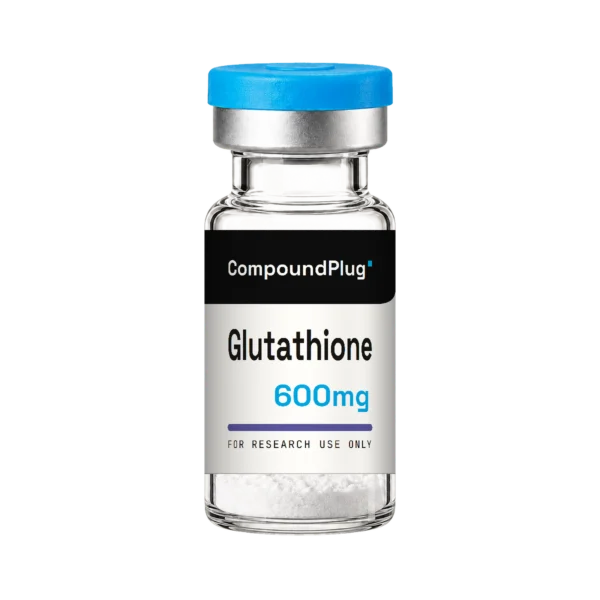
Glutathione Peptide
600mg
$49.00Select options This product has multiple variants. The options may be chosen on the product page -
Longevity Peptides
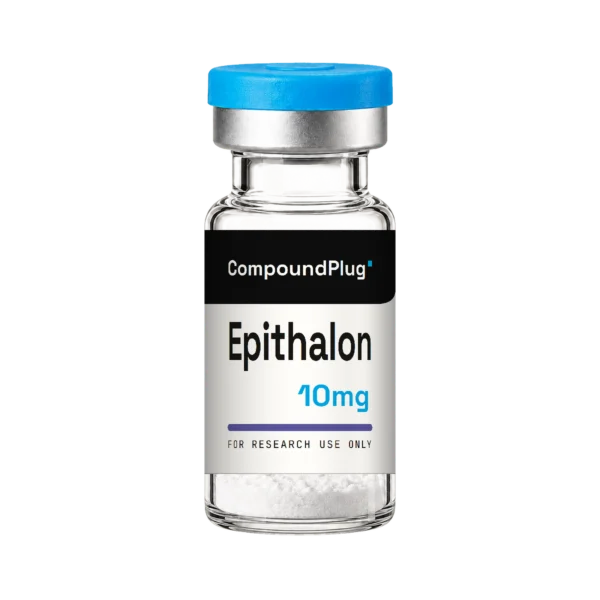
Epithalon Peptide
10mg
$40.00Select options This product has multiple variants. The options may be chosen on the product page -
Longevity Peptides
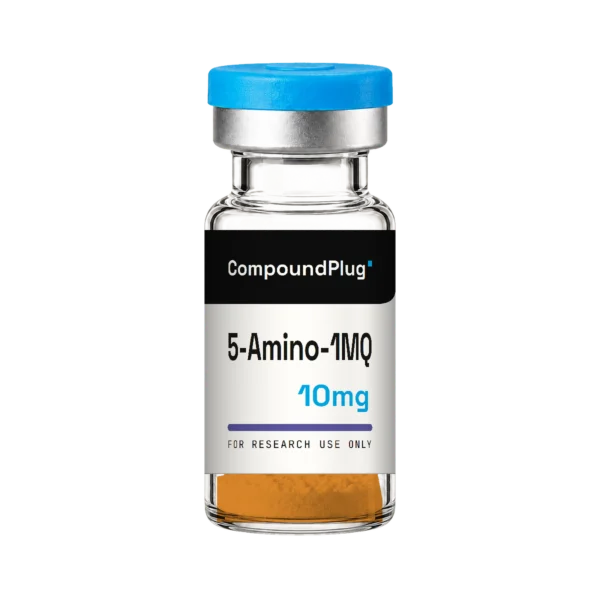
5-Amino-1MQ
10mg
$49.00Select options This product has multiple variants. The options may be chosen on the product page