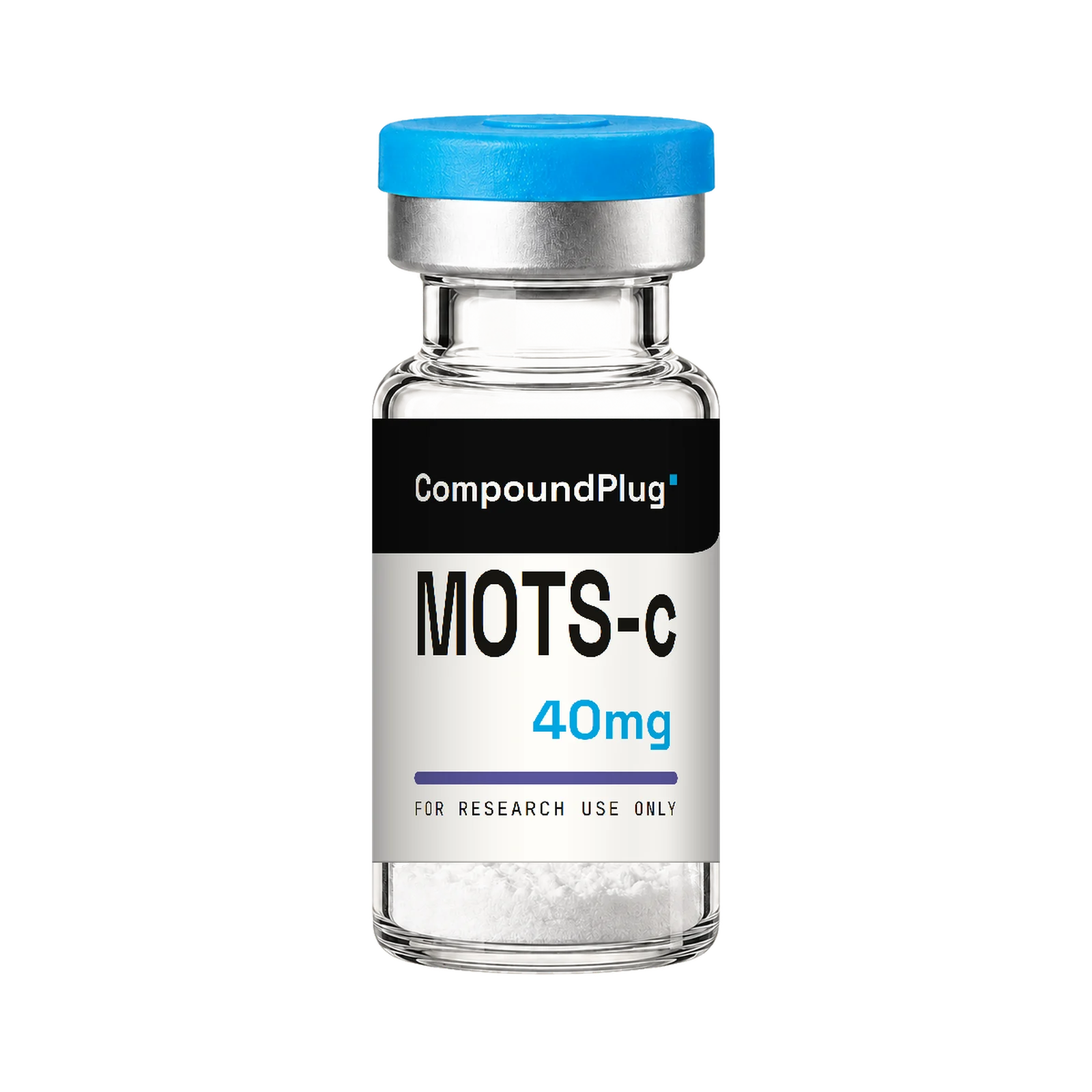
MOTS-c Canada
MOTS-c — a 16-amino-acid mitochondrial-derived peptide, encoded in the mitochondrial genome rather than nuclear DNA. 40mg lyophilized powder, ≥99% HPLC purity, mass-spec verified for identity.
$159.00
- CAS Number
- 1627580-64-6
- Molecular Formula
- C101H152N28O22S2
- Molecular Weight
- 2174.59
- Purity (HPLC)
- ≥99%
- Sequence
- Met-Arg-Trp-Gln-Glu-Met-Gly-Tyr-Ile-Phe-Tyr-Pro-Arg-Lys-Leu-Arg
- Form
- Lyophilized powder
Identity data from PubChem CID 146675088 (US National Library of Medicine).
- HPLC + Mass-Spec Tested
- COA Published Per Lot
- Ships From Canada
- Interac e-Transfer / Crypto
For laboratory research use only. Not for human consumption.
What Is MOTS-c?
MOTS-c is a 16-amino-acid peptide encoded in the mitochondrial genome.
That sentence is doing more work than it appears to. Almost every peptide in existence is encoded by nuclear DNA — the genome in the cell’s nucleus. MOTS-c is not. It is encoded inside the 12S rRNA gene of mitochondrial DNA, in a short 51-base-pair open reading frame that nobody knew was there.
It belongs to a small class of mitochondrial-derived peptides that also includes humanin. Their existence supports a genuinely different picture of what mitochondria are: not merely the cell’s power supply, but a signalling organelle that produces molecules addressed to the rest of the body.
The translation quirk
Here is a detail that says something real about how unusual this compound is.
MOTS-c is encoded in mitochondrial DNA — but it cannot be translated by the mitochondrial genetic code. Read with the mitochondrial code, the sequence produces tandem start and stop codons and yields nothing. It only produces a viable peptide when read with the cytoplasmic genetic code.
So the transcript is polyadenylated and exported out of the mitochondrion to be translated in the cytoplasm. A mitochondrial gene, translated outside the mitochondrion, producing a peptide that signals back to the nucleus.
Discovered in 2015 by Changhan Lee, in Pinchas Cohen’s laboratory at the USC Leonard Davis School of Gerontology (Lee et al., Cell Metabolism, 2015).
How MOTS-c Works: The Folate Cycle Route to AMPK
MOTS-c is usually described as an AMPK activator, and AMPK is the master regulator of cellular energy balance. That description is correct but it skips the interesting part: MOTS-c does not activate AMPK directly.
The mechanism, as described in the founding literature, runs through the folate cycle:
- MOTS-c inhibits the folate cycle at the level of 5-methyl-tetrahydrofolate.
- That inhibition causes accumulation of AICAR — 5-aminoimidazole-4-carboxamide ribonucleotide, an intermediate in de novo purine biosynthesis.
- AICAR is a well-characterised AMPK activator. It is, in fact, the classic pharmacological one.
- AMPK activation follows.
MOTS-c doesn’t press the AMPK button. It jams an upstream pathway, and the byproduct presses the button. An indirect mechanism, and an unusual one.
Research also reports that MOTS-c increases cellular NAD+ — which raises the possibility of SIRT1 involvement, and connects it to the same metabolic territory as NAD+ and 5-Amino-1MQ, by a completely different route.
It goes to the nucleus
Under metabolic stress, MOTS-c translocates to the cell nucleus and regulates nuclear gene expression directly (Kim et al., Cell Metabolism, 2018).
A peptide encoded in the mitochondrial genome, travelling to the nucleus to change which nuclear genes are expressed. That is mitochondrial-to-nuclear signalling, and it is the reason MOTS-c attracts attention beyond metabolism.
MOTS-c Benefits: What the Research Reports
Metabolic effects — the founding findings
The 2015 paper (Lee et al., Cell Metabolism) reported that MOTS-c administration in mice:
- Increased glucose uptake in skeletal muscle
- Improved insulin sensitivity
- Reduced diet-induced obesity in high-fat-diet models
- Promoted metabolic homeostasis broadly
Skeletal muscle appears to be the primary target tissue.
The exercise-mimetic hypothesis
MOTS-c is described in the literature as an exercise mimetic, and the reasoning is specific rather than loose: it activates AMPK and several other pathways that physical exercise engages. Animal studies report improved endurance, increased fat oxidation, and better glucose handling.
Two observations underpin the hypothesis:
- Circulating MOTS-c rises acutely with exercise in humans.
- Circulating MOTS-c declines with age.
Reynolds and colleagues characterised MOTS-c as an exercise-induced regulator of age-dependent physical decline and muscle homeostasis.
The honest framing: “exercise mimetic” does not mean it replicates exercise. It means it shares some of the molecular signalling that exercise engages. Those are different claims.
Evolutionary conservation
The MOTS-c sequence — particularly the first eleven residues — is highly conserved across 14 species, humans and mice among them. Conservation on that scale generally indicates a sequence doing something that matters.
MOTS-c Dosage in the Published Research
The MOTS-c literature is preclinical.
Animal models
Rodent studies have most commonly administered MOTS-c by intraperitoneal injection, with quantities reported in the milligram-per-kilogram range in metabolic and high-fat-diet models. Schedules run from single administration to daily administration across multi-week protocols.
In vitro
Cell culture work reports MOTS-c at micromolar concentrations — the gene-expression and AMPK studies used concentrations in the low micromolar range.
Humans
No human pharmacokinetic data has been published. Human research on MOTS-c is observational — measuring circulating levels in relation to exercise and age — rather than interventional. Nobody has run a proper human dosing study.
CompoundPlug provides no dosing recommendations.
MOTS-c Side Effects Reported in Studies
In the research record
Reported adverse findings are sparse — and that reflects the size and design of the research base rather than an established safety profile. The studies were built to characterise a mechanism, not to establish safety.
What is honestly not known
The biology of MOTS-c is genuinely interesting. The human evidence that it does anything useful is, as of now, essentially absent. There are no controlled human trials. The mechanism is well described in cells and mice; the translation to people is unestablished.
That is the honest state of the evidence, and it is worth saying plainly.
Regulatory
MOTS-c was on the FDA’s Category 2 restricted list for pharmacy compounding from 2023; that restriction was lifted in 2026 without addition to the permitted list.
Banned in competitive sport
MOTS-c is prohibited by the World Anti-Doping Agency, explicitly from 2024. Anyone subject to anti-doping testing should be aware of this. It is stated here because it is a fact that matters and it is frequently omitted.
MOTS-c Research Applications
- Mitochondrial biology — mitochondrial-derived peptides, retrograde mitochondrial-to-nuclear signalling
- AMPK pathway research — the folate cycle / AICAR / AMPK route, and indirect activation mechanisms
- Metabolic research — glucose uptake in skeletal muscle, insulin sensitivity, high-fat-diet models
- Exercise physiology — the exercise-mimetic hypothesis; acute exercise response
- Ageing biology — age-associated decline in circulating MOTS-c; muscle homeostasis
- Folate–methionine cycle — one-carbon metabolism
- NAD+ metabolism — reported increases in cellular NAD+; possible SIRT1 involvement
- Nuclear translocation — MOTS-c as a transcriptional regulator under metabolic stress
All applications preclinical, in-vitro / in-vivo only.
Is MOTS-c Legal in Canada?
MOTS-c is not an authorized health product in Canada. It has not been reviewed by Health Canada for safety, efficacy, or quality, carries no DIN or NPN, and is not approved for human use.
MOTS-c is not a controlled substance under the Controlled Drugs and Substances Act.
It is, however, prohibited by the World Anti-Doping Agency — explicitly from 2024. That is an anti-doping matter, distinct from a legal one, and it applies to anyone subject to sport testing.
CompoundPlug supplies MOTS-c strictly as a research chemical for in-vitro and in-vivo laboratory research. See Research Use Only.
MOTS-c Reconstitution & Storage
MOTS-c is water-soluble and reconstitutes with bacteriostatic water. Add the diluent slowly, down the inside wall of the vial — never directly onto the powder. Swirl gently. Never shake, never vortex.
Note the vial size. At 40 mg, this is one of the larger vials in the catalog. The diluent volume matters more here than on a 5 mg vial — a small diluent volume produces a very concentrated solution and a correspondingly small draw volume, which is harder to measure accurately.
Storage: lyophilized and sealed, stable up to 24 months. Reconstituted, store at 2–8 °C and use within 3–4 weeks. Protect from light. Do not freeze after reconstitution.
Peptide Calculator · How to Reconstitute Peptides · Bacteriostatic water
Quality & Verification
Every CompoundPlug compound is tested independently through third-party laboratories, and the analysis is published rather than asserted.
HPLC for purity — how much of this vial is MOTS-c, and what else is in there.
Mass spectrometry for identity — is the compound in the vial actually MOTS-c. A vial can be 99% pure and 99% the wrong molecule. Purity testing alone cannot catch that.
MOTS-c is a 16-residue peptide with a defined sequence — MRWQEMGYIFYPRKLR. Mass spectrometry confirms the molecular weight matches that sequence. It is the only test that does.
Vials are measured by peptide content — the stated mass is peptide, not gross powder weight.
Where a batch has been independently re-tested under the CompoundPlug name, a CompoundPlug Verified badge appears alongside the batch-specific Certificate of Analysis, tied to the lot printed on the vial.
Buy MOTS-c in Canada
Research-grade MOTS-c — 40mg lyophilized powder, 16-amino-acid mitochondrial-derived peptide, ≥99% HPLC purity, mass-spec verified for identity, with a published reference Certificate of Analysis tied to the lot.
- Full sequence published — MRWQEMGYIFYPRKLR, on the specification panel
- Ships from within Canada — Canada Post Xpresspost, tracked
- CAD pricing
- Interac e-Transfer or cryptocurrency
- Discreet, unbranded packaging
Related: MOTS-c sits alongside NAD+ and 5-Amino-1MQ in mitochondrial and metabolic research — three compounds approaching the same territory by entirely different routes. Browse Longevity Peptides, or pick up bacteriostatic water.
Frequently Asked Questions
What is MOTS-c?
A 16-amino-acid peptide encoded in the mitochondrial genome rather than in nuclear DNA — inside the 12S rRNA gene. It belongs to a small class of mitochondrial-derived peptides, and its existence supports the idea that mitochondria are a signalling organelle, not just a power supply. Discovered in 2015 at USC.
How does MOTS-c work?
Indirectly, and interestingly. MOTS-c inhibits the folate cycle, which causes AICAR to accumulate — and AICAR is a well-characterised AMPK activator. So MOTS-c doesn’t press the AMPK button directly; it jams an upstream pathway and the byproduct presses it. It has also been reported to translocate to the cell nucleus under metabolic stress and regulate nuclear gene expression.
What are the reported benefits of MOTS-c?
The founding paper reported increased glucose uptake in skeletal muscle, improved insulin sensitivity, and reduced diet-induced obesity in mice. It is described as an exercise mimetic because it activates pathways that exercise engages — circulating MOTS-c rises acutely with exercise and declines with age. All findings are preclinical.
What is the MOTS-c dosage in research?
Rodent studies report intraperitoneal administration in the milligram-per-kilogram range. In-vitro work uses micromolar concentrations. No human pharmacokinetic data has been published — human research on MOTS-c is observational, not interventional. CompoundPlug provides no dosing recommendations.
Is MOTS-c banned in sport?
Yes. MOTS-c is prohibited by the World Anti-Doping Agency, explicitly from 2024. Anyone subject to anti-doping testing should be aware of this.
Is there human evidence for MOTS-c?
The biology is well characterised in cells and mice. The human evidence is thin — there are no controlled human trials, and human work to date is observational, measuring circulating levels against exercise and age. The mechanism is interesting; the human translation is unestablished.
Is MOTS-c legal in Canada?
MOTS-c is not an authorized health product in Canada — no DIN, no NPN, not approved for human use. It is also not a controlled substance. It is prohibited by WADA in competitive sport, which is a separate matter from its legal status.
How is MOTS-c reconstituted?
With bacteriostatic water, added slowly down the vial wall and swirled — never shaken or vortexed. Water-soluble. At 40 mg this is a larger vial than most, so the diluent volume matters more — too little produces a very concentrated solution and a small, hard-to-measure draw. Use the MOTS-c calculator.
How long does MOTS-c last?
Lyophilized and sealed: up to 24 months. Reconstituted: 3–4 weeks at 2–8 °C, protected from light. Do not freeze after reconstitution.
Further reading
Related products
-
Longevity Peptides
Epithalon Peptide
10mg
$40.00Select options This product has multiple variants. The options may be chosen on the product page -
Longevity Peptides
5-Amino-1MQ
10mg
$49.00Select options This product has multiple variants. The options may be chosen on the product page -
Longevity Peptides
Glutathione Peptide
600mg
$49.00Select options This product has multiple variants. The options may be chosen on the product page