Tirzepatide Canada
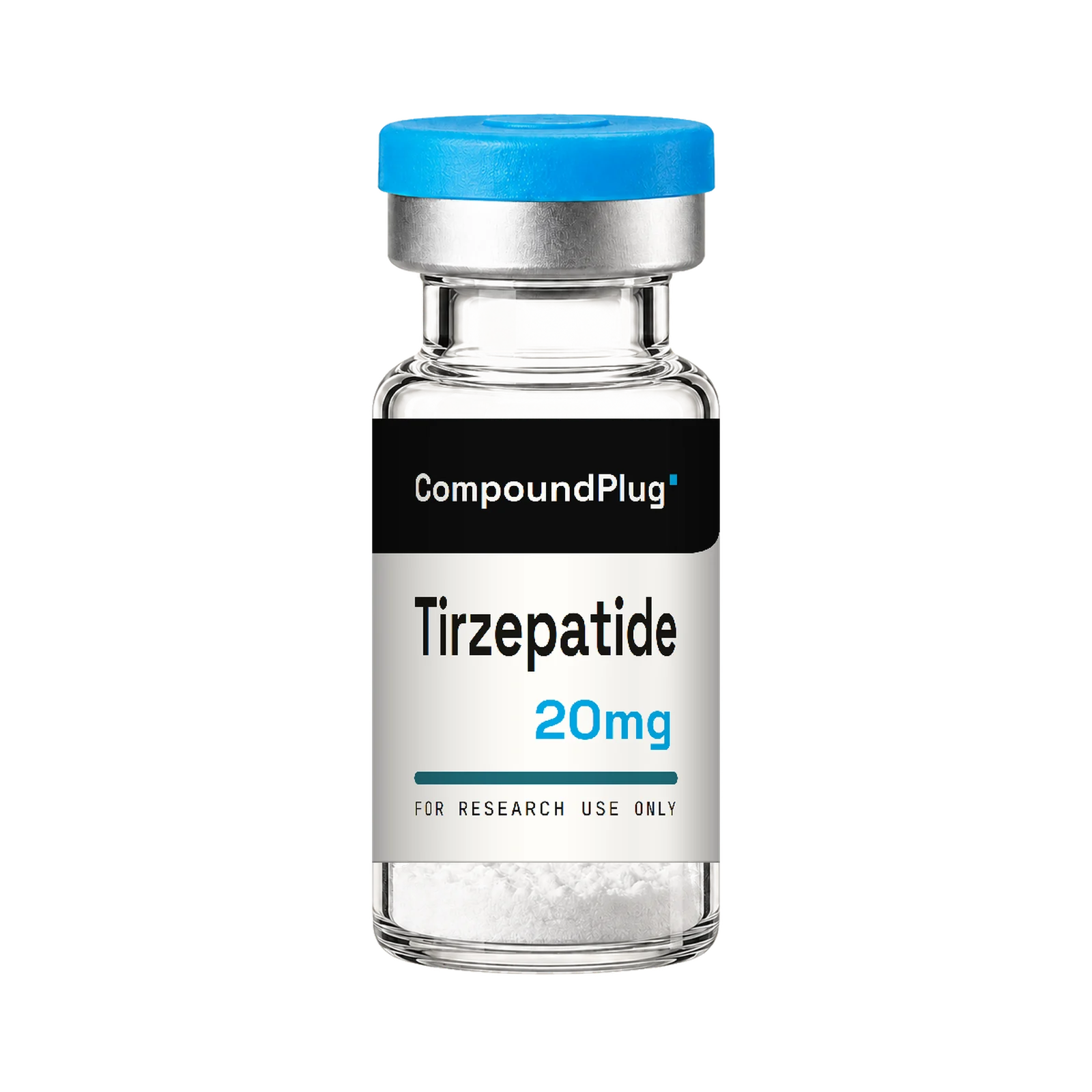
Dual GIP/GLP-1 receptor agonist — lyophilized powder in 10mg, 20mg and 30mg vials. ≥99% HPLC purity, mass-spec verified for identity. Published Certificate of Analysis tied to the lot on the vial.
Price range: $59.00 through $149.00
| Size | Price | Per mg | Availability |
|---|---|---|---|
| 10mg | $59.00 | $5.90 | In stock |
| 20mg | $99.00 | $4.95 | In stock |
| 30mg | $149.00 | $4.97 | In stock |
- CAS Number
- 2023788-19-2
- Molecular Formula
- C225H348N48O68
- Molecular Weight
- 4813.45
- Purity (HPLC)
- ≥99%
- Form
- Lyophilized powder
Identity data from PubChem CID 166567236 (US National Library of Medicine).
- HPLC + Mass-Spec Tested
- COA Published Per Lot
- Ships From Canada
- Interac e-Transfer / Crypto
For laboratory research use only. Not for human consumption.
What Is the Tirzepatide Peptide?
The tirzepatide peptide is a dual agonist — a 39-amino-acid synthetic peptide that activates two receptors: GIP (glucose-dependent insulinotropic polypeptide) and GLP-1.
That second receptor is the entire point. Semaglutide acts on GLP-1 alone. Tirzepatide adds GIP, and the difference in reported outcomes is substantial enough that it has changed how the field thinks about incretin biology.
The GIP arm is still genuinely debated. Three hypotheses appear in the literature, and none is settled:
- Central pathways — GIP receptors are expressed in brain regions governing food intake, and their distribution does not fully overlap with GLP-1 receptor distribution. The non-overlap may explain the additive effect.
- Adipose signaling — GIP receptors are present on adipocytes, and GIP agonism may act directly on fat tissue.
- Tolerability — GIP agonism may blunt the nausea associated with GLP-1 agonism, permitting effective exposure at doses that would otherwise be intolerable. On this reading the benefit is indirect: not a better mechanism, but a higher usable dose.
Receptor affinity is not symmetric. Tirzepatide binds the GIP receptor with substantially higher potency than the GLP-1 receptor — it is often described as an “imbalanced” dual agonist. That asymmetry is itself an active area of research, and it means “dual agonist” understates how differently the two arms are engaged.
Like semaglutide, tirzepatide carries a fatty-acid modification enabling reversible albumin binding — extending its half-life to roughly five days and permitting weekly administration.
Is Tirzepatide Legal in Canada? Approved Products and Regulatory Status
Tirzepatide is an approved prescription drug in Canada, authorized under two brand names, each carrying a Drug Identification Number:
- Mounjaro — type 2 diabetes
- Zepbound — chronic weight management
Unlike semaglutide, there is no approved generic tirzepatide in Canada — the patent position differs.
Anyone seeking tirzepatide as a medication should obtain an authorized, DIN-bearing product on prescription from a licensed pharmacy. That is the correct route, and it is not the route CompoundPlug serves.
Research-grade tirzepatide is not an authorized product. It carries no DIN and is not pharmaceutically equivalent to Mounjaro or Zepbound. Tirzepatide is not a controlled substance. CompoundPlug supplies it strictly as a research chemical for in-vitro and in-vivo laboratory research. See Research Use Only.
Tirzepatide Benefits: What the Research Reports
Weight management — SURMOUNT-1
The SURMOUNT-1 trial (Jastreboff et al., New England Journal of Medicine, 2022) randomised 2,539 adults with obesity, without diabetes, to weekly subcutaneous tirzepatide at 5 mg, 10 mg, or 15 mg, or placebo, over 72 weeks.
Mean body-weight reduction was 16.0% at 5 mg and 20.9% at 15 mg, versus 3.1% on placebo. The effect was dose-dependent across the full range studied.
Two secondary findings are worth stating because they are unusual:
- 96% of participants at the 10 mg and 15 mg doses achieved at least 5% weight reduction, versus 28% on placebo.
- 39.7% at 15 mg achieved at least 25% weight reduction — versus 0.3% on placebo. A quarter of body weight is a magnitude previously associated with bariatric surgery rather than pharmacology.
Body composition was also reported: fat mass fell by 33.9% against a 10.9% reduction in lean mass — roughly a three-to-one ratio.
Type 2 diabetes — SURPASS and SURMOUNT-2
The SURPASS programme established tirzepatide’s glycemic effects and is the basis of the Mounjaro indication. Across those trials, tirzepatide showed superior HbA1c reduction to comparators including semaglutide 1 mg, insulin degludec, and insulin glargine.
SURMOUNT-2, in participants who also had type 2 diabetes, reported weight reductions of 12.8% (10 mg) and 14.7% (15 mg) versus 3.2% on placebo — smaller than in the non-diabetic population, a pattern seen consistently across this drug class.
Head-to-head — SURMOUNT-5
This is what distinguishes tirzepatide from almost everything else in this catalog: it has been compared directly against semaglutide in a clinical trial.
SURMOUNT-5 randomised 751 adults with obesity, without diabetes, to maximum tolerated doses of tirzepatide or semaglutide over 72 weeks. Tirzepatide produced greater weight reduction. Direct comparative evidence is rare in this field — almost every other “X versus Y” claim in the peptide market rests on cross-trial inference, which is not evidence at all.
Tirzepatide Dosage in the Published Research
Tirzepatide’s dosing literature is human clinical trial data — thousands of participants across the SURPASS and SURMOUNT programmes.
The doses studied
Both programmes evaluated weekly subcutaneous doses of 5 mg, 10 mg, and 15 mg. SURMOUNT-1 and SURMOUNT-2 used fixed maintenance doses; SURMOUNT-3 and SURMOUNT-4 used the maximum tolerated dose, defined as 10 or 15 mg.
Trial protocols reached those maintenance doses through gradual escalation over several months, not by starting at target. That design exists for one reason: gastrointestinal tolerability is the dose-limiting factor for this entire drug class, and it is dose-related.
What these figures are
These are trial parameters — the doses evaluated in controlled studies with defined populations, monitoring, and endpoints.
Where tirzepatide is prescribed as an authorized product, the dose is set by a physician, individualized, and documented in the product monograph. It is not determined by a supplier or a website.
CompoundPlug provides no dosing recommendations. The Peptide Calculator converts vial mass and diluent volume into a concentration and draw volume — the mass is an input supplied by the researcher.
Tirzepatide Side Effects Reported in Studies
Gastrointestinal — the dominant finding
Nausea, vomiting, and diarrhea are the most frequently reported adverse events across the trial programme, and they are dose-related. This is why every protocol escalated gradually rather than starting at the maintenance dose. Most events were reported as transient and mild to moderate.
Documented risks
Health Canada documents the known risks associated with authorized GLP-1 products: severe gastrointestinal problems, pancreatitis, worsening kidney injury, and hypoglycemia — the last particularly in combination with other medications.
The distinction that matters
Every effect above was observed with authorized, GMP-manufactured pharmaceutical tirzepatide: a known quantity of a known molecule. A vial containing an unknown amount of an unknown compound has no safety profile at all.
Tirzepatide Half-Life & Pharmacokinetics
- Half-life: approximately five days. Comparable to semaglutide‘s seven days, and achieved the same way — a fatty-acid modification that binds albumin reversibly, shielding the peptide from enzymatic degradation and renal clearance.
- Weekly administration follows from that half-life.
- Steady state is reached after several weeks, which is why trial escalation schedules run over months rather than weeks.
- No oral formulation exists. Unlike semaglutide, which has an oral form (Rybelsus), tirzepatide is injectable only.
Tirzepatide Research Applications
- Dual receptor pharmacology — GIP/GLP-1 co-agonism, relative receptor affinity, imbalanced agonism
- GIP mechanism research — the open question in the field: central, adipose, or tolerability-mediated
- Metabolic research — glucose-dependent insulin secretion, islet models
- Comparative incretin pharmacology — dual agonism against mono (semaglutide) and triple (retatrutide)
- Body composition — fat-mass versus lean-mass differential effects
- CNS appetite research — GIP and GLP-1 receptor distribution in appetite circuits
All applications preclinical, in-vitro / in-vivo only.
Tirzepatide Reconstitution & Storage
Supplied as a lyophilized powder in 10mg, 20mg, and 30mg vials. Reconstitute with bacteriostatic water, added slowly down the inside wall of the vial — never directly onto the powder. Swirl gently. Never shake, never vortex.
Storage: lyophilized and sealed, stable up to 24 months. Reconstituted, store at 2–8 °C and use within 28 days. Protect from light. Do not freeze after reconstitution.
Peptide Calculator · How to Reconstitute Peptides · Bacteriostatic water
Quality & Verification
Every CompoundPlug compound is tested independently through third-party laboratories, and the analysis is published rather than asserted.
GLP-1 compounds are the most counterfeited category in the research-peptide market. Health Canada’s January 2026 advisory named the failure modes: too much active ingredient, too little, or none at all — plus unlisted ingredients and contaminants.
HPLC for purity answers one question: how much of this vial is tirzepatide, and what else is in there.
Mass spectrometry for identity answers the other: is the compound in the vial actually tirzepatide. A vial can be 99% pure and 99% the wrong molecule. Purity testing alone cannot catch that.
Most vendors in this market publish one number. In the most counterfeited compound category that exists, one number is not enough.
Vials are measured by peptide content — the stated mass is peptide, not gross powder weight.
Where a batch has been independently re-tested under the CompoundPlug name, a CompoundPlug Verified badge appears alongside the batch-specific Certificate of Analysis, tied to the lot printed on the vial.
Buy Tirzepatide Canada-Wide
Research-grade tirzepatide — lyophilized powder in 10mg, 20mg, and 30mg vials, ≥99% HPLC purity, mass-spec verified for identity, with a published reference Certificate of Analysis tied to the lot.
- Tirzepatide Canada-wide — ships from within Canada by Canada Post Xpresspost, tracked
- Tirzepatide peptide Canada stock — every lot carries a published batch analysis
- CAD pricing
- Interac e-Transfer or cryptocurrency
- Discreet, unbranded packaging
Related: Semaglutide vs Tirzepatide — the head-to-head trial. Retatrutide vs Tirzepatide — dual versus triple agonist. Also in the catalog: semaglutide, retatrutide, cagrilintide. Browse GLP-1 Peptides, or pick up bacteriostatic water.
Frequently Asked Questions
What is the tirzepatide peptide?
A dual agonist — a 39-amino-acid synthetic peptide activating both the GIP and GLP-1 receptors. Semaglutide activates GLP-1 alone. The added GIP arm is what distinguishes it, and its mechanism is still debated.
What is the tirzepatide dosage in clinical trials?
The SURPASS and SURMOUNT programmes evaluated weekly subcutaneous doses of 5 mg, 10 mg, and 15 mg, reached through gradual escalation over several months to manage gastrointestinal tolerability. Where tirzepatide is prescribed, dosing is set by a physician. CompoundPlug provides no dosing recommendations.
What are the reported benefits of tirzepatide?
SURMOUNT-1 reported mean weight reduction of 16.0% (5 mg) to 20.9% (15 mg) at 72 weeks, versus 3.1% on placebo, in 2,539 participants. 39.7% at the highest dose achieved at least 25% weight reduction. SURPASS established HbA1c reductions in type 2 diabetes.
What are the side effects of tirzepatide?
Gastrointestinal effects — nausea, vomiting, diarrhea — are the most common and are dose-related, which is why trial protocols escalate gradually. Health Canada documents severe gastrointestinal problems, pancreatitis, worsening kidney injury, and hypoglycemia among the known risks of authorized GLP-1 products.
What is the half-life of tirzepatide?
Approximately five days, achieved through a fatty-acid modification that binds albumin reversibly and shields the peptide from degradation and clearance.
Is tirzepatide approved and available in Canada?
Yes — as a prescription drug. Mounjaro (type 2 diabetes) and Zepbound (chronic weight management) carry Drug Identification Numbers and are available on prescription. There is no approved generic. Research-grade tirzepatide is not an authorized product and is not a substitute for one. It is also not a controlled substance.
Tirzepatide vs semaglutide — which produced more weight loss?
Tirzepatide, in SURMOUNT-5 — a head-to-head trial of 751 participants over 72 weeks. Direct comparative evidence is rare in this field; most “X vs Y” claims rest on cross-trial inference. Full comparison.
What vial sizes are available?
10mg, 20mg, and 30mg of lyophilized tirzepatide per vial, and nothing else — no fillers, no carriers. Bacteriostatic water is not included and is available separately.
How is tirzepatide reconstituted?
With bacteriostatic water, added slowly down the vial wall and swirled — never shaken or vortexed. Store reconstituted at 2–8 °C and use within 28 days. Use the Tirzepatide calculator for concentration and draw volume.
How long does tirzepatide last?
Lyophilized and sealed: up to 24 months. Reconstituted: 28 days at 2–8 °C, protected from light. Do not freeze after reconstitution.
Further reading
- ComparisonRetatrutide vs Tirzepatide
- ComparisonSemaglutide vs Tirzepatide
- ArticlePeptides for Weight Loss: What the Research Shows on GLP-1 Receptor Agonists
- ArticleFDA Approved Peptides: Which Are Real Medicines and Which Aren’t
- ArticleAre Peptides Legal in Canada? The Regulatory Status Explained
- All comparisonsCompare Compounds
Related products
-
GLP-1 Peptides
Retatrutide Peptide (RETA)
10mg · 20mg · 30mg
Price range: $99.00 through $229.00Select options This product has multiple variants. The options may be chosen on the product page -
GLP-1 Peptides
Semaglutide Peptide (SEMA)
10mg
$74.00Select options This product has multiple variants. The options may be chosen on the product page -
GLP-1 Peptides
Cagrilintide Peptide (CAGRI)
5mg
$54.00Select options This product has multiple variants. The options may be chosen on the product page