Cagrilintide Peptide (CAGRI)
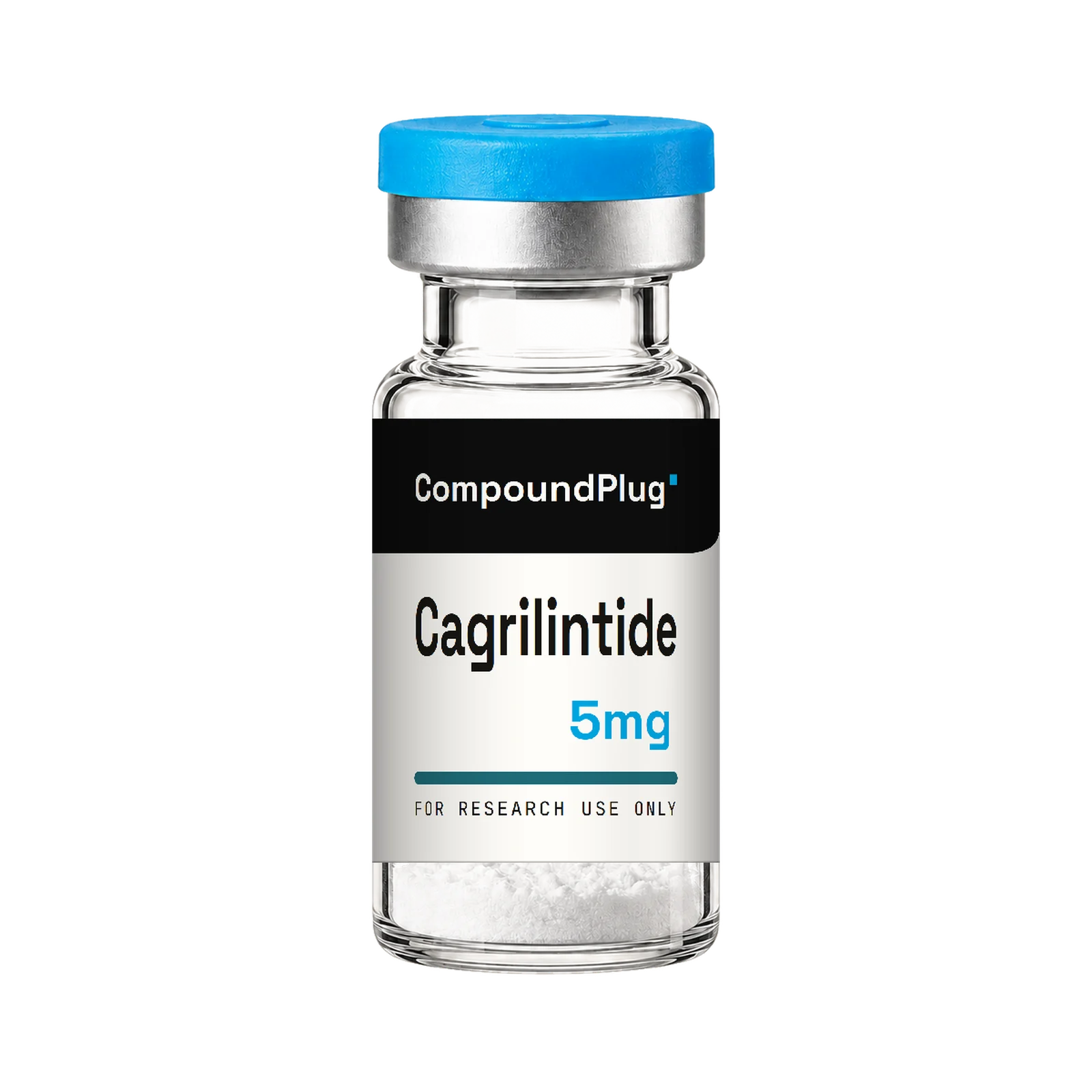
Cagrilintide — long-acting amylin analog. Not a GLP-1: a separate hormone system entirely. 5mg lyophilized powder, ≥99% HPLC purity, mass-spec verified for identity.
$54.00
- Molecular Formula
- C194H312N54O59S2
- Molecular Weight
- 4409.01
- Purity (HPLC)
- ≥99%
- Form
- Lyophilized powder
- HPLC + Mass-Spec Tested
- COA Published Per Lot
- Ships From Canada
- Interac e-Transfer / Crypto
For laboratory research use only. Not for human consumption.
What Is Cagrilintide?
Cagrilintide is not a GLP-1, and that is the entire point of it.
It is a long-acting amylin analog — and amylin is a completely different hormone, acting through a completely different receptor system, from a completely different organ.
What amylin actually is
Amylin — also called IAPP, islet amyloid polypeptide — is a 37-amino-acid hormone co-secreted with insulin from pancreatic beta cells. Every time the pancreas releases insulin, it releases amylin alongside it, in roughly fixed proportion.
Its known functions: satiety signalling, delayed gastric emptying, and glucagon suppression.
Compare that to GLP-1, which is an incretin — a hormone released by the gut in response to food. Different organ. Different trigger. Different receptors.
Semaglutide acts on the GLP-1 receptor. Tirzepatide adds GIP. Retatrutide adds glucagon. All three are incretin-pathway compounds.
Cagrilintide is not in that pathway at all. It is the only compound in this catalog that isn’t.
The Amyloid Problem — and Why Cagrilintide Had to Be Engineered
This is the most interesting thing about amylin, and almost nobody tells it.
Amylin’s other name is islet amyloid polypeptide, and the “amyloid” is not decorative.
Human amylin aggregates. It misfolds and forms amyloid fibrils — the same broad class of protein aggregation implicated in neurodegenerative disease. Islet amyloid deposits are found in the pancreas of the large majority of people with type 2 diabetes, and those deposits are toxic to the beta cells that produce the hormone in the first place.
So you cannot simply give someone human amylin as a drug. It would aggregate.
That is the engineering problem every amylin analog exists to solve. The first one — pramlintide — was built by substituting proline residues at the positions responsible for aggregation, borrowing from rodent amylin, which does not aggregate. But pramlintide is short-acting.
Cagrilintide is the long-acting solution: an amylin analog engineered to resist aggregation and carry a fatty-acid modification for albumin binding, enabling weekly administration.
It is a hormone that naturally forms toxic aggregates, redesigned into a stable weekly drug. That is a genuinely difficult piece of protein engineering, and it is why there are so few amylin analogs.
How Cagrilintide Works: A DACRA
Cagrilintide is described as a DACRA — a dual amylin and calcitonin receptor agonist.
The amylin receptor is not a standalone protein. It is a complex: the calcitonin receptor, paired with a RAMP (receptor activity-modifying protein). Different RAMPs produce different amylin receptor subtypes (AMY1, AMY2, AMY3).
Because the calcitonin receptor is the core of that complex, an amylin agonist inevitably engages calcitonin signalling too — and cagrilintide agonises both.
The result is a satiety signal that runs entirely independently of the incretin system.
CagriSema: Why the Combination Exists
This is the reason cagrilintide is in a research catalog at all.
CagriSema is cagrilintide combined with semaglutide — 2.4 mg of each, weekly.
The rationale is mechanistic rather than additive. Amylin and GLP-1 are two independent satiety pathways. They do not compete for the same receptor, and they do not overlap. The hypothesis is that engaging both produces a larger effect than saturating either one alone.
The trial data
- Cagrilintide alone (Phase 2, Lau et al., Lancet, 2021) — approximately 10.8% weight reduction at 26 weeks, at the 4.5 mg dose.
- CagriSema (REDEFINE-1, Garvey et al., NEJM, 2025) — 3,417 participants, 68 weeks, approximately 22.7% weight reduction.
- REDEFINE-2 (participants with type 2 diabetes) — 1,206 participants, 13.7% versus 3.4% on placebo.
The combination substantially outperformed either component alone — which is the finding the whole hypothesis rests on. An NDA was filed with the FDA in December 2025.
Cagrilintide Benefits: What the Research Reports
Weight reduction
Monotherapy: ~10.8% at 26 weeks (4.5 mg). In combination with semaglutide: ~22.7% at 68 weeks.
A milder gastrointestinal profile
This is the finding that distinguishes cagrilintide, and it is counterintuitive.
Gastrointestinal adverse events are the dose-limiting factor for the entire incretin class. In cagrilintide’s Phase 2 trial, 41–63% of participants reported GI events across the dose range, against 32% on placebo — substantial, but:
Meta-analyses report that cagrilintide had the lowest odds ratios for nausea, vomiting, and diarrhea among incretin-based therapies — including semaglutide and tirzepatide.
Milder GI effects than the GLP-1s. If that holds, it has a real consequence: the GLP-1 class is limited by how much a person can tolerate, so a compound with a gentler profile can potentially be pushed further — or added on top of one that can’t be.
Glucagon suppression and gastric emptying
Amylin’s established physiological functions, reproduced by the analog.
Cagrilintide is investigational. It has not completed clinical development and is not approved in any jurisdiction.
Cagrilintide Dosage in the Published Research
Monotherapy
The Phase 2 trial evaluated weekly subcutaneous doses from 0.3 mg to 4.5 mg, with a dose-dependent relationship across that range.
In combination
CagriSema trials evaluated cagrilintide at 2.4 mg paired with semaglutide at 2.4 mg, weekly.
What these figures are
These are the parameters of trials in progress. Cagrilintide has not completed clinical development and is not approved anywhere. There is no product monograph and no prescriber guidance in existence.
CompoundPlug provides no dosing recommendations.
Cagrilintide Side Effects Reported in Studies
Gastrointestinal
Nausea (reported in 20–47% of participants depending on dose), constipation, diarrhea, and abdominal discomfort. Dose-related.
But comparatively mild for the category — meta-analyses report the lowest GI odds ratios among incretin-based therapies.
What is not established
Cagrilintide has not completed clinical development, and its full safety profile is not established. Long-term human safety data does not exist. Rare adverse events, if any, may not yet have been detected.
Cagrilintide Research Applications
- Amylin receptor pharmacology — AMY1/AMY2/AMY3; the calcitonin receptor + RAMP complex
- DACRA research — dual amylin and calcitonin receptor agonism
- Combination pharmacology — CagriSema; amylin + GLP-1 as independent satiety pathways
- Satiety signalling — amylin-mediated pathways, distinct from incretin signalling
- Comparative mechanism — amylin against incretin agonism (semaglutide, tirzepatide, retatrutide)
- Protein aggregation — amyloidogenicity of human amylin; anti-aggregation engineering
- Gastric emptying and glucagon suppression
All applications preclinical, in-vitro / in-vivo only.
Is Cagrilintide Legal in Canada?
Cagrilintide is not approved in Canada, the United States, or any other jurisdiction. It is investigational and in clinical development. An NDA for CagriSema was filed with the FDA in December 2025; no approval has been granted.
It is not a controlled substance under the CDSA.
CompoundPlug supplies cagrilintide strictly as a research chemical for in-vitro and in-vivo laboratory research. See Research Use Only.
Cagrilintide Reconstitution & Storage
Water-soluble. Bacteriostatic water, added slowly down the vial wall. Swirl gently, never vortex.
⚠️ A note specific to amylin analogs. The parent hormone is amyloidogenic — human amylin aggregates readily. Cagrilintide is engineered to resist aggregation, but mechanical agitation is exactly the kind of stress that promotes protein misfolding.
The general rule against shaking and vortexing applies to every peptide in this catalog. On an amylin analog it is worth taking especially seriously, because aggregation is the specific failure mode the molecule was designed to avoid.
Storage: lyophilized and sealed, up to 24 months. Reconstituted, 2–8 °C, use within 28 days. Protect from light. Do not freeze.
Cagrilintide calculator · Reconstitution guide · Bacteriostatic water
Quality & Verification
Independent HPLC and mass-spec testing, published rather than asserted.
For an amylin analog, purity carries a meaning it does not carry elsewhere.
The parent hormone aggregates into amyloid fibrils. Aggregation is the specific thing this class of molecule is engineered to prevent — and aggregated peptide is not simply a less active version of the same compound. It is a different physical species, with different behaviour, and it is the precise failure mode the drug design exists to avoid.
HPLC quantifies how much of the vial is monomeric, intact cagrilintide. That is not a formality on this compound. It is the measurement that matters most.
Mass spectrometry confirms identity — that the compound is cagrilintide, and not a related amylin analog or a degradation product.
And there is a broader point: cagrilintide is not approved anywhere. There is no authorized reference product to compare a vial against. Every vial of cagrilintide in existence is unapproved material, and the analysis is the only thing distinguishing one from another.
Vials measured by peptide content. Published analysis in the COA Library, tied to the lot.
Buy Cagrilintide in Canada
Research-grade cagrilintide — 5mg lyophilized powder, ≥99% HPLC purity, mass-spec verified for identity, with a published reference Certificate of Analysis tied to the lot.
- The only amylin analog in the catalog — a different receptor system from every GLP-1
- Ships from within Canada — Canada Post Xpresspost, tracked
- CAD pricing · Interac e-Transfer or crypto · discreet packaging
Related: Cagrilintide is studied in combination with semaglutide (as CagriSema) because amylin and GLP-1 are independent satiety pathways. Compare the incretin compounds: semaglutide vs tirzepatide · retatrutide vs tirzepatide. Browse GLP-1 Peptides.
Frequently Asked Questions
What is cagrilintide?
A long-acting amylin analog. Amylin is a 37-amino-acid hormone co-secreted with insulin from pancreatic beta cells — a completely different hormone, receptor system, and organ from GLP-1. Cagrilintide is the only compound in this catalog that is not an incretin-pathway molecule.
Is cagrilintide a GLP-1?
No. GLP-1 is an incretin — a gut hormone released in response to food. Amylin is a pancreatic hormone co-secreted with insulin. Different organ, different trigger, different receptors. That independence is exactly why the two are combined: they are separate satiety pathways that do not overlap.
What is CagriSema?
Cagrilintide combined with semaglutide — 2.4 mg of each, weekly. The REDEFINE-1 trial (3,417 participants, 68 weeks) reported approximately 22.7% weight reduction. Cagrilintide alone reported ~10.8% at 26 weeks. The combination substantially outperformed either component — the finding the whole hypothesis rests on. An NDA was filed with the FDA in December 2025.
Why does amylin need to be engineered?
Because human amylin aggregates. Its other name is islet amyloid polypeptide, and the amyloid isn’t decorative — it misfolds into fibrils, and islet amyloid deposits are found in the pancreas of most people with type 2 diabetes, where they’re toxic to beta cells. You can’t simply administer human amylin. Every amylin analog exists to solve that problem.
Does cagrilintide have milder side effects than GLP-1s?
The published meta-analyses suggest so. Cagrilintide had the lowest odds ratios for nausea, vomiting, and diarrhea among incretin-based therapies — including semaglutide and tirzepatide. Gastrointestinal effects are still the most common adverse events, and they’re dose-related, but the profile appears comparatively mild for the category.
What is the cagrilintide dosage in trials?
The Phase 2 monotherapy trial evaluated weekly subcutaneous doses from 0.3 mg to 4.5 mg. CagriSema trials used 2.4 mg cagrilintide paired with 2.4 mg semaglutide. The compound has not completed clinical development. CompoundPlug provides no dosing recommendations.
Is cagrilintide approved in Canada?
No. Cagrilintide is not approved in Canada, the United States, or any other jurisdiction. It is investigational. An NDA for CagriSema was filed with the FDA in December 2025; no approval has been granted. It is not a controlled substance.
How is cagrilintide reconstituted?
Water-soluble. Bacteriostatic water, added slowly down the vial wall, swirled — never shaken or vortexed. This matters more here than usual: amylin’s parent hormone is amyloidogenic, and mechanical agitation is precisely the kind of stress that promotes protein misfolding. Aggregation is the failure mode this molecule was designed to avoid.
Further reading
- ComparisonRetatrutide vs Tirzepatide
- ComparisonSemaglutide vs Tirzepatide
- ArticlePeptides for Weight Loss: What the Research Shows on GLP-1 Receptor Agonists
- ArticleFDA Approved Peptides: Which Are Real Medicines and Which Aren’t
- ArticleAre Peptides Legal in Canada? The Regulatory Status Explained
- All comparisonsCompare Compounds
Related products
-
GLP-1 Peptides
Retatrutide Peptide (RETA)
10mg · 20mg · 30mg
Price range: $99.00 through $229.00Select options This product has multiple variants. The options may be chosen on the product page -
GLP-1 Peptides
Semaglutide Peptide (SEMA)
10mg
$74.00Select options This product has multiple variants. The options may be chosen on the product page -
GLP-1 Peptides
Tirzepatide Peptide (TIRZ)
10mg · 20mg · 30mg
Price range: $59.00 through $149.00Select options This product has multiple variants. The options may be chosen on the product page