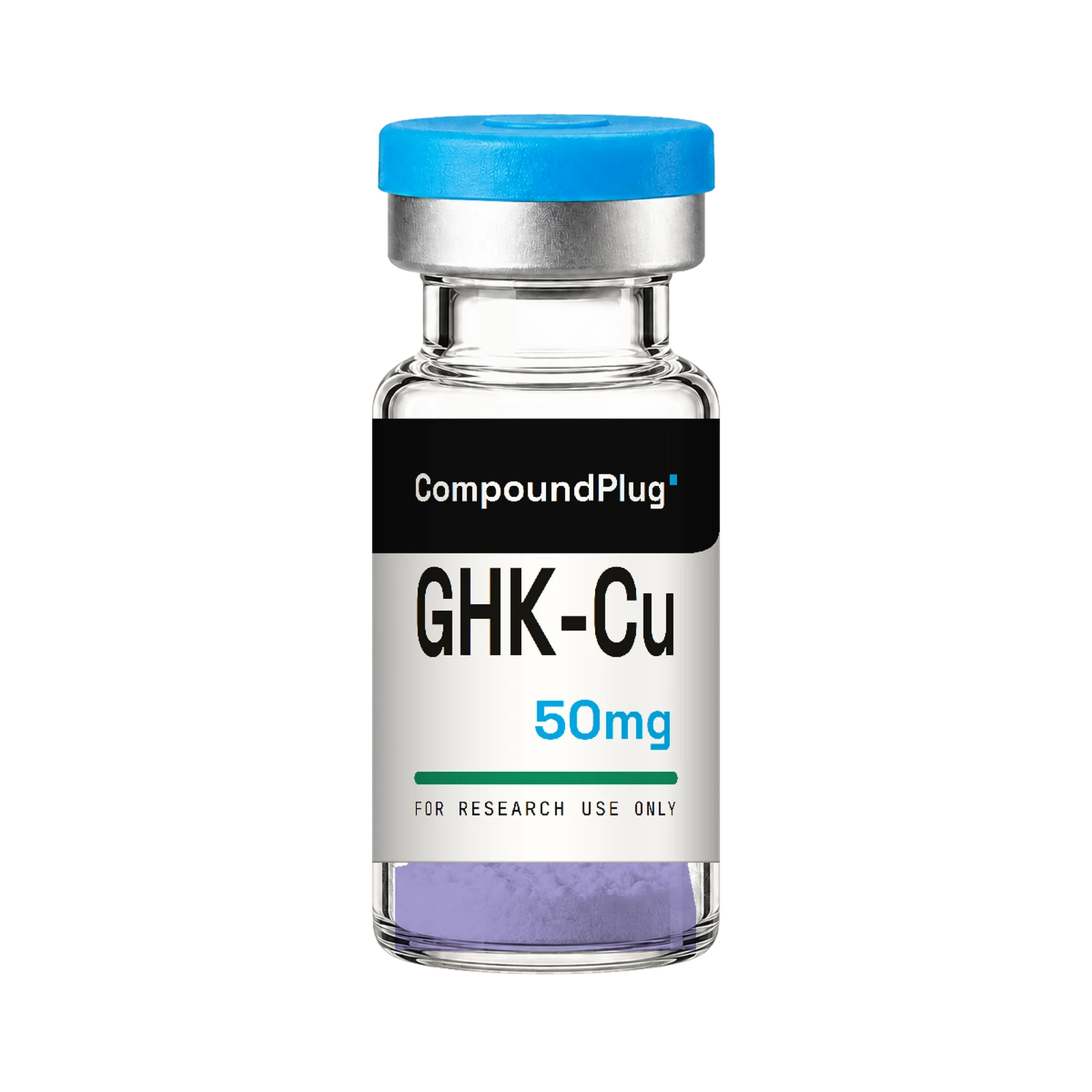
GHK-Cu Canada
GHK-Cu peptide — copper tripeptide, 50mg lyophilized powder, MW 403.93. ≥99% HPLC purity, mass-spec verified for identity. Published Certificate of Analysis tied to the lot on the vial.
$44.00
- Synonyms / Codes
- Copper tripeptide-1, GHK-Cu
- CAS Number
- 89030-95-5
- Molecular Formula
- C14H24CuN6O4
- Molecular Weight
- 403.93
- Purity (HPLC)
- ≥99%
- Sequence
- Gly-His-Lys (copper(II) complex)
- Form
- Lyophilized powder
Identity data from PubChem CID 71587328 (US National Library of Medicine).
- HPLC + Mass-Spec Tested
- COA Published Per Lot
- Ships From Canada
- Interac e-Transfer / Crypto
For laboratory research use only. Not for human consumption.
What Is the GHK-Cu Peptide?
The GHK-Cu peptide is a copper-binding tripeptide — the three-amino-acid sequence glycyl-L-histidyl-L-lysine, complexed with a copper(II) ion.
Unlike almost everything else in this catalog, it isn’t synthetic in origin. GHK occurs naturally in human plasma, and the story of how it was found is worth telling because it explains why anyone studies it at all.
The 1973 experiment
Loren Pickart was studying liver tissue. He observed something odd: liver cells from older donors, incubated in plasma from younger donors, began behaving like younger cells. Something in young plasma was doing it.
Pickart fractionated human plasma albumin until he isolated the factor responsible. It turned out to be a tripeptide — three amino acids, Gly-His-Lys — with a strong affinity for copper (Pickart & Thaler, Nature New Biology, 1973).
And it declines with age. Plasma GHK runs at roughly 200 ng/mL at age 20 and around 80 ng/mL by 60 — a drop of about 60%. That decline is what drives most of the research interest.
The copper is the point
GHK binds copper(II) with high specificity and acts as a copper carrier — and copper is not incidental. It’s a required cofactor for lysyl oxidase (which cross-links collagen and elastin) and superoxide dismutase (a principal antioxidant enzyme). The proposed link between GHK-Cu and its reported effects runs through copper delivery.
CompoundPlug supplies the copper complex — GHK-Cu, molecular weight 403.93. Not free GHK (340.38). The distinction matters: a molar concentration calculated against the wrong figure is wrong, and both are sold in this market.
GHK-Cu Benefits: What the Research Reports
The gene expression finding — the most striking result in the literature
Genome-wide expression profiling reported by Pickart and colleagues found that GHK modulates the expression of roughly 4,048 human genes — approximately 6% of the human genome (Pickart & Margolina, International Journal of Molecular Sciences, 2018).
For a tripeptide, that is extraordinary. Three amino acids and a copper ion, touching thousands of genes. The affected genes cluster in tissue-repair, antioxidant, and inflammatory pathways, and the reported shift is toward expression patterns characteristic of younger tissue.
This is the single most-cited finding about GHK-Cu, and it is the reason a compound this small attracts serious research attention.
Collagen and extracellular matrix
Fibroblast models report increased collagen synthesis and glycosaminoglycan production, alongside modulation of matrix metalloproteinase expression — the enzymes that break the matrix down. The picture in the literature is of remodeling rather than simple accumulation: both synthesis and controlled degradation.
Wound healing
The original research context. Models report accelerated epithelialization and improved repair characteristics.
Antioxidant activity
Via superoxide dismutase, for which copper is a required cofactor. This is a copper-dependent mechanism, not an intrinsic property of the peptide backbone.
Angiogenesis
Endothelial models report activity consistent with new vessel formation.
All findings above are research findings. GHK-Cu has not completed clinical development, and results in laboratory models do not translate reliably to humans.
Copper Peptides: Where GHK-Cu Sits in the Category
“Copper peptides” is a consumer skincare term, and GHK-Cu is the compound behind it. Serums and creams marketed as copper peptides are, in almost every case, formulations of the copper peptide GHK-Cu — the same tripeptide-copper complex described above, at low percentages in a topical base.
The distinction is the product category, not the molecule. Topical copper peptide cosmetics are regulated in Canada under cosmetic rules and are sold for personal use. CompoundPlug supplies neither cosmetics nor cosmetic claims. What is supplied here is research-grade GHK-Cu — lyophilized powder, mass-spec verified for identity, for in-vitro and in-vivo laboratory research only.
The published literature on copper peptides is, in substance, literature on GHK-Cu itself, which is why the mechanism sections above cover both.
GHK-Cu Dosage in the Published Research
The GHK-Cu literature spans in-vitro, topical, and injected preclinical work, and the quantities are not comparable across those categories.
- In vitro: studies typically report GHK-Cu at nanomolar to micromolar concentrations in culture medium. The gene-expression findings were observed at nanomolar concentrations, which is itself notable — the effect appears at very low exposure.
- Topical: reported as a percentage of formulation.
- Injected, preclinical: animal models report quantities in the microgram-per-kilogram range.
A quantity from one route tells you nothing about another. A concentration in culture medium and a dose administered to an animal are not the same kind of number.
No human pharmacokinetic data for injected GHK-Cu has been published. CompoundPlug provides no dosing recommendations.
One arithmetic note: molar calculations for this product must use 403.93 — the copper complex. Free GHK is 340.38. Using the wrong figure produces an error of roughly 16%.
GHK-Cu Side Effects Reported in Studies
The copper question
This is the concern specific to GHK-Cu, and it is not a concern about the peptide.
GHK-Cu carries copper, and copper is not benign in excess. Copper accumulation is a recognised toxicological problem, and it distinguishes this compound from every non-metal peptide in the catalog. The mechanism that makes GHK-Cu interesting — that it delivers copper — is the same mechanism that makes the dose question non-trivial.
This is not a reason to avoid the compound. It is a reason to understand what it is.
In the research record
Reported adverse findings in the published literature are limited. As with most compounds in this catalog, the research base was not designed to establish a safety profile.
Regulatory
Injectable GHK-Cu was placed on the FDA’s Category 2 restricted list for pharmacy compounding in 2023. That restriction was lifted in 2026, without addition to the permitted list. Non-injectable GHK-Cu was placed on a separate evaluative track — a distinction the FDA drew deliberately, and one worth noting.
GHK-Cu Research Applications
- Gene expression research — transcriptional modulation across ~4,048 human genes; the most-cited finding in the literature
- Copper transport — GHK as a copper(II) carrier; lysyl oxidase and superoxide dismutase cofactor pathways
- Extracellular matrix — collagen synthesis, glycosaminoglycan production, matrix metalloproteinase regulation
- Wound healing — epithelialization, fibroblast activity
- Antioxidant research — superoxide dismutase activity
- Angiogenesis — endothelial models
- Ageing biology — the age-associated decline in circulating GHK
- Coordination chemistry — copper(II) binding, the histidine and lysine coordination geometry
All applications preclinical, in-vitro / in-vivo only.
Is GHK-Cu Legal in Canada?
Research-grade GHK-Cu is not an authorized health product in Canada. It has not been reviewed by Health Canada for safety, efficacy, or quality, carries no DIN or NPN, and is not approved for human use.
GHK-Cu is not a controlled substance under the Controlled Drugs and Substances Act.
Note: topical cosmetic formulations containing GHK-Cu exist in the consumer market and are regulated separately, under cosmetic rather than drug rules. CompoundPlug does not supply cosmetic products and makes no cosmetic claims.
CompoundPlug supplies GHK-Cu strictly as a research chemical for in-vitro and in-vivo laboratory research. See Research Use Only.
GHK-Cu Reconstitution & Storage
GHK-Cu is water-soluble and reconstitutes with bacteriostatic water. Add the diluent slowly, down the inside wall of the vial — never directly onto the powder. Swirl gently. Never shake, never vortex.
Note the colour. GHK-Cu solutions are characteristically blue, from the copper(II) coordination. This is expected and correct — a colourless GHK-Cu solution would be the anomaly, not a blue one.
Storage: lyophilized and sealed, stable up to 24 months. Reconstituted, store at 2–8 °C and use within 3–4 weeks. Protect from light. Do not freeze after reconstitution.
Peptide Calculator — use MW 403.93 for molar calculations · How to Reconstitute Peptides · Bacteriostatic water
Quality & Verification
Every CompoundPlug compound is tested independently through third-party laboratories, and the analysis is published rather than asserted.
GHK-Cu has a specific identity problem, and it is the reason mass spectrometry matters here.
Two compounds are sold in this market under closely related names: GHK-Cu — the copper complex, molecular weight 403.93 — and GHK, the free GHK peptide with no copper, molecular weight 340.38. They are not the same compound. Copper is the mechanism.
HPLC cannot distinguish them by purity alone. Both can return ≥99%. Mass spectrometry measures molecular weight directly, and that is what says which one is in the vial.
CompoundPlug supplies the copper complex, MW 403.93, and publishes the analysis that shows it. Vials are measured by peptide content — the stated mass is peptide, not gross powder weight.
Where a batch has been independently re-tested under the CompoundPlug name, a CompoundPlug Verified badge appears alongside the batch-specific Certificate of Analysis, tied to the lot printed on the vial.
Buy GHK-Cu in Canada
Research-grade GHK-Cu — 50mg lyophilized powder, copper tripeptide complex, molecular weight 403.93, ≥99% HPLC purity, mass-spec verified for identity, with a published reference Certificate of Analysis tied to the lot.
- The copper complex, stated — MW and formula published, not left ambiguous
- GHK-Cu peptide Canada-wide — ships from within Canada by Canada Post Xpresspost, tracked
- CAD pricing
- Interac e-Transfer or cryptocurrency
- Discreet, unbranded packaging
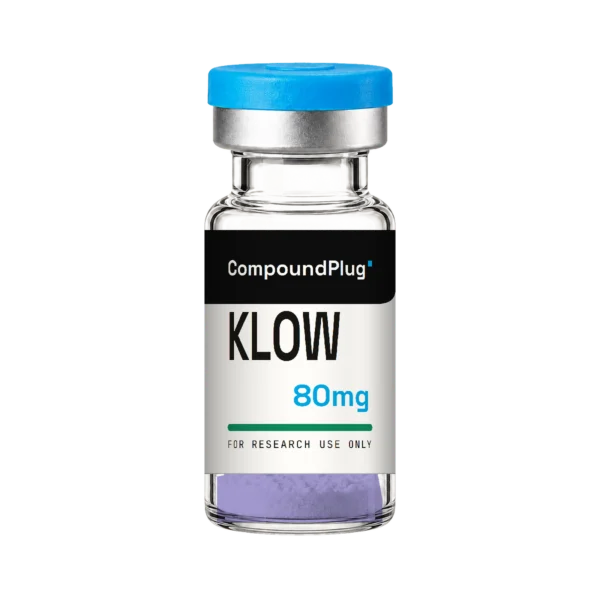
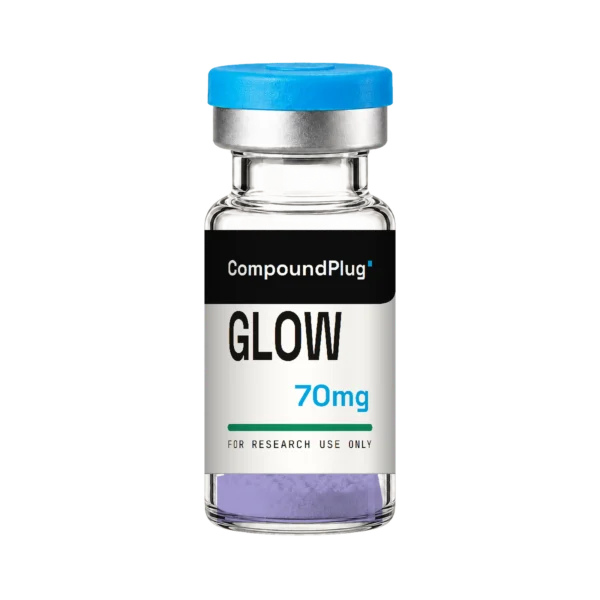
Related: GHK-Cu is also a component of the GLOW blend (with TB-500 and BPC-157) and the KLOW blend (adding KPV). Compare the mechanisms in BPC-157 vs TB-500. Browse Healing Peptides, or pick up bacteriostatic water.
Frequently Asked Questions
What is the GHK-Cu peptide?
A copper-binding tripeptide — glycyl-L-histidyl-L-lysine complexed with copper(II), molecular weight 403.93. It occurs naturally in human plasma, was isolated by Loren Pickart in 1973, and declines with age from roughly 200 ng/mL at 20 to around 80 ng/mL by 60.
What are the reported benefits of GHK-Cu?
The most-cited finding is gene expression: published profiling reports GHK modulating roughly 4,048 human genes — about 6% of the genome — concentrated in tissue-repair, antioxidant, and inflammatory pathways. Research also reports increased fibroblast collagen synthesis, glycosaminoglycan production, antioxidant activity via superoxide dismutase, and angiogenic activity.
Are copper peptides the same thing as GHK-Cu?
In practice, yes — the copper peptide sold in consumer skincare is GHK-Cu, formulated at low percentages in a topical base. The molecule is the same; the product category is not. Topical copper peptide cosmetics fall under cosmetic regulation in Canada. CompoundPlug supplies research-grade GHK-Cu as lyophilized powder for laboratory research only, and does not supply cosmetics or make cosmetic claims.
What is the GHK-Cu dosage in research?
The literature spans in-vitro (nanomolar to micromolar in culture), topical (as a percentage of formulation), and injected preclinical work (microgram-per-kilogram in animal models). A quantity from one route says nothing about another. No human pharmacokinetic data has been published. CompoundPlug provides no dosing recommendations.
What are the side effects of GHK-Cu?
The concern specific to GHK-Cu is copper. Copper is not benign in excess, and accumulation is a recognised toxicological problem — which distinguishes this compound from every non-metal peptide. Reported adverse findings in the research record are limited, though the literature was not designed as a safety programme. Injectable GHK-Cu was on the FDA’s Category 2 restricted list from 2023; that restriction was lifted in 2026.
Is GHK-Cu the same as GHK?
No, and the difference matters. GHK-Cu is the copper complex, molecular weight 403.93. GHK is the free tripeptide with no copper, molecular weight 340.38. Copper is the mechanism — it is the required cofactor for lysyl oxidase and superoxide dismutase. Both are sold in this market. CompoundPlug supplies the copper complex and publishes the molecular weight.
Why is my GHK-Cu solution blue?
That is expected and correct. GHK-Cu solutions are characteristically blue from the copper(II) coordination. A colourless GHK-Cu solution would be the anomaly.
Is GHK-Cu legal in Canada?
Research-grade GHK-Cu is not an authorized health product in Canada — no DIN, no NPN, not approved for human use. It is also not a controlled substance. Topical cosmetic formulations containing GHK-Cu are regulated separately; CompoundPlug does not supply cosmetics.
How is GHK-Cu reconstituted?
With bacteriostatic water, added slowly down the vial wall and swirled — never shaken or vortexed. Water-soluble. Molar calculations must use MW 403.93, the copper complex. Use the GHK-Cu calculator for concentration and draw volume.
How long does GHK-Cu last?
Lyophilized and sealed: up to 24 months. Reconstituted: 3–4 weeks at 2–8 °C, protected from light. Do not freeze after reconstitution.
Further reading
Related products
-
Healing Peptides
KLOW Peptide Blend
80mg
$169.00Select options This product has multiple variants. The options may be chosen on the product page -
Healing Peptides
GLOW Peptide Blend
70mg
$129.00Select options This product has multiple variants. The options may be chosen on the product page -
Healing Peptides
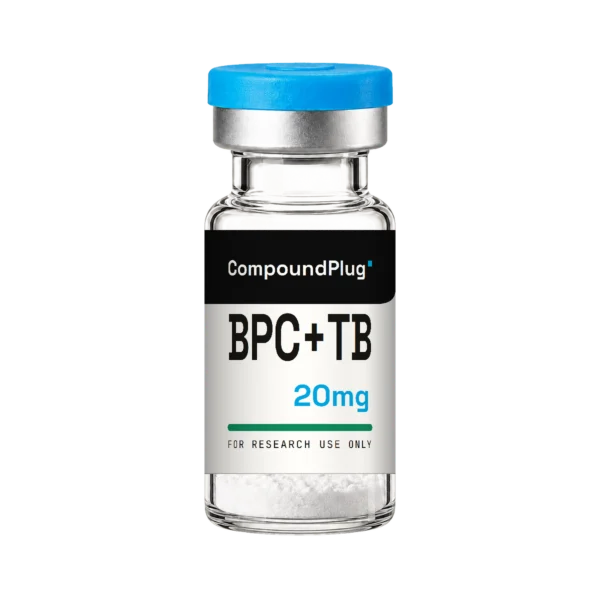
BPC-157 + TB-500 Blend (Wolverine Stack)
10+10mg
$99.00Select options This product has multiple variants. The options may be chosen on the product page -
Healing Peptides
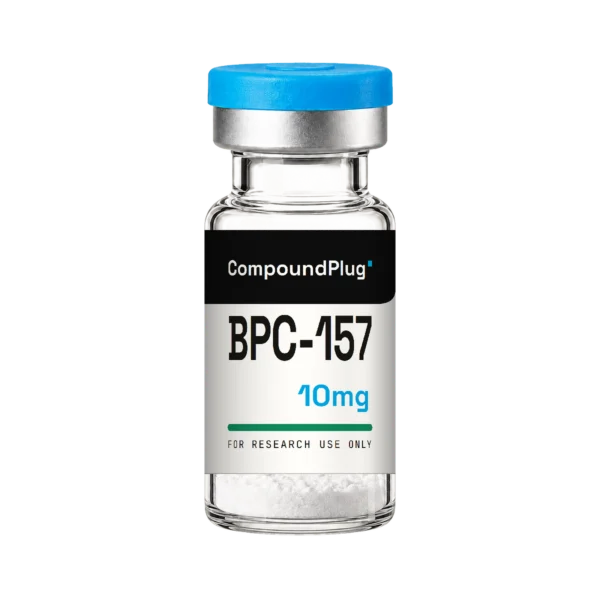
BPC-157 Peptide
10mg
$64.00Select options This product has multiple variants. The options may be chosen on the product page