Retatrutide Canada
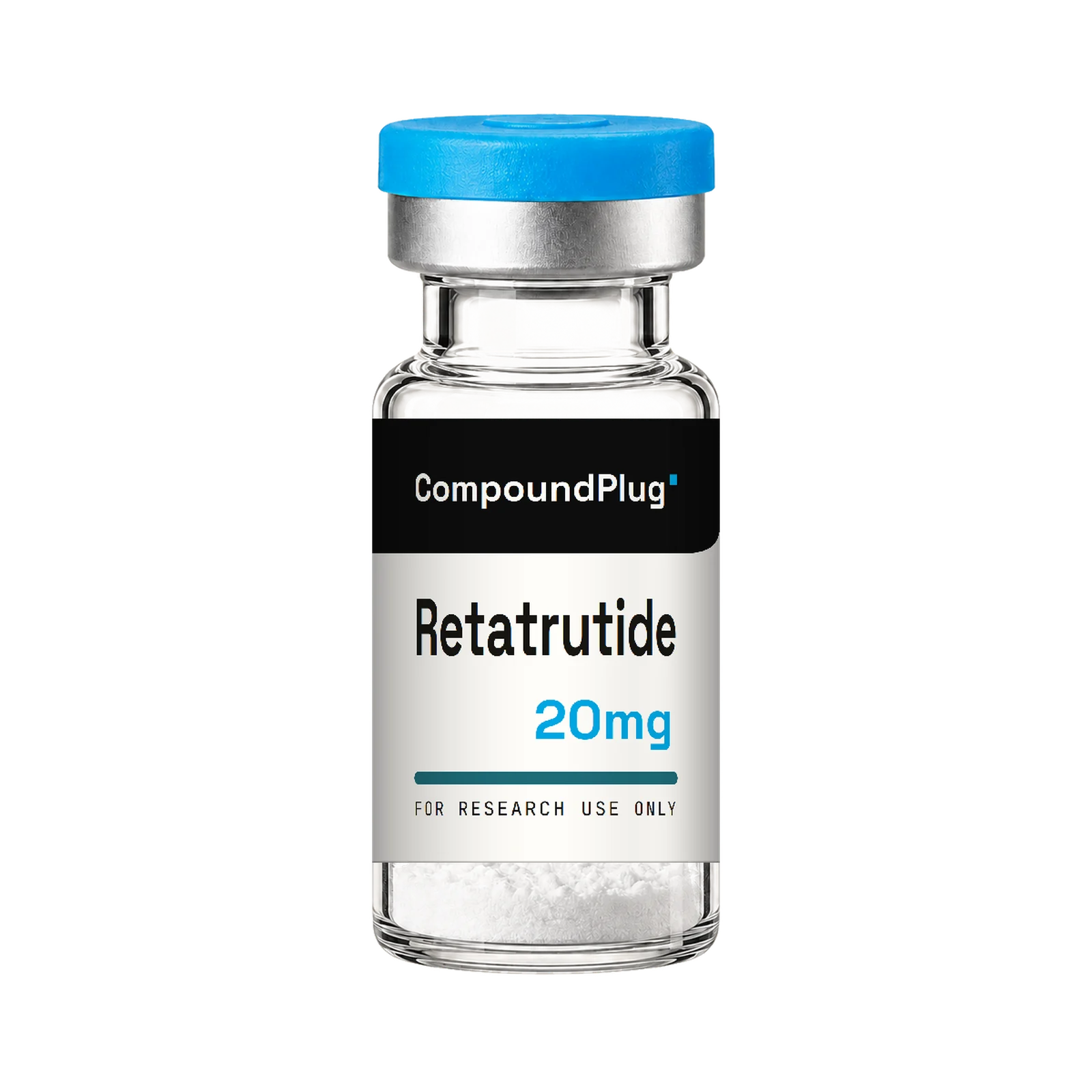
Retatrutide peptide (RETA) — triple GIP/GLP-1/glucagon receptor agonist. Retatrutide, Canada stock: lyophilized powder in 10mg, 20mg and 30mg vials. ≥99% HPLC purity, mass-spec verified for identity. Published Certificate of Analysis tied to the lot on the vial.
Price range: $99.00 through $229.00
| Size | Price | Per mg | Availability |
|---|---|---|---|
| 10mg | $99.00 | $9.90 | In stock |
| 20mg | $159.00 | $7.95 | In stock |
| 30mg | $229.00 | $7.63 | In stock |
- Molecular Formula
- C221H342N46O68
- Molecular Weight
- 4731.33
- Purity (HPLC)
- ≥99%
- Form
- Lyophilized powder
- HPLC + Mass-Spec Tested
- COA Published Per Lot
- Ships From Canada
- Interac e-Transfer / Crypto
For laboratory research use only. Not for human consumption.
What Is the Retatrutide Peptide?
Retatrutide (LY-3437943) is a triple agonist — a single 39-amino-acid peptide that activates three receptors simultaneously: GIP, GLP-1, and glucagon.
It is sold across the research market under the short name RETA. The RETA peptide and the retatrutide peptide are the same 39-residue sequence — one name is an abbreviation of the other, not a different compound.
The glucagon receptor is the whole story, and it is what makes retatrutide genuinely different rather than incrementally better.
GLP-1 and GIP agonism reduce intake — they suppress appetite and slow gastric emptying. Glucagon agonism does something else entirely: it is associated in the literature with increased energy expenditure. Output rather than input. Retatrutide works both sides of the energy balance equation. Every approved incretin drug works one.
It is also the bolder bet. Glucagon agonism was historically avoided in metabolic drug development for an obvious reason: glucagon raises blood glucose, which is the exact opposite of what a diabetes drug is supposed to do. The wager retatrutide is testing is that the glucagon arm can be balanced against the incretin arms — that the GLP-1 and GIP effects offset the glycemic cost while the energy-expenditure benefit is retained.
The clearest evidence that the glucagon arm is doing real work is not the weight data. It is the liver.
Developed by Eli Lilly. The most potent compound in the incretin class studied to date.
Is Retatrutide Legal in Canada? Regulatory Status
Retatrutide is not approved in Canada, the United States, or any other jurisdiction. It is an investigational compound in clinical development.
This distinguishes it from semaglutide and tirzepatide, which have authorized prescription products available in Canada. For retatrutide there is no authorized route — not because access is restricted, but because the compound has not completed clinical development. There is no approved product, no Drug Identification Number, and no product monograph anywhere in the world.
Retatrutide is not a controlled substance under the Controlled Drugs and Substances Act.
CompoundPlug supplies retatrutide strictly as a research chemical for in-vitro and in-vivo laboratory research by qualified professionals. See Research Use Only.
Retatrutide Benefits: What the Research Reports
Weight reduction — the Phase 2 trial
The Phase 2 trial (Jastreboff et al., New England Journal of Medicine, June 2023) randomised 338 adults with obesity or overweight to weekly subcutaneous retatrutide at 1 mg, 4 mg, 8 mg, or 12 mg, or placebo, over 48 weeks.
Mean body-weight reduction at 48 weeks:
- 1 mg — 8.7%
- 4 mg — 17.1%
- 8 mg — 22.8%
- 12 mg — 24.2%
- Placebo — 2.1%
At the highest dose, 26% of participants lost at least 30% of their body weight.
And the curves had not plateaued at 48 weeks. That is the detail most coverage skips, and it is the most consequential one in the dataset: the trial ended before the effect did. Whatever the ceiling is, this trial did not find it.
Liver fat — the glucagon signature
This is the finding that separates retatrutide from every dual agonist, and it is not a weight-loss finding.
A Phase 2a substudy (n=98) examined participants with metabolic dysfunction-associated steatotic liver disease and at least 10% liver fat. Mean relative change in liver fat at 24 weeks:
- 1 mg — −42.9%
- 4 mg — −57.0%
- 8 mg — −81.4%
- 12 mg — −82.4%
- Placebo — +0.3%
86% of participants at the 12 mg dose reached normal liver fat (<5%) at 24 weeks. In the placebo group: zero.
Glucagon receptor agonism drives hepatic fatty acid oxidation. This is the mechanism doing exactly what the pharmacology predicts, in the tissue where it should be visible — and it is why retatrutide’s Phase 3 programme extends beyond weight management.
Phase 3 — TRIUMPH
The Phase 3 programme (TRIUMPH) is evaluating retatrutide for chronic weight management, obstructive sleep apnea, and knee osteoarthritis. The first Phase 3 readout, in December 2025, reported mean body-weight reduction of up to 28.7% at 68 weeks — higher than the Phase 2 figure, over a longer treatment period.
Cardiometabolic markers
Phase 2 also reported improvements in exploratory endpoints: systolic and diastolic blood pressure, triglycerides, LDL and total cholesterol, HbA1c, and fasting glucose and insulin.
Retatrutide Dosage in the Published Research
Retatrutide’s dosing literature comes from Eli Lilly’s Phase 2 trial and the ongoing Phase 3 programme.
The doses studied
The Phase 2 obesity trial evaluated weekly subcutaneous doses of 1 mg, 4 mg, 8 mg, and 12 mg. The relationship was dose-dependent across the full range — more compound produced more effect, with no plateau reached at 48 weeks.
Participants in the higher-dose arms reached their assigned dose through gradual escalation, a design choice made necessary by the compound’s potency and the gastrointestinal tolerability that limits this entire drug class.
What these figures are — and are not
These are the parameters of a clinical trial that is still running.
No dose of retatrutide has been established as safe or effective by any regulatory authority, because the compound has not completed clinical development. There is no approved product, no product monograph, and no prescriber guidance anywhere in the world. Quantities circulating in online discussion are extrapolated from trial abstracts.
CompoundPlug provides no dosing recommendations. The Peptide Calculator converts vial mass and diluent volume into a concentration and draw volume — the mass is an input supplied by the researcher.
Retatrutide Side Effects Reported in Studies
Gastrointestinal
Nausea, vomiting, and diarrhea were the most frequently reported adverse events, and were dose-related — the reason the trial escalated gradually rather than starting at target.
What is specific to retatrutide
Retatrutide escalation has been associated in the trial record with tingling, numbness, or prickling sensations — paresthesia. This is not a general GLP-1 class effect; it appears in the retatrutide record specifically.
The glucagon arm also carries a theoretical glycemic concern by design: glucagon raises blood glucose. Whether the incretin arms fully offset that across a broad population and a long duration is one of the questions Phase 3 exists to answer.
What is not established
Retatrutide has not completed clinical development, and its full safety profile is not established. Long-term human safety data does not exist. Rare adverse events, if there are any, may not yet have been detected — a Phase 2 trial of 338 participants is not large enough to find them. The Phase 2 figures are an interim signal, not a settled result.
Retatrutide Half-Life & Pharmacokinetics
- Half-life: approximately six days. Achieved the same way as semaglutide and tirzepatide — a fatty diacid modification that binds albumin reversibly, shielding the peptide from enzymatic degradation and renal clearance.
- Weekly subcutaneous administration follows from that half-life.
- Balanced triple agonism is the design constraint. The relative potency at each of the three receptors is the central engineering problem — too much glucagon activity and the glycemic effect turns adverse; too little and the energy-expenditure benefit disappears. The sequence is optimised to hold that balance.
Retatrutide Research Applications
- Triple-agonist pharmacology — GIP/GLP-1/glucagon receptor binding, relative affinity, balance
- Glucagon receptor research — energy expenditure, hepatic fatty acid oxidation
- Hepatic metabolism — liver fat models; the MASLD/MAFLD signal
- Comparative incretin biology — the triple-agonist anchor in a gradient series: semaglutide (mono) → tirzepatide (dual) → retatrutide (triple)
- Energy expenditure — thermogenic contribution of glucagon receptor agonism in adipose models
- Receptor balance — how glucagon’s glycemic effect is offset by incretin co-activation
All applications preclinical, in-vitro / in-vivo only.
Retatrutide Reconstitution & Storage
Supplied as a lyophilized powder in 10mg, 20mg, and 30mg vials. Reconstitute with bacteriostatic water, added slowly down the inside wall of the vial — never directly onto the powder. Swirl gently. Never shake, never vortex.
Storage: lyophilized and sealed, stable up to 24 months. Reconstituted, store at 2–8 °C and use within 28 days. Protect from light. Do not freeze after reconstitution.
Peptide Calculator · How to Reconstitute Peptides · Bacteriostatic water
Quality & Verification
Every CompoundPlug compound is tested independently through third-party laboratories, and the analysis is published rather than asserted.
Retatrutide is a particular case. Because there is no approved product anywhere in the world, there is no authorized reference standard to compare against — no Ozempic, no Mounjaro, no pharmacy-dispensed equivalent. Every vial of retatrutide in existence is unapproved material, and the only thing distinguishing one from another is the analysis behind it.
HPLC for purity: how much of this vial is retatrutide, and what else is in there.
Mass spectrometry for identity: is the compound in the vial actually retatrutide. A vial can be 99% pure and 99% the wrong molecule — and with a compound that has no approved reference product, that is not a hypothetical concern. Purity testing alone cannot catch it. Only mass spectrometry can.
Most vendors in this market publish one number. Where the compound is investigational and there is nothing to compare it to, one number is close to meaningless.
Vials are measured by peptide content — the stated mass is peptide, not gross powder weight.
Where a batch has been independently re-tested under the CompoundPlug name, a CompoundPlug Verified badge appears alongside the batch-specific Certificate of Analysis, tied to the lot printed on the vial.
Buy Retatrutide Canada-Wide
Research-grade retatrutide (RETA) — lyophilized powder in 10mg, 20mg, and 30mg vials, ≥99% HPLC purity, mass-spec verified for identity, with a published reference Certificate of Analysis tied to the lot.
- Ships from within Canada — Canada Post Xpresspost, tracked
- CAD pricing
- Interac e-Transfer or cryptocurrency
- Discreet, unbranded packaging
Related: Retatrutide vs Tirzepatide — triple agonist versus dual, and what the third receptor actually changes. Also in the catalog: tirzepatide, semaglutide, cagrilintide. Browse GLP-1 Peptides, or pick up bacteriostatic water.
Frequently Asked Questions
What is retatrutide?
A triple agonist — a 39-amino-acid peptide activating the GIP, GLP-1, and glucagon receptors simultaneously. The glucagon arm is what distinguishes it: GLP-1 and GIP reduce intake, while glucagon agonism is associated with increased energy expenditure. Developed by Eli Lilly; investigational, not approved anywhere.
Is RETA the same as retatrutide?
Yes. RETA is the short-form name used across the research market, and the RETA peptide and the retatrutide peptide are the same compound — LY-3437943, a 39-amino-acid triple agonist. CompoundPlug supplies the RETA peptide Canada-wide from domestic stock, with the analysis published against the lot printed on the vial.
What is the retatrutide dosage in clinical trials?
The Phase 2 obesity trial evaluated weekly subcutaneous doses of 1 mg, 4 mg, 8 mg, and 12 mg, reached through gradual escalation. No dose has been established as safe or effective by any regulatory authority, because the compound has not completed clinical development. CompoundPlug provides no dosing recommendations.
What are the reported benefits of retatrutide?
The Phase 2 trial reported mean weight reduction of 24.2% at 48 weeks on the 12 mg dose, versus 2.1% on placebo, in 338 participants — with 26% of that group losing at least 30% of body weight. A substudy reported liver fat reduced by 82.4%, with 86% of participants reaching normal liver fat. The first Phase 3 readout reported up to 28.7% weight reduction at 68 weeks.
What are the side effects of retatrutide?
Gastrointestinal effects — nausea, vomiting, diarrhea — are the most common and are dose-related. Paresthesia (tingling or numbness) has been associated with escalation in the trial record, specific to retatrutide rather than a general class effect. The compound has not completed clinical development and its full safety profile is not established.
Is retatrutide approved in Canada?
No. Retatrutide is not approved in Canada, the United States, or any other jurisdiction. It is investigational and in clinical development. It is also not a controlled substance.
What is the half-life of retatrutide?
Approximately six days, achieved through a fatty diacid modification that binds albumin reversibly.
Is retatrutide stronger than tirzepatide?
Retatrutide’s Phase 2 trial reported a larger mean weight reduction (24.2% at 48 weeks) than tirzepatide’s SURMOUNT-1 (20.9% at 72 weeks). But these are different trials with different designs, durations, and populations — no head-to-head trial has been published, and cross-trial comparison is not evidence. Full comparison.
What vial sizes are available?
10mg, 20mg, and 30mg of lyophilized retatrutide per vial, and nothing else — no fillers, no carriers. Bacteriostatic water is not included and is available separately.
How is retatrutide reconstituted?
With bacteriostatic water, added slowly down the vial wall and swirled — never shaken or vortexed. Store reconstituted at 2–8 °C and use within 28 days. Use the Retatrutide calculator for concentration and draw volume.
How long does retatrutide last?
Lyophilized and sealed: up to 24 months. Reconstituted: 28 days at 2–8 °C, protected from light. Do not freeze after reconstitution.
Further reading
- ComparisonRetatrutide vs Tirzepatide
- ComparisonSemaglutide vs Tirzepatide
- ArticlePeptides for Weight Loss: What the Research Shows on GLP-1 Receptor Agonists
- ArticleFDA Approved Peptides: Which Are Real Medicines and Which Aren’t
- ArticleAre Peptides Legal in Canada? The Regulatory Status Explained
- All comparisonsCompare Compounds
Related products
-
GLP-1 Peptides
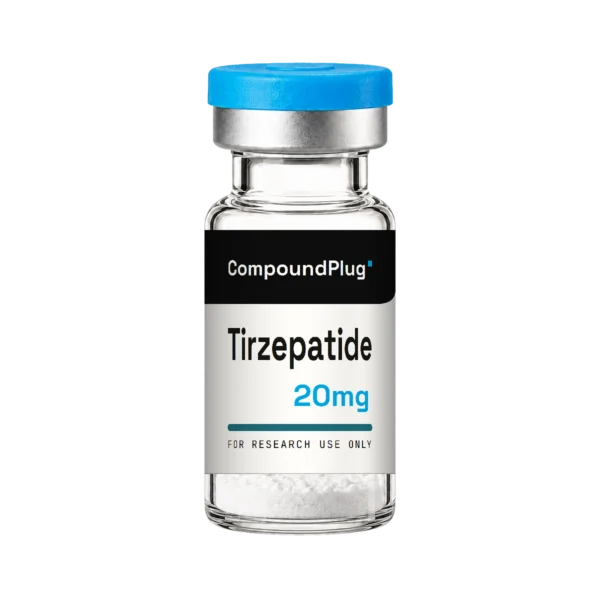
Tirzepatide Peptide (TIRZ)
10mg · 20mg · 30mg
Price range: $59.00 through $149.00Select options This product has multiple variants. The options may be chosen on the product page -
GLP-1 Peptides
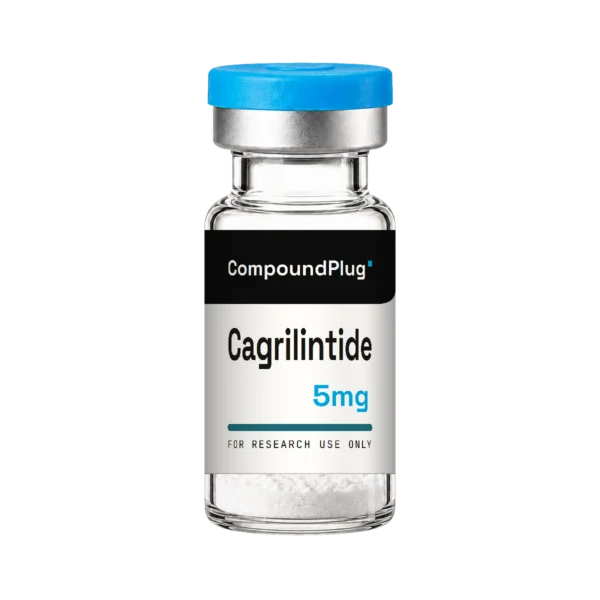
Cagrilintide Peptide (CAGRI)
5mg
$54.00Select options This product has multiple variants. The options may be chosen on the product page -
GLP-1 Peptides
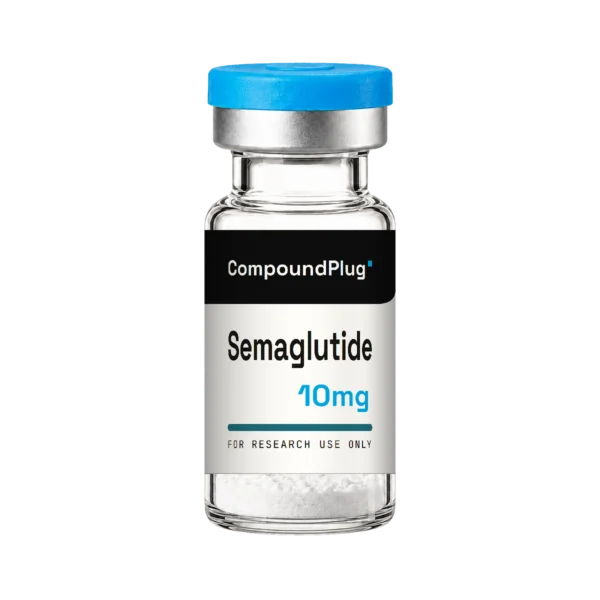
Semaglutide Peptide (SEMA)
10mg
$74.00Select options This product has multiple variants. The options may be chosen on the product page