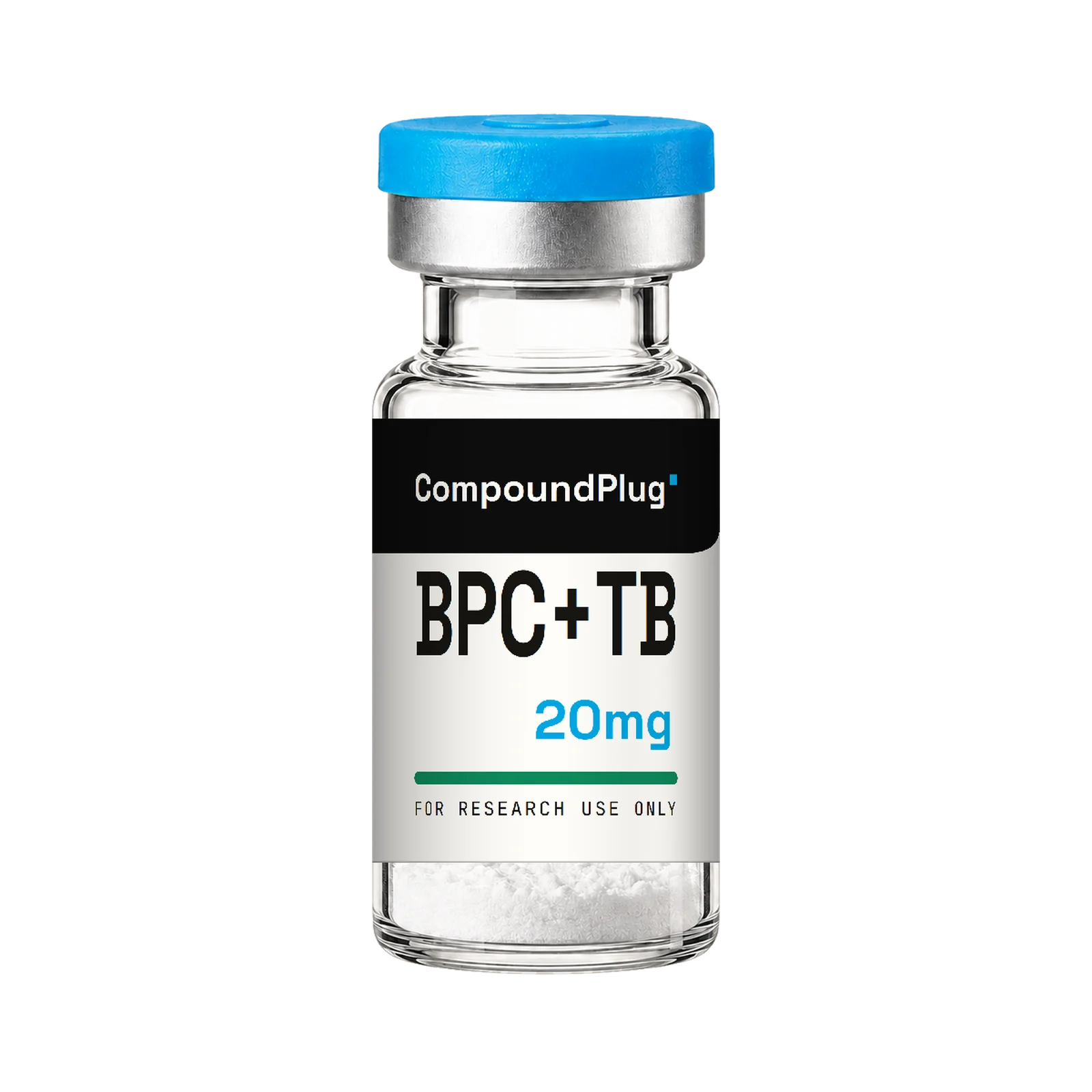
BPC-157 + TB-500 Blend (Wolverine Stack)
BPC-157 + TB-500, the wolverine stack — 10mg of each. Two unrelated repair mechanisms: VEGF angiogenesis and actin-mediated cell migration. Full-length Thymosin Beta-4 (MW 4963), stated. ≥99% HPLC purity.
$99.00
- Molecular Formula
- BPC-157: C62H98N16O22 · TB-500: C212H350N56O78S
- Molecular Weight
- BPC-157: 1419.55 · TB-500: 4963.44
- Purity (HPLC)
- ≥99%
- Form
- Lyophilized powder
- HPLC + Mass-Spec Tested
- COA Published Per Lot
- Ships From Canada
- Interac e-Transfer / Crypto
For laboratory research use only. Not for human consumption.
What Is the BPC-157 + TB-500 Blend (the Wolverine Stack)?
Two compounds, 10mg of each, in one vial. And they act through completely unrelated mechanisms — which is the entire reason they are blended.
The market calls this pairing the wolverine stack, and the wolverine peptide nickname comes from a comic-book healing-factor comparison rather than from anything in the published literature. It is a name, not a finding.
| BPC-157 | TB-500 | |
|---|---|---|
| What it is | 15-amino-acid peptide fragment | Full-length Thymosin Beta-4, 43 aa |
| Molecular weight | 1419.55 | 4963.44 |
| Mechanism | VEGF angiogenesis · nitric oxide | Actin sequestration · cell migration |
| In one line | Builds the vascular supply to a repair site | Gets repair cells to that site |
Why These Two Together
Tissue repair is a sequence, and these compounds act at different points in it.
BPC-157 operates on VEGF-mediated angiogenesis and nitric oxide signalling. Hsieh and colleagues reported it engages VEGFR2 signalling in a VEGF-independent manner — driving endothelial proliferation and new vessel formation. It builds the plumbing. A damaged site with no blood supply cannot be supplied with anything.
TB-500 — full-length Thymosin Beta-4 — operates on actin sequestration. It binds G-actin, the free monomer form of the protein cells use to move, and maintains the available pool. Cells with more free actin migrate faster. And tissue repair is fundamentally a migration problem: fibroblasts and endothelial cells have to physically reach a damaged site before anything gets rebuilt.
Neither substitutes for the other. One improves the supply route; the other moves the workers. That is why the literature examines them together as often as separately, and why they are supplied in a single vial.
Full mechanism comparison: BPC-157 vs TB-500.
⚠️ Which TB-500 Is In This Vial
This matters, and almost no vendor will tell you.
“TB-500” is sold across the research market under one name that refers to two different molecules:
- Full-length Thymosin Beta-4 — 43 amino acids, molecular weight 4963.44
- The TB-500 fragment — 7 amino acids (LKKTETQ, the actin-binding domain), molecular weight ~878
More than five times the mass. Same product name.
CompoundPlug supplies full-length Thymosin Beta-4, MW 4963.44, and publishes the molecular weight and sequence on the TB-500 product page. Any molar calculation performed against the wrong figure is out by a factor of five.
What the Research Reports
BPC-157
Preclinical models report accelerated tendon and ligament repair via fibroblast migration through the FAK-paxillin pathway (Chang et al., 2011), gastric mucosal protection, angiogenesis via VEGF signalling, and effects on bone healing.
TB-500 / Thymosin Beta-4
Models report accelerated wound closure, cardiomyocyte migration and survival following ischemic injury (Hinkel et al., 2008), corneal epithelial repair, and endothelial cell migration (Philp et al., 2003).
All findings are preclinical. Neither compound has completed clinical development, and effects in animal models do not translate reliably to humans.
Wolverine Stack Dosage in the Published Research
The two compounds have separate literatures and separate quantities. They are not interchangeable and they should not be combined into a single figure.
BPC-157 — rodent studies most commonly report 10 µg/kg, within a wider range of roughly 10 ng/kg to 100 µg/kg across tissue-repair models.
TB-500 / Thymosin Beta-4 — animal studies report the microgram-to-milligram per kilogram range. The literature is inconsistent about whether reported quantities refer to the full-length protein or the fragment, which makes cross-study comparison unreliable.
No human pharmacokinetic data has been published for either compound. CompoundPlug provides no dosing recommendations.
Is This Blend Legal in Canada?
Neither BPC-157 nor TB-500 is an authorized health product in Canada. Neither carries a DIN or NPN. Neither has been reviewed by Health Canada for human use.
Neither is a controlled substance under the CDSA.
CompoundPlug supplies both strictly as research chemicals. See Research Use Only.
Reconstitution & Storage
Both compounds are water-soluble and reconstitute together in the same bacteriostatic water. Add slowly down the vial wall, swirl, never vortex.
For molar calculations, run each component separately: BPC-157 at MW 1419.55, TB-500 at 4963.44. A 1:1 blend by mass is not a 1:1 blend by moles — the molecular weights differ by a factor of 3.5.
Storage: lyophilized and sealed, up to 24 months. Reconstituted, 2–8 °C, 3–4 weeks, protected from light.
BPC-157 + TB-500 calculator · Reconstitution guide
Quality & Verification
Independent HPLC and mass-spec testing on both compounds, published rather than asserted.
On a blend, identity testing does something a purity test cannot: it confirms both molecules are present, and that they are the right ones.
HPLC tells you how much of the vial is compound and what else is in there. Mass spectrometry tells you which compounds — and on this blend that is not academic, because “TB-500” refers to two molecules five times apart in mass. A purity test cannot distinguish them. Mass spec can.
Vials measured by peptide content — 10mg of each compound, not 10mg of gross powder. Published analysis in the COA Library.
Buy the BPC-157 + TB-500 Blend in Canada
Research-grade blend — 10mg BPC-157 + 10mg TB-500, ≥99% HPLC purity, both compounds mass-spec verified, published reference COA.
- Both molecular weights published — including which TB-500 is in the vial
- Ships from within Canada — Canada Post Xpresspost, tracked
- CAD pricing · Interac e-Transfer or crypto · discreet packaging
Related: BPC-157 · TB-500 · Full mechanism comparison · GLOW blend (adds GHK-Cu) · Healing Peptides
Frequently Asked Questions
What’s in the BPC-157 + TB-500 blend?
10mg of BPC-157 and 10mg of TB-500 — 20mg total, and nothing else. No fillers, no carriers. Measured by peptide content, so the stated mass is peptide, not gross powder weight.
Is this the wolverine stack?
Yes. “Wolverine stack peptides” and “wolverine peptide stack” are informal market names for the BPC-157 and TB-500 pairing. The nickname is a comic-book healing-factor reference and carries no scientific meaning — it describes nothing that appears in the published literature. What is in the vial is 10mg BPC-157 and 10mg full-length Thymosin Beta-4, both mass-spec verified.
Why are these two blended?
Because their mechanisms are unrelated and complementary. BPC-157 works on VEGF-mediated angiogenesis — it builds the vascular supply to a repair site. TB-500 works on actin sequestration and cell migration — it gets repair cells to that site. One improves the supply route; the other moves the workers. Neither substitutes for the other.
Which TB-500 is in this blend?
Full-length Thymosin Beta-4 — 43 amino acids, MW 4963.44. The name “TB-500” is applied across the market to two different molecules: the full-length protein and a 7-residue fragment (MW ~878). More than five times the mass, same name. CompoundPlug publishes the molecular weight and sequence.
How is the blend reconstituted?
Both compounds are water-soluble and dissolve together in the same bacteriostatic water. For molar calculations, run each component separately — BPC-157 at MW 1419.55, TB-500 at 4963.44. A 1:1 blend by mass is not a 1:1 blend by moles.
Is the blend legal in Canada?
Neither compound is an authorized health product in Canada — no DIN, no NPN. Neither is a controlled substance. Supplied research-use-only.
Further reading
Related products
-
Healing Peptides
GLOW Peptide Blend
70mg
$129.00Select options This product has multiple variants. The options may be chosen on the product page -
Healing Peptides
KLOW Peptide Blend
80mg
$169.00Select options This product has multiple variants. The options may be chosen on the product page -
Healing Peptides
GHK-Cu Peptide
50mg
$44.00Select options This product has multiple variants. The options may be chosen on the product page