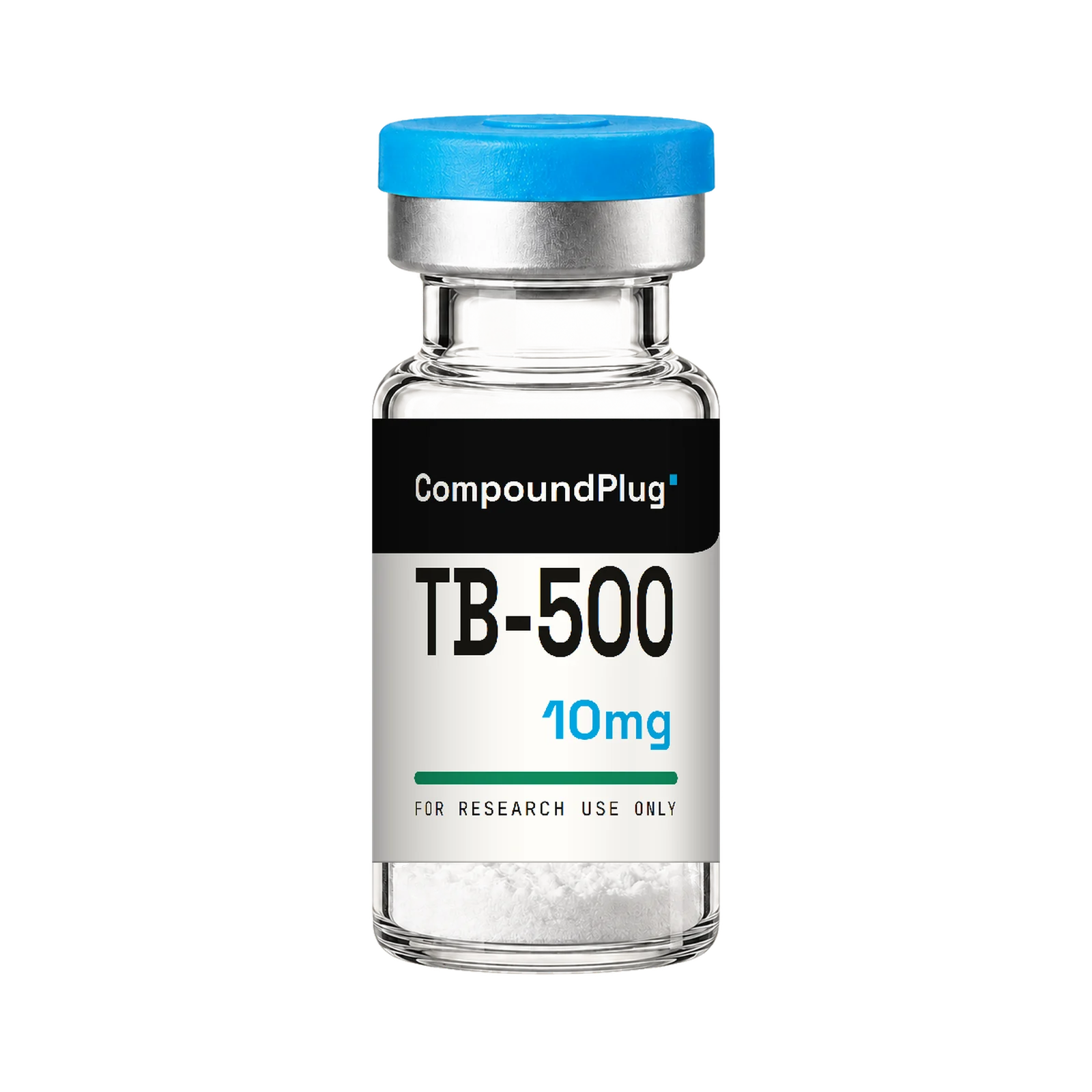
TB-500 Peptide
Full-length Thymosin Beta-4 (TB-500, also written TB500) — 43 amino acids, MW 4963. 10mg lyophilized powder, ≥99% HPLC purity, mass-spec verified for identity. Published Certificate of Analysis tied to the lot on the vial.
$65.00
- Molecular Formula
- C212H350N56O78S
- Molecular Weight
- 4963.44
- Purity (HPLC)
- ≥99%
- Sequence
- Ac-Ser-Asp-Lys-Pro-Asp-Met-Ala-Glu-Ile-Glu-Lys-Phe-Asp-Lys-Ser-Lys-Leu-Lys-Lys-Thr-Glu-Thr-Gln-Glu-Lys-Asn-Pro-Leu-Pro-Ser-Lys-Glu-Thr-Ile-Glu-Gln-Glu-Lys-Gln-Ala-Gly-Glu-Ser
- Form
- Lyophilized powder
- HPLC + Mass-Spec Tested
- COA Published Per Lot
- Ships From Canada
- Interac e-Transfer / Crypto
For laboratory research use only. Not for human consumption.
What Is TB-500 (TB500)?
TB-500 is not one molecule — and which one is in the vial is the thing to check before buying.
The name originally referred to a seven-amino-acid fragment — the sequence LKKTETQ, the actin-binding domain of Thymosin Beta-4, with a molecular weight of roughly 878.
But almost everything sold in the research market as “TB-500” is not that fragment. It is full-length Thymosin Beta-4 — the complete 43-amino-acid protein, molecular weight 4963. Different molecule. More than five times the mass. Sold under the same name.
CompoundPlug supplies full-length Thymosin Beta-4. 43 amino acids, N-acetylated, CAS 77591-33-4, molecular formula C212H350N56O78S, molecular weight 4963.44. The full sequence and specification are in the panel above.
This matters because a researcher reconstituting a vial, calculating a molar concentration, or comparing against a published study needs to know which molecule is actually in it. A concentration calculated against the wrong molecular weight is wrong by a factor of five.
What Thymosin Beta-4 Actually Is
Thymosin Beta-4 (Tβ4) is not an experimental compound in the way most of this catalog is. It is a naturally occurring protein present in nearly every human cell, and it is one of the most abundant intracellular proteins there is — present at concentrations of roughly 0.4 to 0.8 millimolar in most cell types.
It is concentrated in wound fluid and platelets, which is the observation that started the research: the body appears to deliver Tβ4 to sites of injury.
First isolated from thymus tissue in the 1960s. The synthetic version supplied for research is chemically identical to the endogenous protein.
How TB-500 Works: Actin Sequestration
Thymosin Beta-4’s mechanism is actin sequestration, and it is mechanistically unlike anything else in the tissue-repair category.
Actin is the structural protein cells use to move. It exists in two states: G-actin (free monomers, floating in the cytoplasm) and F-actin (polymerised filaments, the cell’s scaffolding). To crawl toward a wound, a cell must rapidly build filaments at its leading edge and dismantle them behind — which requires a large, available pool of free G-actin monomers to draw from.
Tβ4 is the protein that maintains that pool. It binds G-actin monomers and holds them in reserve — sequestered, unpolymerised, available. It is described in the literature as the primary regulator of unpolymerised actin in mammalian cells.
The practical consequence, as the research frames it: cells that can access a larger free-actin pool can migrate faster. And tissue repair is fundamentally a migration problem — fibroblasts, endothelial cells, and epithelial cells all have to physically move into a damaged site before anything can be rebuilt.
The actin-binding activity resides in a short internal sequence — LKKTETQ, residues 17 to 23. That heptapeptide is the fragment originally called TB-500, and its existence is why the naming confusion exists at all.
This is a completely different mechanism from BPC-157, which acts on VEGF-mediated angiogenesis and nitric oxide signaling — the vascular supply to a repair site rather than the movement of cells into it. The two are studied together because the mechanisms are complementary rather than overlapping. See BPC-157 vs TB-500.
TB-500 Benefits: What the Research Reports
Wound healing
Philp and colleagues (Wound Repair and Regeneration, 2003) reported that Thymosin Beta-4 accelerated wound closure in impaired-healing models, including diabetic and aged mice. Both full-length Tβ4 and a synthetic peptide containing the actin-binding domain promoted re-epithelialization, angiogenesis, and collagen deposition — a study design that is directly relevant here, because it tested both molecules.
Cardiac
Hinkel and colleagues (Circulation, 2008) examined Tβ4 in a porcine model of myocardial infarction, reporting that the protein functions as a paracrine factor in endothelial progenitor cell-mediated cardioprotection. Cardiomyocyte migration and survival following induced ischemic injury are the most-studied endpoints in this area.
Corneal
Epithelial repair models, where cell migration across the corneal surface is the rate-limiting step in healing.
Angiogenesis
Endothelial cell migration models report increased activity — consistent with the actin mechanism, since endothelial cells must migrate to form new vessels.
Inflammation
Cytokine modulation is reported across several models, though the mechanistic link to actin sequestration is less direct than in the migration findings.
All findings are preclinical. Thymosin Beta-4 has not completed clinical development, and effects in animal models do not translate reliably to humans.
TB-500 Dosage in the Published Research
The literature is preclinical, and it carries a specific complication worth naming.
What the studies used
Animal studies have administered Thymosin Beta-4 and TB-500 across a wide range, with rodent work commonly reporting quantities in the microgram-to-milligram per kilogram range depending on the model. Routes in the literature include intraperitoneal, subcutaneous, and topical application in wound models.
The complication
The literature is not consistent about which molecule it is reporting. Some studies used full-length Thymosin Beta-4 (43 amino acids, MW 4963). Others used the actin-binding fragment (7 amino acids, MW ~878). Many papers refer to both as “Tβ4” or “TB-500” without distinguishing.
A quantity reported in milligrams means something entirely different depending on which molecule it refers to — the molar difference is more than fivefold. Cross-study comparison in this literature is therefore unreliable unless the specific paper states which molecule it used. This is a real methodological problem in the TB-500 research base and it is rarely acknowledged.
What the literature does not contain
No human pharmacokinetic data for TB-500 has been published. No dose has been established as safe or effective in humans by any regulatory authority.
CompoundPlug provides no dosing recommendations. The Peptide Calculator converts vial mass and diluent volume into a concentration and draw volume — the mass is an input supplied by the researcher.
TB-500 Side Effects Reported in Studies
In the preclinical record
Reported adverse findings are limited. Animal studies have not surfaced a consistent toxicity signal at the quantities used.
Context: the research base is small, the studies were not designed as safety studies, and follow-up periods were short. An absence of reported harm in small preclinical studies is not an established safety profile.
The mechanistic concern
One concern appears in the literature and is worth stating plainly: cell migration is not selectively beneficial. A mechanism that helps repair cells move faster does not distinguish between repair cells and other cells. Whether accelerating migration systemically carries risk in tissues where migration is undesirable is an open question, and it has not been resolved.
Regulatory
TB-500 was placed on the FDA’s Category 2 restricted list for pharmacy compounding in 2023 — a list reserved for bulk substances the agency identified as presenting significant safety risks. It was removed from that list in 2026 without being added to the permitted list, leaving it in an evaluative state rather than an approved one.
No long-term human safety data exists for TB-500.
TB-500 Half-Life & Pharmacokinetics
No human pharmacokinetic study has been published. There is no measured human half-life, no absorption curve, and no bioavailability figure for any route.
- Full-length Tβ4 is a 43-amino-acid protein, not a small peptide. It carries no half-life-extending modification — no albumin-binding fatty acid chain, no PEGylation. Preclinical work suggests relatively rapid plasma clearance.
- N-terminal acetylation is present in the natural protein and in the synthetic version, and is described in the literature as contributing to stability.
- Tβ4 does not bind the extracellular matrix, which is noted in the literature as permitting relatively free distribution through tissue.
- The fragment and the full protein would have different pharmacokinetics — a 7-residue peptide and a 43-residue protein do not behave the same way. Another reason knowing which molecule is in the vial matters.
TB-500 Research Applications
- Wound healing — cell migration, wound closure rate, re-epithelialization models
- Cardiac research — cardiomyocyte migration and survival after ischemic injury; endothelial progenitor cell models
- Corneal research — epithelial repair models
- Cytoskeletal biology — G-actin sequestration, actin polymerisation dynamics, the free-monomer pool
- Angiogenesis — endothelial cell migration
- Musculoskeletal — tendon and ligament repair models
- Inflammation — cytokine modulation
- Comparative mechanism — full-length Tβ4 against the LKKTETQ fragment; migration-driven repair against vascular-driven repair (BPC-157)
All applications preclinical, in-vitro / in-vivo only.
Is TB-500 Legal in Canada?
TB-500 is not an authorized health product in Canada. It has not been reviewed by Health Canada for safety, efficacy, or quality. It carries no Drug Identification Number (DIN) and no Natural Product Number (NPN), and it is not approved for human use.
TB-500 is not a controlled substance under the Controlled Drugs and Substances Act.
CompoundPlug supplies TB-500 strictly for in-vitro and in-vivo laboratory research by qualified professionals. Purchasers are responsible for ensuring their use complies with applicable regulations. See Research Use Only.
TB-500 Reconstitution & Storage
TB-500 is water-soluble and reconstitutes readily with bacteriostatic water.
Procedure: add the diluent slowly, down the inside wall of the vial — never directly onto the lyophilized powder. Swirl gently. Never shake, never vortex.
Note on the calculation: molar concentrations for this product must be calculated against a molecular weight of 4963.44 — the full-length protein. Using the fragment’s molecular weight (~878) would produce a result wrong by more than a factor of five. This is not a hypothetical error; it follows directly from the naming ambiguity described above.
Storage: lyophilized and sealed, stable up to 24 months. Reconstituted, store at 2–8 °C and use within 3 weeks. Protect from light. Do not freeze after reconstitution.
Peptide Calculator · How to Reconstitute Peptides · Bacteriostatic water
Quality & Verification
Every CompoundPlug compound is tested independently through third-party laboratories, and the analysis is published rather than asserted.
TB-500 is the compound where this matters most, and it is the clearest illustration of why purity testing alone is not enough.
HPLC for purity tells you how much of a vial is a single compound, and what else is in there. What it cannot tell you is which compound. A vial of the 878-dalton fragment and a vial of the 4963-dalton full-length protein can both return ≥99% purity. Both results are true. They describe different molecules.
Mass spectrometry for identity is the only test that distinguishes them. It measures molecular weight directly. On this compound — where the market sells two different molecules under one name — mass spectrometry is not a nice-to-have. It is the only thing that tells you what you bought.
This is what “a vial can be 99% pure and 99% the wrong molecule” means in practice. TB-500 is where it is literally, demonstrably true.
CompoundPlug supplies full-length Thymosin Beta-4, MW 4963.44, and publishes the analysis that proves it. Vials are measured by peptide content — the stated mass is peptide, not gross powder weight.
Where a batch has been independently re-tested under the CompoundPlug name, a CompoundPlug Verified badge appears alongside the batch-specific Certificate of Analysis, tied to the lot printed on the vial.
Buy TB-500 in Canada
Research-grade TB-500 — full-length Thymosin Beta-4, 43 amino acids, MW 4963.44. 10mg lyophilized powder, ≥99% HPLC purity, mass-spec verified for identity, with a published reference Certificate of Analysis tied to the lot.
- Molecule stated on the page — full-length Tβ4, not a fragment, with the sequence and molecular weight published
- Ships from within Canada — Canada Post Xpresspost, tracked
- CAD pricing
- Interac e-Transfer or cryptocurrency
- Discreet, unbranded packaging
Related: BPC-157 vs TB-500 — migration versus vascular supply; the mechanisms are complementary, not competing. Also available in the BPC-157 + TB-500 blend, the GLOW blend, and the KLOW blend. Browse Healing Peptides, or pick up bacteriostatic water.
Frequently Asked Questions
What is TB-500?
CompoundPlug supplies full-length Thymosin Beta-4 — a naturally occurring 43-amino-acid protein, molecular weight 4963.44. It is one of the most abundant actin-binding proteins in mammalian cells, concentrated in wound fluid and platelets. Its mechanism is G-actin sequestration, which regulates cell migration.
Is TB-500 the same as Thymosin Beta-4?
It depends on the vendor, and it’s worth checking before buying. The name “TB-500” originally referred to a 7-amino-acid fragment (LKKTETQ, MW ~878). Most of what is sold as TB-500 is actually full-length Thymosin Beta-4 (43 amino acids, MW 4963) — a different molecule, more than five times the mass. CompoundPlug supplies full-length Thymosin Beta-4 and states so on the page, with the sequence and molecular weight published.
What is the TB-500 dosage in research studies?
Animal studies report quantities in the microgram-to-milligram per kilogram range, depending on the model and route. The literature is inconsistent about whether reported quantities refer to full-length Thymosin Beta-4 or the shorter fragment, which makes cross-study comparison unreliable. No human pharmacokinetic data has been published. CompoundPlug provides no dosing recommendations.
What are the reported benefits of TB-500?
Preclinical models report accelerated wound closure, cardiomyocyte migration and survival after ischemic injury, corneal epithelial repair, and endothelial cell migration. The unifying mechanism proposed across these findings is actin-mediated cell migration.
What are the side effects of TB-500?
Reported adverse findings in the preclinical record are limited, though the research base is small. One mechanistic concern appears in the literature: cell migration is not selectively beneficial, and whether accelerating it systemically carries risk is an open question. TB-500 was on the FDA’s Category 2 restricted list from 2023; that restriction was lifted in 2026. No long-term human safety data exists.
How does TB-500 work?
Through actin sequestration. Thymosin Beta-4 binds G-actin — the free monomer form of the protein cells use to move — and maintains the available pool. Cells that can draw on a larger free-actin pool migrate faster, and tissue repair is fundamentally a migration problem: repair cells have to physically reach a damaged site before anything can be rebuilt.
Is TB-500 legal in Canada?
TB-500 is not an authorized health product in Canada — no DIN, no NPN, not approved for human use. It is also not a controlled substance. Supplied research-use-only.
How is TB-500 reconstituted?
With bacteriostatic water, added slowly down the vial wall and swirled — never shaken or vortexed. Water-soluble. Molar concentrations must be calculated against a molecular weight of 4963.44 — the full-length protein. Use the TB-500 calculator for concentration and draw volume.
How long does TB-500 last?
Lyophilized and sealed: up to 24 months. Reconstituted: 3 weeks at 2–8 °C, protected from light. Do not freeze after reconstitution.
TB-500 vs BPC-157?
Entirely different mechanisms. TB-500 works through actin sequestration, influencing cell migration — getting repair cells to a damaged site. BPC-157 works through VEGF angiogenesis and nitric oxide signaling — the vascular supply to that site. Complementary rather than competing, which is why the literature studies them together. Full comparison.
Further reading
Related products
-
Healing Peptides
KLOW Peptide Blend
80mg
$169.00Select options This product has multiple variants. The options may be chosen on the product page -
Healing Peptides
GHK-Cu Peptide
50mg
$44.00Select options This product has multiple variants. The options may be chosen on the product page -
Healing Peptides
BPC-157 + TB-500 Blend (Wolverine Stack)
10+10mg
$99.00Select options This product has multiple variants. The options may be chosen on the product page