Semax Peptide
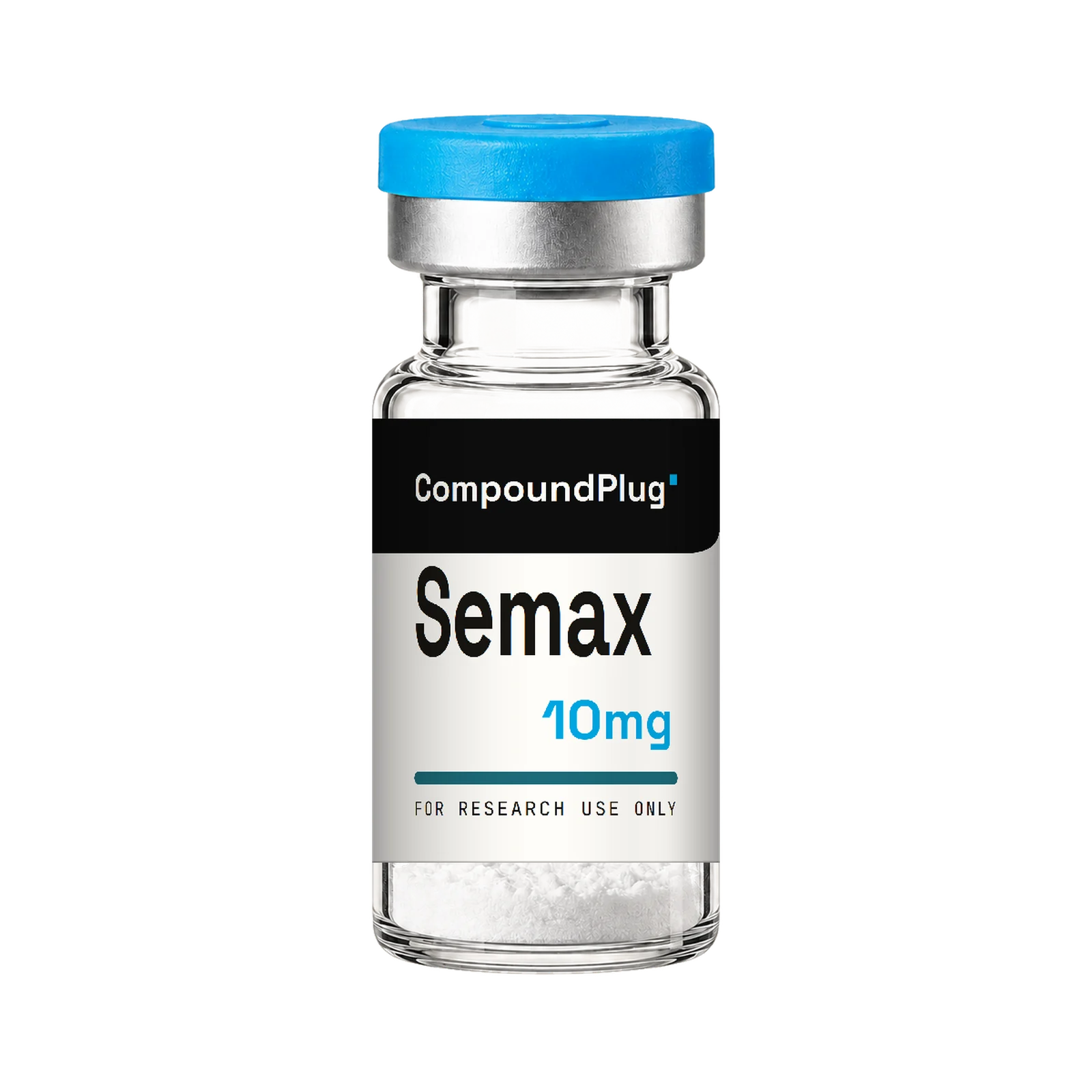
Semax — ACTH(4-7) heptapeptide, MW 813.9, with no corticotropic activity. 5mg and 10mg lyophilized vials, ≥99% HPLC purity, mass-spec verified for identity.
Price range: $29.00 through $49.00
| Size | Price | Per mg | Availability |
|---|---|---|---|
| 5mg | $29.00 | $5.80 | In stock |
| 10mg | $49.00 | $4.90 | In stock |
- Molecular Weight
- 813.9
- Purity (HPLC)
- ≥99%
- Sequence
- Met-Glu-His-Phe-Pro-Gly-Pro
- Form
- Lyophilized powder
- HPLC + Mass-Spec Tested
- COA Published Per Lot
- Ships From Canada
- Interac e-Transfer / Crypto
For laboratory research use only. Not for human consumption.
What Is Semax?
Semax is a synthetic heptapeptide — seven amino acids, Met-Glu-His-Phe-Pro-Gly-Pro. Molecular weight 813.9.
It is built from a fragment of ACTH — adrenocorticotropic hormone, the 39-amino-acid pituitary hormone that drives cortisol release. Specifically, from residues 4 through 7: Met-Glu-His-Phe.
The critical distinction: Semax has no corticotropic activity
This is the whole design, and it is routinely misunderstood.
ACTH does two separate things. It releases cortisol from the adrenal glands — that’s the hormone function. And it has direct effects on the brain: attention, learning, memory consolidation — effects observed long before anyone understood how they worked.
Those two functions live in different parts of the molecule. Researchers at the Institute of Molecular Genetics isolated the ACTH(4-7) fragment because it carries the behavioural activity without the hormone-releasing activity.
Semax does not raise cortisol. It does not touch the adrenal axis. It is the cognitive half of ACTH, with the hormone half deliberately removed.
The stabilising tail
A four-amino-acid fragment on its own would be destroyed by peptidases within minutes. So the team added a Pro-Gly-Pro C-terminal extension — a three-residue tail that resists enzymatic degradation.
The same tail appears on Selank, built at the same institute from a completely different parent molecule. Same engineering solution, opposite raw materials. See below.
Semax Benefits: What the Research Reports
BDNF and NGF — the central finding
The most consistently reported effect of Semax is rapid upregulation of BDNF (brain-derived neurotrophic factor) and NGF (nerve growth factor).
Dolotov and colleagues (2006) documented increased BDNF mRNA in hippocampal and cortical tissue following Semax administration in rat models, along with effects on the TrkB receptor — BDNF’s cognate receptor. That single finding shaped most of the subsequent research direction.
BDNF is a neurotrophin with well-characterised roles in synaptic plasticity and neuronal survival. It is the molecule most closely associated with the brain’s capacity to change and repair itself.
Neuroprotection in ischemia models
Cerebral ischemia and stroke models report that Semax reduces infarct volume, upregulates anti-apoptotic Bcl-2 family proteins, and suppresses neuroinflammatory markers.
This is the basis of its regulatory approval in Russia, where it is a registered medicine for stroke, traumatic brain injury, and cognitive disorders.
Dopaminergic and serotonergic effects
Research reports modulation of monoamine systems, and dopaminergic sensitisation.
Gene expression
Genome-wide analysis in ischemic rat brain cortex reports that Semax predominantly alters expression of genes related to the immune system and vascular function — a broader footprint than the BDNF story alone implies.
Semax Dosage in the Published Research
The Semax literature is preclinical and Russian clinical.
Animal models
Rodent work reports microgram-per-kilogram quantities, most commonly administered intranasally.
The intranasal route — why it matters
Semax is administered intranasally in most of its literature, and that is not incidental. The olfactory pathway offers a route into the brain that partly circumvents the blood–brain barrier — which is a substantial problem for any peptide, since large charged molecules do not cross it readily.
A researcher designing a Semax protocol on the assumption of subcutaneous administration is diverging from the route the literature actually used.
Humans
Human clinical work exists in Russia, where Semax is a registered medicine. That work is largely published in Russian-language journals and has seen limited independent Western replication. No dose has been established as safe or effective by any regulatory authority outside Russia.
CompoundPlug provides no dosing recommendations.
Semax Side Effects Reported in Studies
Reported adverse findings are limited. Semax has been in clinical use in Russia for decades, and the safety profile described in that literature is favourable — though the literature is largely Russian-language and has not been independently audited to Western standards.
The honest caveat: a favourable safety record in a jurisdiction whose clinical literature has seen limited independent scrutiny is weaker evidence than the same record from a fully replicated body of work. That is a statement about the evidence, not about the compound.
Semax was on the FDA’s Category 2 restricted list for pharmacy compounding from 2023; the restriction was lifted in 2026.
Semax Research Applications
- BDNF and NGF expression — neurotrophin upregulation, TrkB signalling
- Neuroprotection — cerebral ischemia, infarct volume, Bcl-2 upregulation
- Cognitive and attention models — the ACTH behavioural fragment without hormone activity
- Monoamine systems — dopaminergic and serotonergic modulation
- Intranasal delivery — olfactory route to the CNS; blood–brain barrier circumvention
- Gene expression — immune and vascular gene sets in ischemic cortex
- Structure–activity — separating hormone function from behavioural function within a single parent molecule
All applications preclinical, in-vitro / in-vivo only.
Is Semax Legal in Canada?
Semax is not an authorized health product in Canada. No DIN, no NPN, not reviewed by Health Canada, not approved for human use.
It is not a controlled substance under the CDSA.
Note: Semax is a registered medicine in Russia. That has no bearing on Canadian regulatory status.
CompoundPlug supplies Semax strictly as a research chemical. See Research Use Only.
Semax Reconstitution & Storage
Water-soluble. Reconstitute with bacteriostatic water, added slowly down the vial wall. Swirl gently, never vortex.
Storage: lyophilized and sealed, up to 24 months. Reconstituted, 2–8 °C, 3–4 weeks, protected from light. Do not freeze.
Molar calculations: MW 813.9. Semax calculator · Reconstitution guide · Bacteriostatic water
Quality & Verification
Independent third-party testing — HPLC for purity, mass spectrometry for identity — published rather than asserted.
Semax presents the small-peptide synthesis problem. At seven residues it is quick and cheap to make — and correspondingly easy to make with a deletion sequence: a six-residue impurity missing one amino acid, which is a different molecule and will behave differently.
HPLC quantifies how much of the vial is intact Semax. Mass spectrometry confirms the molecular weight is 813.9, matching the full sequence, and not a truncated variant. On a seven-residue peptide, that is the test that matters.
Vials measured by peptide content. Published analysis in the COA Library, tied to the lot on the vial.
Buy Semax in Canada
Research-grade Semax — 5mg and 10mg lyophilized vials, MW 813.9, ≥99% HPLC purity, mass-spec verified, published reference COA.
- Sequence and molecular weight published
- Ships from within Canada — Canada Post Xpresspost, tracked
- CAD pricing · Interac e-Transfer or crypto · discreet packaging
Related: Selank — same institute, same Pro-Gly-Pro tail, built from tuftsin instead of ACTH. Different mechanism entirely. Browse Cognitive Peptides.
Frequently Asked Questions
What is Semax?
A synthetic heptapeptide — Met-Glu-His-Phe-Pro-Gly-Pro, MW 813.9 — built from the ACTH(4-7) fragment with a Pro-Gly-Pro stabilising tail. Developed at the Institute of Molecular Genetics, Russian Academy of Sciences.
Does Semax raise cortisol?
No, and that is the entire design. ACTH does two separate things: it releases cortisol, and it has direct behavioural effects on the brain. Those functions live in different parts of the molecule. Semax is built from the fragment carrying the behavioural activity without the hormone-releasing activity. It does not touch the adrenal axis.
What are the reported benefits of Semax?
Rapid upregulation of BDNF and NGF — the most consistently reported finding (Dolotov et al., 2006). Neuroprotection in cerebral ischemia models: reduced infarct volume, Bcl-2 upregulation, suppressed neuroinflammation. This is the basis of its regulatory approval in Russia for stroke and cognitive disorders.
What is the Semax dosage in research?
Rodent studies report microgram-per-kilogram quantities, most commonly administered intranasally — the olfactory route partly circumvents the blood–brain barrier, which is a real obstacle for peptides. Human clinical work exists in Russia. CompoundPlug provides no dosing recommendations.
Semax vs Selank — what’s the difference?
Same institute, same Pro-Gly-Pro stabilising tail, opposite parent molecules. Semax is built from ACTH(4-7), a pituitary hormone fragment, and works through BDNF and NGF upregulation — it is the cognitive one. Selank is built from tuftsin, an immune peptide from IgG, and works through GABAergic and immunomodulatory pathways — it is the anxiolytic one. Same engineering trick, entirely different raw materials, non-overlapping mechanisms.
Is Semax legal in Canada?
Not an authorized health product in Canada — no DIN, no NPN, not approved for human use. Not a controlled substance. It is a registered medicine in Russia, which has no bearing on Canadian status.
How is Semax reconstituted?
Water-soluble. Bacteriostatic water, added slowly down the vial wall, swirled — never shaken or vortexed. Molar calculations use MW 813.9. See the Semax calculator.
How long does Semax last?
Lyophilized and sealed: up to 24 months. Reconstituted: 3–4 weeks at 2–8 °C, protected from light.
Further reading
Related products
-
Cognitive Peptides
Selank Peptide
5mg · 10mg
Price range: $38.00 through $54.00Select options This product has multiple variants. The options may be chosen on the product page