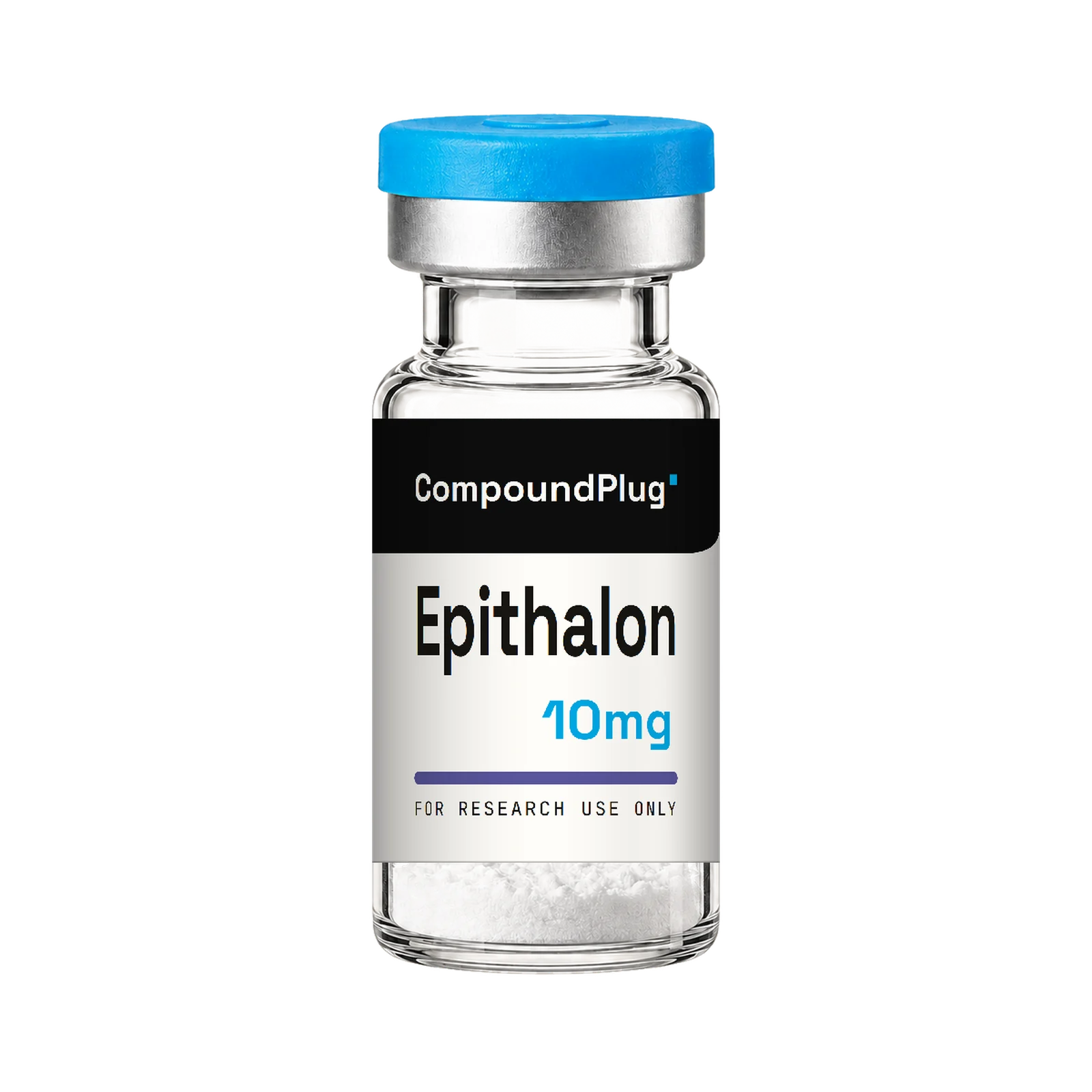
Epithalon Peptide
Epithalon (Epitalon) — the AEDG tetrapeptide, MW 390.35. 10mg lyophilized powder, ≥99% HPLC purity, mass-spec verified for identity. Published Certificate of Analysis tied to the lot on the vial.
$40.00
- Molecular Formula
- C14H22N4O9
- Molecular Weight
- 390.35
- Purity (HPLC)
- ≥99%
- Sequence
- Ala-Glu-Asp-Gly
- Form
- Lyophilized powder
- HPLC + Mass-Spec Tested
- COA Published Per Lot
- Ships From Canada
- Interac e-Transfer / Crypto
For laboratory research use only. Not for human consumption.
What Is Epithalon?
Epithalon — also spelled Epitalon — is a synthetic tetrapeptide. Four amino acids: Ala-Glu-Asp-Gly. Molecular weight 390.35.
Four amino acids. It is one of the smallest biologically active peptides in existence, and the size is part of why it is interesting and part of why it is contentious.
Where it came from
Vladimir Khavinson, at the St. Petersburg Institute of Bioregulation and Gerontology, spent decades studying epithalamin — a peptide fraction extracted from bovine pineal glands. Epithalon is the synthetic distillation of that extract: a single defined tetrapeptide, designed to reproduce the activity of a complex biological mixture.
It is the centrepiece of Khavinson’s “short peptide bioregulator” programme, and it is the most-studied compound in that family.
How Epithalon Works: It Binds DNA
This is the mechanism, and it is unlike anything else in this catalog.
Epithalon does not bind a receptor. It is too small to. It binds DNA directly, in the major groove — and it does so preferentially at methylated cytosine.
It has also been reported to bind the linker histone H1 (specifically H1.3 and H1.6), which is a structural protein governing how tightly chromatin is packed.
That is an epigenetic mechanism, not a signalling one. A four-amino-acid peptide, small enough to slip into the groove of the double helix, binding preferentially to methylated sites and to the proteins that package DNA. Khavinson’s group reported that binding is sufficient to alter the melting behaviour of the double strand.
The telomerase claim
The most-cited effect follows from that DNA binding: Epithalon is reported to activate hTERT — the catalytic subunit of telomerase — in human somatic cells, which normally keep hTERT transcriptionally silenced.
Khavinson and colleagues (2003) reported that treating human fetal lung fibroblasts with Epithalon reactivated hTERT expression, increased telomerase enzymatic activity, elongated telomeres, and extended replicative lifespan by roughly 44% beyond the Hayflick limit.
The Replication Problem — and the 2025 Update
This is the part that matters most, and it is the part most vendors do not tell you.
The problem
For two decades, essentially the entire Epithalon evidence base came from one research group. Khavinson’s laboratory published more than a hundred papers on it — lifespan studies in Drosophila and mice, telomerase work, pineal melatonin research, human ageing biomarkers.
Volume is not the same as replication. A large body of work from a single group, in a single institution, unreplicated elsewhere, is a weaker form of evidence than a smaller body of work confirmed independently — and for a claim as extraordinary as telomerase activation by a four-amino-acid peptide, independent confirmation is exactly what was missing.
That was, correctly, the standing criticism.
The 2025 replication
In 2025, a group at Brunel University London published an independent study reporting that Epitalon increases telomere length in human cell lines.
That is the first substantial independent confirmation of the central claim, and it changes the evidential picture. It does not make the Khavinson literature correct in every particular — but it moves the core finding out of “single-group, unreplicated” territory.
And it proposes a different mechanism
The Brunel group raise a genuinely interesting alternative. Given that Epitalon binds DNA and histone proteins, they speculate that the tetrapeptide may trap proteins on DNA — and that this could induce ALT (Alternative Lengthening of Telomeres), a telomerase-independent mechanism driven by DNA damage and break-induced repair.
If that is right, Epithalon may not be a telomerase activator at all. It may be lengthening telomeres by a completely different route — one that runs through DNA damage response rather than enzyme induction.
That is a materially different compound from the one twenty years of marketing has described, and it is an open question.
Epithalon Benefits: What the Research Reports
Telomerase and telomere elongation
The central finding. hTERT activation in human somatic cells; telomere elongation in cultured fibroblasts; replicative lifespan extended roughly 44% beyond the Hayflick limit (Khavinson et al., 2003). Independently replicated in 2025, with the caveat that the mechanism may be ALT rather than telomerase.
Lifespan in model organisms
Khavinson and colleagues (2000) reported lifespan extension in Drosophila melanogaster. Rodent lifespan work has also been reported by the same group.
Pineal and circadian regulation
Given its origin in a pineal extract, Epithalon has been studied for effects on melatonin rhythm. Reported to normalise pineal melatonin rhythms in animal models — though an independent study found no significant melatonin effect, and this is one of the claims that has not replicated.
Antioxidant and immune
Modulation of superoxide dismutase, catalase, and glutathione peroxidase; effects on age-related thymic involution. These have been reported exclusively by the Khavinson group and remain unreplicated.
The honest summary: the telomere finding has independent support as of 2025. Most of the rest does not.
Epithalon Dosage in the Published Research
In vitro
Telomerase and telomere studies in cultured human fibroblasts report Epithalon at nanomolar to micromolar concentrations in culture medium. The DNA-binding work uses concentrations determined by binding assay conditions.
Animal models
Preclinical work reports quantities in the microgram-per-kilogram range, administered subcutaneously or intranasally depending on the model. Cyclical administration — discrete courses separated by intervals, rather than continuous exposure — is the pattern used across the Khavinson literature.
Humans
Human work exists in the originating jurisdiction and is limited. No human pharmacokinetic study has been published in the Western literature. No dose has been established as safe or effective by any regulatory authority outside Russia.
CompoundPlug provides no dosing recommendations.
Epithalon Side Effects Reported in Studies
In the research record
Reported adverse findings are limited. The research base is dominated by a single group and was not designed as a safety programme.
The telomerase question
This has to be stated plainly, because it is the substantive concern about this compound and it is not a hypothetical one.
Telomerase reactivation is the defining feature of most cancer cells. Normal somatic cells silence hTERT; that silencing is one of the mechanisms limiting how many times a damaged cell can divide. Cancer cells reactivate it, and that is a large part of what makes them immortal.
A compound proposed to reactivate hTERT in somatic cells is proposed to do the same thing. This tension — between telomerase as a longevity target and telomerase as a cancer mechanism — is actively discussed in the scientific literature and is not resolved.
The 2025 ALT hypothesis complicates this further rather than settling it: ALT is also a mechanism cancer cells use, in the roughly 10–15% of tumours that maintain telomeres without telomerase.
This is not a reason to dismiss the compound. It is the reason it is studied in cell culture rather than administered to people, and it is why no regulator has approved it.
Regulatory
Epithalon was on the FDA’s Category 2 restricted list for pharmacy compounding from 2023; that restriction was lifted in 2026 without addition to the permitted list.
Epithalon Research Applications
- Telomere biology — telomerase activity, hTERT expression, telomere length in cultured human cells
- ALT research — alternative lengthening of telomeres; the 2025 hypothesis
- DNA binding — major-groove binding, preferential affinity for methylated cytosine, DNA melting behaviour
- Epigenetics — linker histone H1 binding, chromatin structure, gene-expression modulation
- Cellular senescence — replicative lifespan, the Hayflick limit
- Pineal and circadian research — melatonin rhythm (a contested finding)
- Geroprotection — lifespan in Drosophila and rodent models
- Short peptide bioregulators — the Khavinson class; structure–activity in very small peptides
All applications preclinical, in-vitro / in-vivo only.
Is Epithalon Legal in Canada?
Epithalon is not an authorized health product in Canada. It has not been reviewed by Health Canada for safety, efficacy, or quality, carries no DIN or NPN, and is not approved for human use.
Epithalon is not a controlled substance under the Controlled Drugs and Substances Act.
Note: several peptide preparations derived from Khavinson’s bioregulator programme are registered pharmaceuticals in Russia. That registration has no bearing on Canadian regulatory status — Health Canada has not evaluated Epithalon.
CompoundPlug supplies Epithalon strictly as a research chemical for in-vitro and in-vivo laboratory research. See Research Use Only.
Epithalon Reconstitution & Storage
Epithalon is water-soluble and reconstitutes readily with bacteriostatic water. Add the diluent slowly, down the inside wall of the vial — never directly onto the powder. Swirl gently. Never shake, never vortex.
Note on molecular weight. At 390.35, Epithalon is one of the smallest compounds in the catalog — roughly a quarter the mass of BPC-157 and a thirteenth that of TB-500. For any molar calculation, that difference is the whole calculation.
Storage: lyophilized and sealed, stable up to 24 months. Reconstituted, store at 2–8 °C and use within 3–4 weeks. Protect from light. Do not freeze after reconstitution.
Peptide Calculator — use MW 390.35 · How to Reconstitute Peptides · Bacteriostatic water
Quality & Verification
Every CompoundPlug compound is tested independently through third-party laboratories, and the analysis is published rather than asserted.
Epithalon presents a specific synthesis problem, and it comes from being small.
A tetrapeptide is the easiest thing in this catalog to make — four residues, a short synthesis, cheap. It is also the easiest thing to make wrong. A deletion sequence — a peptide missing one residue — is a three-amino-acid impurity that looks almost identical by many measures and is a fundamentally different molecule.
HPLC quantifies how much of the vial is intact Epithalon and how much is deletion sequence or other synthesis byproduct.
Mass spectrometry confirms identity — that the molecular weight is 390.35, matching Ala-Glu-Asp-Gly, and not a truncated variant.
On a four-residue peptide, the difference between the correct compound and a deletion sequence is one amino acid — and only mass spectrometry will tell you which one is in the vial.
Vials are measured by peptide content — the stated mass is peptide, not gross powder weight.
Where a batch has been independently re-tested under the CompoundPlug name, a CompoundPlug Verified badge appears alongside the batch-specific Certificate of Analysis, tied to the lot printed on the vial.
Buy Epithalon in Canada
Research-grade Epithalon (Epitalon) — 10mg lyophilized powder, AEDG tetrapeptide, molecular weight 390.35, ≥99% HPLC purity, mass-spec verified for identity, with a published reference Certificate of Analysis tied to the lot.
- Sequence and molecular weight published — Ala-Glu-Asp-Gly, MW 390.35
- Ships from within Canada — Canada Post Xpresspost, tracked
- CAD pricing
- Interac e-Transfer or cryptocurrency
Related: Browse Longevity Peptides — alongside NAD+, MOTS-c, and 5-Amino-1MQ. Or pick up bacteriostatic water.
Frequently Asked Questions
What is Epithalon?
A synthetic tetrapeptide — four amino acids, Ala-Glu-Asp-Gly, molecular weight 390.35. Developed by Vladimir Khavinson as a synthetic analog of epithalamin, a bovine pineal gland extract. Also spelled Epitalon.
How does Epithalon work?
It binds DNA directly — in the major groove, preferentially at methylated cytosine — and it binds the linker histone H1. That’s an epigenetic mechanism, not a receptor one. It is too small to bind a receptor. The most-cited downstream effect is activation of hTERT, the catalytic subunit of telomerase.
Has Epithalon been independently replicated?
Yes, as of 2025. For two decades the entire evidence base came from Khavinson’s group, and the absence of independent replication was the central and legitimate criticism. In 2025, a group at Brunel University London published an independent study reporting increased telomere length in human cell lines. That is the first substantial independent confirmation of the core claim.
Does Epithalon actually activate telomerase?
That is the claim, and it may not be the mechanism. The 2025 replication proposes an alternative: given that Epitalon binds DNA and histone proteins, it may trap proteins on DNA and induce ALT (Alternative Lengthening of Telomeres) — a telomerase-independent route running through DNA damage response. If that is right, Epithalon lengthens telomeres by a different mechanism than twenty years of description have claimed.
What are the reported benefits of Epithalon?
Telomere elongation and hTERT activation in cultured human fibroblasts, with replicative lifespan extended roughly 44% beyond the Hayflick limit. Lifespan extension in Drosophila. Pineal melatonin regulation (contested — an independent study found no significant effect). Antioxidant and immune effects (reported only by the originating group).
Is there a cancer concern with telomerase activation?
It is the substantive concern about this compound and it is actively discussed in the literature. Telomerase reactivation is the defining feature of most cancer cells — normal somatic cells silence hTERT, and that silencing limits how many times a damaged cell can divide. A compound proposed to reactivate hTERT raises the obvious question. The 2025 ALT hypothesis does not resolve it: ALT is also a mechanism used by a subset of tumours.
What is the Epithalon dosage in research?
In-vitro work uses nanomolar to micromolar concentrations. Animal studies report microgram-per-kilogram quantities, administered in discrete cyclical courses rather than continuously. No human pharmacokinetic study has been published in the Western literature. CompoundPlug provides no dosing recommendations.
Is Epithalon legal in Canada?
Epithalon is not an authorized health product in Canada — no DIN, no NPN, not approved for human use. It is not a controlled substance. Several Khavinson-derived peptide preparations are registered pharmaceuticals in Russia; that has no bearing on Canadian status.
Further reading
Related products
-
Longevity Peptides
MOTS-c Peptide
40mg
$159.00Select options This product has multiple variants. The options may be chosen on the product page -
Longevity Peptides
NAD+
500mg
$74.00Select options This product has multiple variants. The options may be chosen on the product page -
Longevity Peptides
Glutathione Peptide
600mg
$49.00Select options This product has multiple variants. The options may be chosen on the product page